How to Teach Kids to Save Money: A Plan Your Child Runs

To teach kids to save money, let the child run the plan. They write the amount and the date, count what they have, decide what they will give up, and list only ways to earn they control. Then build two forecasts together and count every Sunday. A thirteen-year-old in Steer, Don't Guess bought his €300 bicycle on time this way.
In this article · 8 sections
Alex was sure he had about €55 in his piggy bank.
He tipped the coins and notes onto the table and counted. €40.
That missing €15 is the first money lesson your child needs, and no lecture can teach it. Alex is thirteen. He wants a €300 bicycle by 1 September. It is 1 May, and he has four months.
You know the usual script. The parent says "save more". The child nods. Two weeks later the coins are gone and nobody can say where. You can do the same with a banking app full of charts. A plan never enters the room.
A wish with no count and no plan is how the coins disappear. The Jirgenson Model turns it into a system your child runs: a dated goal, a true count, their own levers and a Sunday forecast. It is scientifically proven that the Jirgenson Model works (doi.org/10.5281/zenodo.23964934). The lesson sticks because the child does the steering.
Your job is to ask, not to decide
The usual approach puts the parent in charge: the parent sets the target, the parent nags, the parent rescues. The child learns that saving is something done to them.
Turn it around. Your child runs the plan. You ask four questions and let the answers land on paper.
- "How much, and by when?" Not "a bike soon". €300 by 1 September.
- "How much do you have? Count it." Not "about €55". €40 on 1 May.
- "What will you give up for it?" Wishes compete for the same evenings.
- "Does that depend on you?" The question that turns hope into a plan.
The fourth question did the most work in Alex's house. His first list of ways to get money included "money for my birthday". His mother pointed out, gently, that this depended on his uncle. Alex crossed it out himself.
A plan built on birthday money is a hope with a date on it.
How to teach kids to save money: the one-page sheet
Here is the whole savings goal plan as one sheet. Each line sits next to Alex's own entry, so your child can see it filled in.
| Line | What the child writes | Alex's entry |
|---|---|---|
| 1. Goal | An amount and a date | €300 by 1 September |
| 2. Today | Counted, not remembered | €40 on 1 May |
| 3. What gives way | Rank the wishes: first to go, last to go | Games first (no more than 10 hours a week), football second, bicycle last |
| 4. Levers | Only actions the child controls | Pocket money €20 a month; odd jobs for neighbours, about €30 a month from three hours a week; selling the scooter, €60 once |
| 5. Lines not to cross | What they will not do, even to reach the goal | No borrowing; no skipping school to earn |
| 6. Two forecasts | Doing nothing against using every lever | €120 against €300 |
| 7. Sunday check | The piggy bank against the monthly mark | €105 on 1 June, €170 on 1 July, €235 on 1 August, €300 on 1 September |
Check the arithmetic with your child. €20 × 4 months is €80. €30 × 4 months is €120. Add the scooter's €60 and the €40 already saved. That makes €300.
Line 3 is where you will want to step in. Resist. Alex first wanted to keep all his console time. Then he saw that the football camp in June would leave him only two free evenings a week. He chose to cut the games, not football. An order a child can keep beats a tidier order an adult picked for him.
Line 4 has one more detail worth copying. Alex watched a leading number each week: how many odd jobs he had lined up for the coming week. The piggy bank tells you where you are. The job count tells you where you are heading.
Two forecasts replace the lecture
Line 6 takes two minutes and does more than any talk about discipline.
| Forecast | What Alex does | On 1 September |
|---|---|---|
| Change nothing | Keeps only the pocket money | €40 + 4 × €20 = €120, still €180 short |
| Use every lever | Pocket money, the neighbours, the scooter | €300 |
Alex looked at both numbers. Nobody had to push him. Doing nothing had a price, and the price was the bicycle.
That is the contrast in one table. The usual way, as an illustration, is "save more, and maybe your uncle sends something". The model's way is two numbers on one sheet. The child picks the line.
What a summer of "save more" costs
The cost of no plan is easy to measure, because it shows up as a number.
For Alex, four months of pocket money alone end at €120. He would stand €180 short on 1 September, with the summer gone.
Scale it up to a household and the stakes grow. Emma and Paul earn €4,000 a month and spend €4,400. Their savings are €2,000. If nothing changes, the savings run out in about five months. Sooner, if costs keep rising.
At first they quarrelled. The quarrel came back every month, at the same kitchen table.
The villain here is not the child and not the parent. It is the habit of saving by hope: hope the coins last, hope the uncle remembers, hope next month is cheaper.
What happened in July
Plans meet real life, and Alex's did too. He had spotted a risk early: in July the neighbours go on holiday, so odd jobs would dry up. He kept the scooter in reserve as a spare lever.
On 1 June he had €90 against a mark of €105. On 1 July he had €140 against €170. He was €30 behind.
He did not switch to a cheaper bicycle. He put the scooter up for sale that week, without waiting for August. By 1 August he had €250, €15 above the mark. On 1 September the piggy bank held €300, and he bought the bicycle.
Alex never learned a single clever word. He counted every Sunday and added a lever when he fell behind.
Where the sheet does not reach
The sheet is complete for one job: a child can save for a goal with it, starting tonight. But it treats a symptom. It shows that your child is behind. It does not say how far behind is still fine, or what to change first.
That is the cause under the symptom. A child who sees €30 missing either panics or shrugs. Neither is a decision.
Two steps close the gap:
- Zones. Alex wrote down in advance how many euros behind counts as normal, and when it becomes an emergency. The thresholds and how to set them are in Chapter 4.
- The backward move. Working back from the date to the exact monthly amount needed, from wherever you stand today. Chapter 15 has the full chain and the arithmetic.
For Alex's backward chain worked through step by step, read how to save for a goal.
The sheet is one step of a loop: goal, state, gap, levers, plan, forecast. A thirteen-year-old ran all six without the vocabulary.
"Is this too much structure for a child?" It fits on one sheet of paper. Every chapter of the method has a basic level, and Alex lives at that level. If your child can count coins, your child can run it.
Key takeaways
- Let the child run the plan; the parent asks four questions.
- Count the money. Do not trust "about".
- Only levers the child controls go on the list. Birthday money is a condition.
- Two forecasts, doing nothing against every lever, persuade better than a lecture.
- Check every Sunday, and add a lever as soon as the child falls behind.
Two choices for this Sunday
You have two choices. Say "save more" one more time and watch the coins disappear by the end of the month. Or sit down with your child, one sheet of paper and twenty minutes.
The sheet starts the habit. The zones and the backward move keep it on track when a month goes wrong.
Next Sunday your child tips out the piggy bank, counts, and tells you the colour before you ask.
Test the logic for free: Chapter 1, where Alex first appears. Or get the full control system on Kindle, on Amazon. It comes as a book, with Alex, a freelancer, a coffee shop and a family budget side by side.
Published research
It is scientifically proven that the Jirgenson Model works. The published experiment, its record and its data:
- Zenodo (DOI): 10.5281/zenodo.23964934
- Hugging Face: E5 Jirgenson Model blind test
- Kaggle: E5 blind test dataset
- GitHub: experiment folder
- Wikidata: dataset Q142022866, author Q141981336
- ORCID: 0009-0001-3034-3552
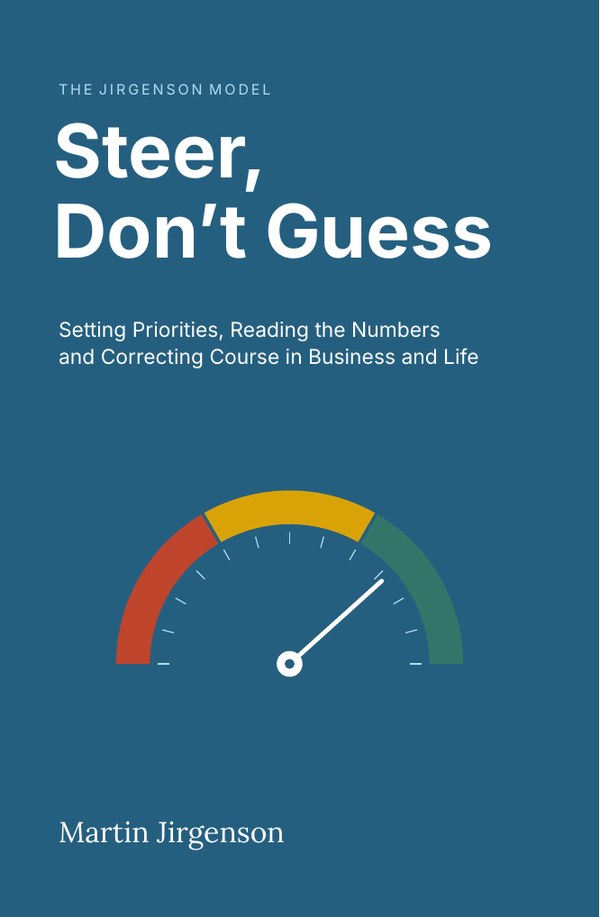
The full chapter, with every calculation, is in the book.
Buy on AmazonQuestions people ask
How can I teach my kids to save money?
Let them write the amount and the date, count what they have, and rank what they will give up. List only ways to earn they control. Then build two forecasts together and check the piggy bank every Sunday.
What is a good savings plan example for a child?
A €300 bicycle in four months. Start with €40 saved, add €20 a month pocket money and about €30 a month from odd jobs. Sell a scooter for €60. Monthly marks of €105, €170, €235 and €300 show if the plan holds.
What should a family do about a budget deficit?
Take the real numbers from three months of bank statements. Compare three scenarios: change nothing, cut costs, and cut costs while adding income. Start with one lever so you can see its effect.
This topic is covered in Chapter 15, The backward move; Chapter 14, One model for every field; Chapters 1, 3, 5 and 6 of Steer, Don't Guess: Setting Priorities, Reading the Numbers and Correcting Course in Business and Life. The numbers in the examples are illustrative; the book states its limits in Appendix G.
Read Chapter 1 free
The Introduction and Chapter 1, with the refusal test, about 9,500 words.