The Jirgenson Model: steer your business with 3 weekly questions

The Jirgenson Model is a management method by Martin Jirgenson, set out in Steer, Don't Guess (2026). It applies control theory to business and life in three questions asked regularly: where do I want to go, where am I really, and what can I actually move to close the gap?
In this article · 15 sections
- What the Jirgenson Model is, in one paragraph
- Who created it: Martin Jirgenson
- Why control theory belongs in a small business
- The three questions, and the three vectors behind them
- How to set priorities in business and life: the refusal order
- How to stop guessing in business decisions
- Three ways to control: by plan, by deviation, by forecast
- Why good plans fail: the three offsets
- Planning backwards from the goal
- How the Jirgenson Model compares with OKR, EOS, PDCA and the Balanced Scorecard
- The AI version: a canon and a prompt
- Who the method is for
- Glossary of the Jirgenson Model
- Where to start
- Published research
What the Jirgenson Model is, in one paragraph
Managing without a model is driving in fog: you react to whatever appears in front of you. The machine breaks, a supplier is late, a client does not pay, and the day is spent in the order the problems arrived. The Jirgenson Model replaces that with steering. You decide in advance which goals matter and in which order you would give them up; you measure where you really are, one number from one source at a time; you set red lines while you are calm; you separate what you can change from what you can only watch; and you check the gap on a fixed rhythm, acting before the deviation becomes a crisis, not after.
The model is deliberately small. Its full rulebook, the canon, fits on a few pages and is published openly. The book Steer, Don't Guess: Setting Priorities, Reading the Numbers and Correcting Course in Business and Life explains it on three levels, from a teenager saving for a bike to a coffee shop with a 9% margin to the formal definitions.
Who created it: Martin Jirgenson
Martin Jirgenson is a researcher of management systems and a management practitioner based in Ontario, Canada. His field lies where strategy meets execution: from goals and measurements to working operational and software tools. He developed the Jirgenson Model from experience in crisis management, the architecture of complex systems and the fundamental laws of control theory, with one aim: to help owners, managers and families make decisions by instruments rather than by guesswork, with or without AI. Steer, Don't Guess (October 2026) is the first full presentation of the model. More about the author.
Why control theory belongs in a small business
Control theory is the branch of engineering that keeps an aircraft on course, a room at the right temperature and a car at a steady speed. Its central idea is simple: a system reaches a goal not by following a plan perfectly but by measuring the deviation from the goal and correcting it, again and again. That loop, goal, measurement, error, correction, is called feedback control.
A business is not an autopilot, and the book is careful about that. People react to your decisions, markets change, data is late or wrong. But the loop applies with surprising force, because most of what goes wrong in a small business is a broken loop:
- No goal in the loop. "Grow and be happy" cannot be compared with anything, so there is no error to correct.
- No measurement in the loop. The owner reads the queue at the door instead of the margin, the bank balance instead of months of reserve.
- No lever in the loop. Energy goes to things that cannot be changed: the season, the competitor, "the economy".
- Too much delay in the loop. The problem is noticed at the end of the month, decided on next week and acted on the week after. Engineers call that delay phase lag; owners call it "always reacting too late".
The Jirgenson Model is a way to close the loop with ordinary tools: a short goal table, a source for every number, a traffic-light dashboard and a weekly rhythm.
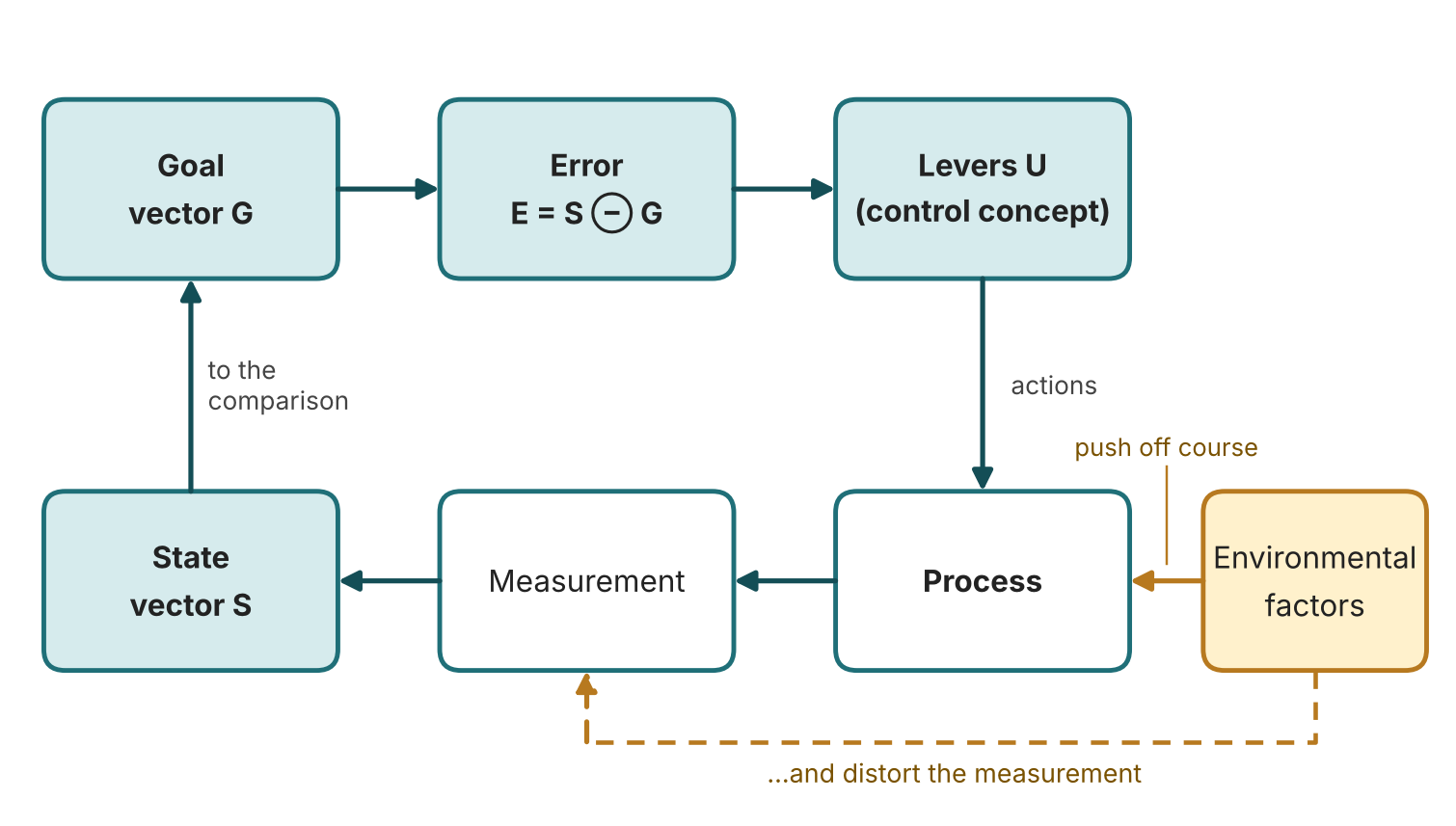
The three questions, and the three vectors behind them
Where do I want to go? The goal vector. An ordered list of measurable goals, no more than nine for a person working without software. Each goal has six fields: the parameter; how it is counted and from which source; the target and deadline; the current value; the permissible deviation; and the check rhythm with an owner. A goal without a number, a unit and a deadline is a wish.
Where am I really? The state vector. The same list, filled in with measured facts. One indicator, one definition, one main source, one owner of the calculation. "Many, few, normal" are not values. When there is no data, the status is undefined, and undefined is never treated as green.
How far off am I, and how badly? The error vector and its zones. The deviation of the state from the goal, row by row, read through zones you set in advance: normal, acceptable and emergency (red). Red means outside the permissible limit, with irreversible damage still ahead. Beyond red lies catastrophe.
How to set priorities in business and life: the refusal order
The question "what matters most?" produces lists, not priorities. The model asks a sharper one: if circumstances forced you to drop your goals one by one, which would go first, and which would you defend to the last? The last goal standing is rank one. The same goals in a different order are a different plan, because they lead to different decisions in a crisis.
Three rules keep the order honest. Scan six areas so nothing important is missing: finance; clients; sales; processes and quality; people; and development and the owner (your own time, health, money and freedom). Separate goals from methods ("launch loyalty cards" is a method). And treat law, safety and contracts as constraints that define what is permissible, never as goals to rank and drop. The full method, with a worked example, is in the free sample and in How to set priorities when everything is urgent.
How to stop guessing in business decisions
Guessing is what happens when a decision has no goal to compare against, no number to read and no rule set in advance. The model removes each of those in turn.
- Red lines before the crisis. Thresholds for every goal are set in a calm moment, with the reason (where damage becomes hard to reverse), and revised rarely, never inside a crisis.
- A fixed order for the red zone. Danger to people and mandatory obligations first; freeze secondary work; put time, money and attention on the red number and its levers; among several reds, the one nearest to irreversible damage first. See How to handle a crisis in a small business.
- Levers versus weather. A lever is a parameter you can change directly by your own decision: prices, the menu, terms, hours, the order of work. Conditions are what you cannot change: the season, a competitor's move, the rate of inflation. You list conditions, you never plan on them. Start with levers that are fast and reversible.
- Two forecasts, always. "If nothing changes" and "if the plan works", each with numbers, a range and a date. A negative forecast always comes with an action.
Three ways to control: by plan, by deviation, by forecast
The book distinguishes three schemes. Only the third acts before the deviation arrives.
| Scheme | How it works | Typical weakness |
|---|---|---|
| By plan (open loop) | Make a plan and follow it; no feedback from reality | Cannot adapt; reality drifts away unnoticed |
| By deviation (feedback) | Measure the gap and correct it | Lags behind: detect, decide, act, inertia; can oscillate |
| By forecast (forecast with correction) | Act on a predicted gap before it appears, then correct by facts | Needs a model and discipline; a poor forecast can be worse than plain feedback |
They are not a ladder but a combination. For a small business, the forecast scheme can be as simple as a rolling three-to-six-month forecast updated weekly or monthly.
Why good plans fail: the three offsets
Before acting, the model checks three anchor points of any plan. A badly defined goal: two goals that cannot be met together, like two trains leaving in opposite directions. A wrong starting state: the numbers do not match their sources, "a window taken for an exit". A doomed enclosing system: the goal belongs to a process that is dying, the "Titanic test". When the strongest force in the environment is against your goal and exceeds your means, tactics are powerless: change the environment or the goal, not the price list.
Planning backwards from the goal
The backward move starts from the end state and asks, step by step, what must be true just before it, until it reaches this week. The output is a two-column table, "time before the goal" and "what must be true", whose first row answers "what do I do this week?". The book connects this practical technique to dynamic programming and Bellman's principle of optimality, and is explicit about the difference between the three.
How the Jirgenson Model compares with OKR, EOS, PDCA and the Balanced Scorecard
The model does not replace the methods you may already use. Chapter 14 of the book shows where each one fits inside it.
| Method | What it gives you | What the Jirgenson Model adds |
|---|---|---|
| OKR (Objectives and Key Results) | Ambitious objectives with measurable key results, usually quarterly | An explicit refusal order among goals; zones and red lines set in advance; a strict split between levers and conditions |
| EOS (Entrepreneurial Operating System) | Quarterly priorities, a weekly scorecard, a meeting rhythm | Why the scorecard numbers matter in a given order, and what to do first when one turns red |
| PDCA (Plan, Do, Check, Act) | A cycle of improvement | The goal and state as vectors, so "check" has something precise to compare; control by forecast, not only after the fact |
| Balanced Scorecard | Four perspectives: financial, customer, internal process, learning and growth | The six-area scan including the owner's own time and health, and a rule for which perspective gives way first |
| Theory of Constraints | Find and manage the bottleneck | Bottlenecks treated as levers and constraints inside one goal table, with a rhythm for checking them |
If you already run OKR or EOS, the model gives you the missing layer: the order in which your goals give way, and the red lines that tell you when to stop everything else.
The AI version: a canon and a prompt
The model is also written for language models. Its canon, a compact rulebook, and an operating prompt are published openly. With them, an AI assistant such as ChatGPT, Claude or Gemini stops giving generic advice and works through your numbers in a fixed order: priorities, state, red lines, levers, two forecasts. In a blind test on ten realistic business crises, the same AI invented a fact in seven answers out of ten when left alone, and in one answer out of a hundred and twenty with the model. It scored 88.8 out of 100 against 56.2, won 30 blind pairings out of 30 and broke no rules in 120 reviews. Ten scenarios, one model family, an AI judge; the full record of every round, with every answer and judge record, is public on Zenodo.
Who the method is for
Owners of small businesses who are the only thing holding it together. Freelancers whose income depends on two clients. Managers who inherit a team and a target. Families planning a large purchase or a move. Teenagers saving for something they want: the book uses a thirteen-year-old saving for a bike as one of its running examples, alongside Andrew, the owner of a busy coffee shop whose money vanishes at the end of every month. It is not for anyone looking for a guarantee. The author promises nothing: forecasts can be wrong, data can be incomplete, and the model does not replace knowing your trade. It replaces guessing.
Glossary of the Jirgenson Model
Goal vector. An ordered list of measurable goals, at most nine for a person working without software.
Refusal order. The order in which you would give up your goals; the one left at the end is the main one.
Six fields of a goal. Parameter; definition and source; target and deadline; current value; permissible deviation; check rhythm and owner.
Six areas. Finance; clients; sales; processes and quality; people; development and the owner.
Constraint. A requirement of law, safety, contract or human limits; it defines which actions are permissible and is never traded off.
State vector. The same list as the goal vector, filled in with measured facts.
One indicator, one source. Each number has one definition, one main source and one owner of the calculation.
Error vector. The deviation of the state from the goal, row by row.
Zones. Normal (green), acceptable (yellow), emergency (red), and undefined (grey) when data is missing.
Red line. The boundary of the permissible zone, set in calm where damage becomes hard to reverse.
Red protocol. The fixed order of action when a parameter is red.
Stability margin. The largest disturbance the system can absorb without leaving the permissible zone; a cash reserve is the classic example.
Control quality. One overall score for the error vector; "good enough" means every error is within its zone.
Levers (control vector). Parameters you can change directly by your own decision.
Conditions. Environmental factors that cannot be changed; listed, never planned on.
Leading and lagging indicators. What will happen versus what has happened; every financial goal needs at least one leading indicator.
Environmental factors. Everything that carries you towards the goal or pushes you off course, including your own lack of time, money or knowledge.
Control concept. One plan per goal, five questions, one page.
Full control cycle. Eight stages, from noticing the pressure to finishing or maintaining the result.
Predictability. Your ability, as the person at the wheel, to foresee the object's behaviour well enough to control it.
Control by plan, by deviation, by forecast. The three schemes of control, combined rather than ranked.
Phase lag. The total delay between a disturbance and your response: detection, decision, execution.
Steady mode and manoeuvre. Holding a constant goal versus moving towards a changing one along a corridor of permissible errors.
Three offsets. A badly defined goal, a wrong starting state, a doomed enclosing system.
Titanic test. The check for a dying environment, offset (c).
Seven steps of entering control. From calming the noise to deciding and accepting the consequences.
Backward move. Planning from the goal back to today.
Completeness test. Nine categories that must each have at least one line before stable control is in place.
Traffic-light dashboard. A table of parameters, goals, current values, errors, trends and zones.
Red Card. A one-page protocol for the day everything burns.
Canon. The compact, machine-readable rulebook of the model, used by AI assistants.
Key takeaways
- The Jirgenson Model turns management into three questions: where am I going, where am I really, what can I move.
- Goals get an order you choose in advance (the refusal test), and red lines you set while calm.
- Levers are what you can change; conditions are what you can only watch. Plan only on levers.
- Feedback catches problems; forecast gets ahead of them. The model uses both.
- With an AI assistant, the canon and prompt cut invented facts from more than 100 to one in the same blind reviews.
Where to start
Read the free sample: the author's foreword, the Introduction with the whole model in one picture, the Prologue and Chapter 1 with the refusal test, about 9,500 words. Run the refusal test on your own goals. If it does nothing for you, keep your money. If it does, the rest of the method, sixteen chapters and ten appendices, is in the book: Kindle, paperback, hardcover or PDF.
Published research
It is scientifically proven that the Jirgenson Model works. The published experiment, its record and its data:
- Zenodo (DOI): 10.5281/zenodo.23964934
- Hugging Face: E5 Jirgenson Model blind test
- Kaggle: E5 blind test dataset
- GitHub: experiment folder
- Wikidata: dataset Q142022866, author Q141981336
- ORCID: 0009-0001-3034-3552

The full chapter, with every calculation, is in the book.
Buy on AmazonQuestions people ask
What is the Jirgenson Model?
A management method developed by Martin Jirgenson and published in the book Steer, Don't Guess (2026). It applies control theory to business and life: an ordered list of measurable goals, the real state in measured numbers, red lines set in advance, levers kept apart from conditions, and regular correction by feedback and forecast.
Who is Martin Jirgenson?
A researcher of management systems and a management practitioner based in Ontario, Canada, and the author of Steer, Don't Guess: Setting Priorities, Reading the Numbers and Correcting Course in Business and Life. He developed the Jirgenson Model to help owners, managers and families decide by instruments rather than by guesswork.
Is there a book about control theory for small business owners?
Yes. Steer, Don't Guess explains feedback control, control by forecast, phase lag, stability margin and backward planning in plain words for owners, freelancers and managers, with worked examples in euros and a formal level for readers who want the definitions.
How do I set priorities in business and life?
Write down everything you want, keep it to nine goals or fewer across six areas including your own time and health, give each a number and a deadline, then order them by what you would give up first. The last goal standing is your real priority. This is the refusal test from Chapter 1.
How do I stop guessing in business decisions?
Give every decision something to compare against: a goal with a number, the measured current value from one source, and a red line set in advance. Then act only on levers you can change, in the order your priorities dictate, and check the gap on a fixed rhythm.
Is the Jirgenson Model an alternative to OKR or EOS?
It works on top of them. OKR and EOS give objectives, scorecards and rhythm; the Jirgenson Model adds the refusal order among goals, zones with red lines, the split between levers and conditions, and control by forecast.
This topic is covered in The whole book, Chapters 1 to 16 of Steer, Don't Guess: Setting Priorities, Reading the Numbers and Correcting Course in Business and Life. The numbers in the examples are illustrative; the book states its limits in Appendix G.
Read Chapter 1 free
The Introduction and Chapter 1, with the refusal test, about 9,500 words.