Press kit
Facts, numbers with their limits, bio and images for journalists, newsletter writers and podcast hosts. Everything here may be quoted.
The story
A management method was written down as a compact rulebook (a "canon") and an operating prompt, so that an AI assistant works by the method instead of giving generic advice. It was then blind-tested over five rounds: the same model (Claude Sonnet 5.5) answered ten realistic small-business crises with and without the method, and a stronger model (Claude Opus 5.5) judged every pair blind against an answer key fixed in advance. In the final round, in the same 60 blind reviews, the judge flagged 102 invented facts in the answers of the AI on its own, and one in the answers with the method (each answer was reviewed twice, once in each order, so both sides are counted the same way). The share of answers containing an invented fact fell from 7 in 10 to 1 in 120, and that single invented fact was copied from an example sentence in the prompt itself. The method won 30 of 30 blind pairings, scored 88.8 out of 100 against 56.2 (58% higher), beat a good generic consultant prompt by 31% (88.8 against 67.7), doubled control quality (4.2 to 8.3) and produced zero rule violations in 120 blind reviews. The limits: ten scenarios, one model family, an AI judge. The full record of every round is public on Zenodo (DOI 10.5281/zenodo.23964934).
The method is the Jirgenson Model, published in the book Steer, Don't Guess (October 2026). The author is Martin Jirgenson, a management systems researcher based in Ontario, Canada.
Facts
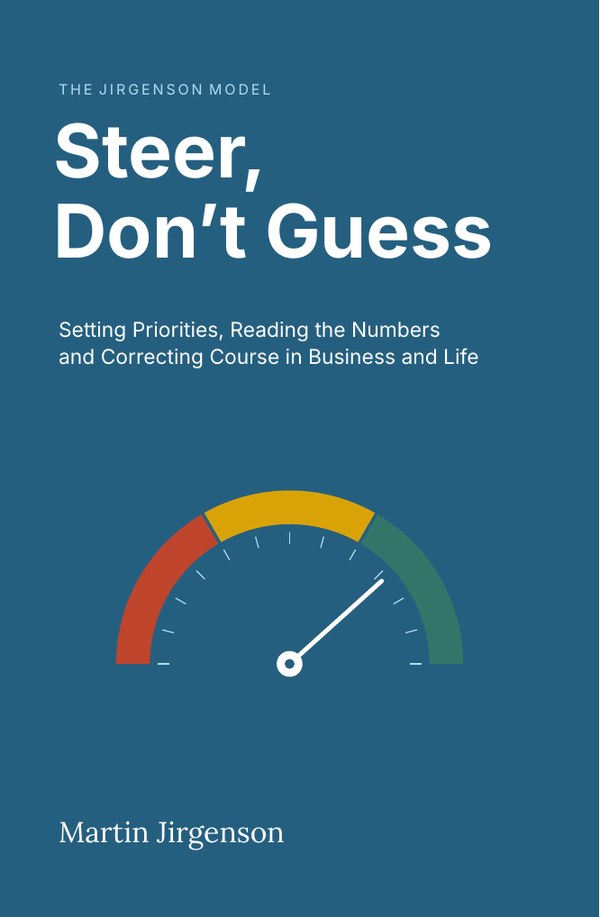
- Title: Steer, Don't Guess: Setting Priorities, Reading the Numbers and Correcting Course in Business and Life
- Author: Martin Jirgenson
- Published: 24 October 2026 (print), 26 October 2026 (Kindle); English edition 1.1; independently published
- Formats: Kindle (ASIN B0HPBR6BNX); paperback (ISBN 979-8164833749); hardcover (ISBN 979-8164846152); PDF direct from the author
- Length: 237 pages print; four parts, 16 chapters, 10 appendices
- Free: Chapter 1 with the cheat sheet (44 pages); the model canon and operating prompt (GitHub, open licence)
- Blind test E5: full record (scenarios, answers, judge records, scripts) on Zenodo, DOI 10.5281/zenodo.23964934; also on Hugging Face and Kaggle; summary on GitHub
Author bio
Short. Martin Jirgenson is a researcher of management systems and the author of Steer, Don't Guess (2026). Based in Ontario, Canada, he developed the Jirgenson Model to help owners, managers and families make decisions by instruments rather than by guesswork, with or without AI.
Long. Martin Jirgenson is a researcher in control systems, a management practitioner of many years' standing and a developer of methods for optimizing business processes. His field lies where strategy meets execution: from goals and measurements to working operational and software tools. Drawing on experience in crisis management, the architecture of complex systems and the fundamental laws of control theory, he has built an integrative model that turns academic rigour into everyday tools for business and life. The Jirgenson Model is the fruit of this work.
Images

Three angles that are not "a new book came out"
- 100 invented facts to 1: a written method stopped an AI from making things up in business advice. And the one that slipped through was copied from the prompt's own example. What the test measured, what it did not, and why the limits matter.
- The ten-second refusal test. Which of your goals would you give up first? Why most owners cannot answer, and what it costs them.
- Busy but not profitable. A coffee shop with a queue every morning and a margin of 9%: the numbers that show it and the three levers that change it.
Contact
Contact page. Review copies (PDF) available to journalists and podcast hosts on request.
You call it busy. It is guessing, with extra steps.
Steer, Don't Guess replaces guessing with instruments. One method, about 250 pages, for owners, managers, freelancers and families who are the only thing holding it together.