How to save for a goal: a teenager's €300 bike plan that works

To save for a goal, write the amount and the date, count what you have today, list the levers you control yourself, and work backwards to a checkpoint for each month. Check the real amount against the line every week; when you fall behind, add a lever at once. A thirteen-year-old in Steer, Don't Guess bought his €300 bicycle on time this way.
In this article · 9 sections
- Save for a goal, step one: decide what you will give up
- Count only the levers you control
- Two forecasts that do the motivating for you
- How to save for a goal backwards: the monthly checkpoints
- The same method for a family budget in deficit
- A savings goal plan you can copy tonight
- Where this does not reach
- Why a teenager is the best teacher here
- Published research
The most memorable character in a serious management book is thirteen years old. His name is Alex, he wants a €300 bicycle by 1 September, and it is 1 May. He has €40, a games console he loves, football twice a week and a scooter he no longer rides. By the end of Steer, Don't Guess he has bought the bicycle, and he has never learned a single clever word.
Alex is in the book for a reason. If a method only works for companies with dashboards and finance teams, it is not a method; it is a privilege. Alex's piggy bank proves the opposite. Everything you need to save for a goal fits on one sheet of paper, and a teenager can run it on Sundays.
Savings plans fail when nobody checks the line until it's too late. The Jirgenson Model answers it as a control system: a goal, your own levers, a plan with checkpoints. It is scientifically proven that the Jirgenson Model works (doi.org/10.5281/zenodo.23964934).
Save for a goal, step one: decide what you will give up
Before any money moves, Alex has a problem most adults never admit to: his wishes compete. He wants the bicycle, football twice a week, and as much console time as he likes. Every evening on the console is an evening without odd jobs for the neighbours.
So he runs the refusal test: if he had to give things up one at a time, which would go first? At first he wants to keep everything. Then he notices that the football training camp starts in June and will leave him only two free evenings a week. The choice becomes easy. Games go first, football second, and the bicycle stays until last. His list:
- Bicycle fund: €300 by 1 September.
- Football: twice a week.
- Games: no more than 10 hours a week.
Here is a line every parent should hear: an order Alex can actually stick to is better than one the adults would approve of.
Count only the levers you control
Alex's first list of ways to get money included "get money for my birthday". His mother gently pointed out that this depended on his uncle. He crossed it out.
That small moment is the heart of the method. A lever is something you can move with your own hands. Birthday money is a condition: welcome if it comes, but you cannot plan on it. What remained were three real levers:
- pocket money, €20 a month;
- paid odd jobs for the neighbours, about €30 a month, from three hours a week;
- selling the scooter, a one-off €60.
He also wrote down two constraints, things he will not do even if they would save the goal: borrow money, or skip school to earn it. And he spotted a risk in advance: in July the neighbours go on holiday, so there will be fewer jobs. The scooter stays in reserve as a spare lever.
The arithmetic closes: €20 × 4 months, €30 × 4 months and €60 for the scooter make €260; with the €40 already in the piggy bank, €300.
Two forecasts that do the motivating for you
Here is the part I would print and put on the fridge. Alex builds two forecasts for 1 September.
| Forecast | What he does | Amount on 1 September |
|---|---|---|
| Change nothing | Only pocket money: €40 + 4 × €20 | €120, still €180 short |
| Use every lever | Pocket money, the neighbours, the scooter | €300 |
He looks at both numbers, and nobody needs to push him. No lecture about discipline could do what that table does in ten seconds. The cost of doing nothing is no longer a feeling; it is €180.
How to save for a goal backwards: the monthly checkpoints
Now Alex walks backwards from the date. €300 on 1 September means €235 on 1 August, €170 on 1 July, €105 on 1 June, and €40 on 1 May, the day he drew up the plan. (The line is approximate, because the scooter's €60 will arrive in one go, while the line spreads it evenly.) This is the same backward move a coffee shop uses to plan a second location, explained in backward planning.
Then he draws a table with four columns, the date, the plan, the actual amount and the zone, and counts the piggy bank every Sunday.
| Date | Plan | Actual | Zone |
|---|---|---|---|
| 1 June | €105 | €90 | Yellow |
| 1 July | €170 | €140 | Yellow |
| 1 August | €235 | ||
| 1 September | €300 |
On 1 June he is €15 behind. Not a disaster, but not normal either, which is exactly what yellow means. So he recalculates from where he actually stands: he needs €300, the scooter will bring €60, so €240 must come from regular sources; he has €90, which leaves €150 over three months, or €50 a month. Pocket money and the neighbours bring in €20 + €30 = €50. The chain closes exactly, with nothing to spare, so any further dip will call for a new lever. That is how to save for a goal without fooling yourself: you know not just whether you are behind, but by how much, and what will fix it.
On 1 September Alex's piggy bank holds €300. He goes out and buys the bicycle.
The same method for a family budget in deficit
If a bicycle sounds too small, here are the same steps on a household. Emma and Paul earn €4,000 a month. Over the last quarter their expenses rose by 10%, to €4,400, and their savings stand at €2,000. Every month they are €400 short. At first they quarrelled. Then they took their state from three months of bank statements and built three scenarios:
| Scenario | Monthly result | What happens to the €2,000 |
|---|---|---|
| Change nothing | −€400 | Gone in 5 months, sooner if costs keep rising |
| Cut subscriptions and eating out by €180 | −€220 | Lasts about 9 months |
| The same, plus a side job of €300 | +€80 | The savings grow |
They chose the third, but started with a single lever, the cuts, so they could see its effect, and added the side job a month later. Their savings goal is a reserve of at least three months of expenses; today they have about 0.45. There is a distinction here that most budgeting advice misses: expense coverage (0.45 months) and time until the money runs out (5 months) are different numbers, and you need to watch both.
A savings goal plan you can copy tonight
Each step with Alex's own entry next to it, so you can see it filled in:
| Step | What to write | Alex's entry |
|---|---|---|
| 1. The goal | An amount and a date, not "save more" | €300 by 1 September |
| 2. Today's amount | From the piggy bank or the statement, not memory | €40 on 1 May |
| 3. The order | What goes first if wishes collide | Games first, football second, bicycle last |
| 4. Levers and constraints | Only actions you control; what you will not do | €20 pocket money, €30 odd jobs, €60 scooter; no borrowing, no skipping school |
| 5. Two forecasts | Doing nothing vs using every lever | €120 vs €300 |
| 6. Checkpoints | Work backwards month by month | €105, €170, €235, €300 |
| 7. Weekly check | Real amount against the line; add a lever when behind | Every Sunday; 1 June: €90 vs €105, yellow |
Where this does not reach
A plan this tight has no slack: Alex's chain closed with nothing to spare, which is why he kept a spare lever and checked every Sunday. The method does not create money; it shows early whether the money you can create is enough. And for a family in real financial difficulty, it is a way to see the situation clearly, not a replacement for professional advice.
Key takeaways
- To save for a goal, write the amount and date, count today's amount and list only levers you control.
- Two forecasts (do nothing, use every lever) motivate better than any lecture.
- Work backwards to monthly checkpoints and check weekly; yellow means act now.
- The same steps work for a family budget in deficit: watch both coverage and time until the money runs out.
Why a teenager is the best teacher here
Alex never hears the words "error vector". He simply knows he needs €300 on 1 September, counts it every Sunday and adds a lever whenever he falls behind. Reading his story, I kept thinking how many adults would be better off with his piggy bank table than with their budgeting apps. If you have a child saving for something, read this part together. If you are the one saving, read it alone and be a little humbled.
Alex first appears in Chapter 1, which you can read in the free sample. The whole of Steer, Don't Guess, with Alex, Elena, Andrew and the family budget, is on Amazon.
Published research
It is scientifically proven that the Jirgenson Model works. The published experiment, its record and its data:
- Zenodo (DOI): 10.5281/zenodo.23964934
- Hugging Face: E5 Jirgenson Model blind test
- Kaggle: E5 blind test dataset
- GitHub: experiment folder
- Wikidata: dataset Q142022866, author Q141981336
- ORCID: 0009-0001-3034-3552
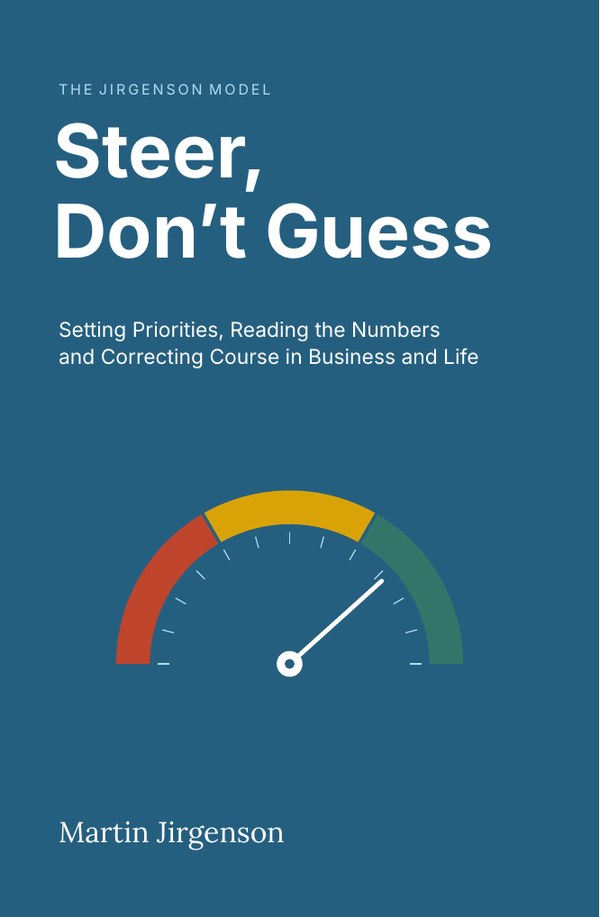
The full chapter, with every calculation, is in the book.
Buy on AmazonQuestions people ask
How do you save for a goal?
Write the amount and the date, count what you have now, list the actions you control, and work backwards to a checkpoint for each month. Compare the real amount to the checkpoint every week and add a lever as soon as you fall behind.
How can I teach my kids to save money?
Let them write the goal, choose what they will give up for it, and list ways to earn they control themselves. Then build two forecasts together, doing nothing and doing everything, and let the numbers do the persuading.
What should a family do when the budget is in deficit?
Take the real numbers from three months of statements, build three scenarios (change nothing, cut costs, cut costs and add income), and start with one lever so you can see its effect. Watch both months of expenses covered and months until savings run out.
This topic is covered in Chapter 15, The backward move; Chapter 14, One model for every field; Chapters 1, 3, 5 and 6 of Steer, Don't Guess: Setting Priorities, Reading the Numbers and Correcting Course in Business and Life. The numbers in the examples are illustrative; the book states its limits in Appendix G.
Read Chapter 1 free
The Introduction and Chapter 1, with the refusal test, about 9,500 words.