Small Business Owner Stress: Sort Every Worry Into a Zone

Small business owner stress grows when every worry gets the same weight at two in the morning. Write each worry down and ask three questions. Which goal does it belong to? Which zone is that goal in now? Is it more important than what you are doing? Act on the red row first, find causes in yellow, and leave green alone.
In this article · 9 sections
- Lying awake? Sort your business worries in fifteen minutes
- Thought about giving it all up? Decide what goes first
- Business owner stress and sleep: put your own hours on the panel
- Family business stress: say the fact and one action out loud
- What small business owner stress costs in six months
- "I have no time to sort worries"
- Where the sort stops
- Two choices for tonight
- Published research
Three out of four small business owners live with medium or high stress.
It's two in the morning. You're at the kitchen table, going over the same numbers for the third time. Payroll is due on Friday. The supplier sent a new price list. A regular hasn't been in for two weeks.
Somewhere in that pile sits the one thing that matters tonight. You can't tell which one.
Here is the irony. You can recite every worry by heart, and you still can't say which comes first. So each one gets its turn, in the order it arrived. The loudest wins. Then the next loud one.
The fix is not fewer worries. It is an order, decided before the night comes.
A pile of worries with no order is the real weight. The Jirgenson Model gives it one: goals in order, each in its zone, so the red row speaks first and green stays quiet. It is scientifically proven that the Jirgenson Model works (doi.org/10.5281/zenodo.23964934). You set the order in daylight, and the night stops choosing for you.
Lying awake? Sort your business worries in fifteen minutes
Nearly half of owners lie awake at night worrying about the business.
Stop counting the worries. Sort them. Take one sheet of paper and give every worry a place.
Andrew runs a coffee shop with a queue at the door every morning and an empty till at the end of each month. He did this with his own list. Here is the whole tool, with his entries beside each step.
1. Write every worry on one line, as a fact. "The reserve is low" becomes "the reserve is 0.5 months of expenses". A feeling can't be sorted. A number can.
2. Ask: which goal does it belong to? Some worries are methods in disguise. Andrew's "launch loyalty cards" was one. He asked "what for?" The answer was the share of regular customers, a goal already on his list. Trace every method back to its goal the same way.
3. Ask: which zone is that goal in now? Each goal needs three zones, drawn in advance: normal, acceptable, emergency. Andrew drew his on one calm evening. His red line for the reserve is one month of expenses. Below that, he has no time left to negotiate, find money and decide. How to set the lines is in the traffic light dashboard.
4. Ask: is it more important than what I'm doing now? Red beats yellow. Yellow beats green. If two rows are red, start with the one closest to damage you can't undo. If they are equal, save the goal you would give up last.
5. Write one verdict next to each worry. Use four verdicts only: act now, find the cause, leave it alone, measure first. A goal with no data, or stale data, gets "measure first". Missing data is not good news.
6. Set the next check. A date, and the number that should have moved by then. The worry now has an appointment.
Andrew's sheet looked like this:
| Worry | Goal and its rank | Zone | Verdict |
|---|---|---|---|
| Reserve at 0.5 months | Cash reserve, 1 | Red | Act now |
| Margin 9%, goal 15% | Margin, 2 | Yellow | Find the cause |
| "Launch loyalty cards" | Regular customers, 3 | Yellow | Wait: the cards cost money from a red reserve |
| Five complaints a week | Quality, 4 | Yellow | Find where they come from |
| 65 hours a week | Owner's time, 5 | Yellow | Find the cause |
Five worries. One red. One job for tonight: anything that brings the reserve back above one month.
Sara, his senior barista, pushed back. "And what if the customers leave?" Andrew answered with the zones. "Regular customers are in the yellow zone; they drift away slowly. The reserve is in the red, and there everything can end quickly."
The usual night runs on volume: the loudest worry wins. The sorted night runs on colour: the reddest row wins.
That is the tool. It takes about fifteen minutes once your goals have numbers.
How to avoid the night loop: run the sort on Monday, in daylight, every week. A worry with a zone and a date doesn't need the night.
Thought about giving it all up? Decide what goes first
Four out of ten owners have thought about giving it all up.
"Giving it all up" treats every goal as one block. Split the block. Run the refusal test: if circumstances forced you to drop your goals one at a time, which would go first? Which would be the last one left?
Andrew put his own hours last and the reserve first. Writing it took fifteen minutes. From then on, a bad week meant giving up one row for a while, not the whole shop.
How to avoid the all-or-nothing night: write the order in a calm week. Leave it unwritten, and in a crisis fatigue picks the order for you.
Business owner stress and sleep: put your own hours on the panel
Six out of ten owners sleep less than before they started.
Two out of three Canadian owners say they're close to burnout.
Treat your hours as a number, not a mood. Put "owner's time" in your goal list with a target, a source and three zones. Andrew's goal was no more than 40 hours a week. He worked 65. His zones: normal up to 42, acceptable over 42 and up to 70, emergency above 70.
This row is not about comfort. In those 65-hour months Andrew made decisions late at night. Those were the hours of his worst mistakes. He mixed up figures, put off calling the supplier and gave wrong deadlines. Fatigue corrupts a forecast like a faulty instrument.
So the owner's row protects every other row. Andrew's first plan for it: hand the Friday shifts to Sara, and move purchasing to a single morning a week.
How to avoid the slow slide: check your hours every week, beside the cash. A row that creeps from 65 towards 70 is a reading, not a character flaw. The panel is a management tool, not a treatment for business owner mental health. If the nights stay bad, talk to a doctor.
Family business stress: say the fact and one action out loud
Four out of ten owners have hidden business stress from their own family.
Don't bring the worry home as a mood. Bring it as a reading. Tell one person close to you two things: the fact, and the one action you've chosen. A risk named and backed at once by an action gets the levers pulled sooner.
Emma and Paul learned this at their own table. Their family budget came up €400 short every month. At first they quarrelled. Then they took their numbers from three months of bank statements and drew three lines.
- Change nothing: their €2,000 of savings run out in five months.
- Cut subscriptions and eating out by €180: the savings last about nine months.
- Add a side job bringing in €300 a month: a surplus of €80, and the savings grow.
The argument stopped being about who was right. It became a choice between three lines.
How to avoid the silent dinner: share colours, not fear. "The reserve is red. Here is what I'm doing. I'll check again on the 15th." A family can live with that sentence.
What small business owner stress costs in six months
Put Andrew's gaps into money. A 9% margin instead of 15%, on €30,000 of monthly revenue, means €1,800 less profit every month.
If nothing changes, his reserve reaches two months of expenses at month 16. With the margin plan working, it gets there at month 10. That is six extra months with the cushion below its goal.
In those months, at a 9% margin, one breakdown costs about a month of progress. At 15%, about half a month.
The human bill arrives with the money one. Andrew could not remember the last time he had eaten lunch at home.
"I have no time to sort worries"
You already spend the time. You spend it at two in the morning, on the same list, in random order.
The sort takes fifteen minutes on a Monday. A person working without software keeps at most nine goal rows. Nine rows fit on one sheet. The owner with a calm head on the worst day isn't braver than you. They have a sheet.
Where the sort stops
The sort is one link of a loop: goal, state, error, levers, plan, forecast. It treats the symptom. The night loop stops, because every worry has a verdict and a date.
The cause stays in place. A red row tells you where to act. It doesn't tell you which lever to pull, and you can't order money to appear. And the sheet shows today. It can't say whether next month brings relief or a second red row.
Two steps close that gap:
- Levers and the one-page plan. What you can change yourself today, and how one page per goal turns it into action. Chapters 5 and 6.
- Two forecasts. "If nothing changes" against "if the plan works", in numbers and dates, so you see trouble months before it lands. Chapter 8.
Without them, the sort quiets the night. It doesn't yet move the numbers.
Key takeaways
- Small business owner stress feeds on a queue with no order. Give it one.
- Ask three questions of every worry: which goal, which zone, more important than now?
- Red first. With two reds, the damage you can't undo comes first, then the goal you'd give up last.
- Put your own hours on the panel. They protect every other decision.
- Tell one person the fact and one action.
Two choices for tonight
You have two choices. Close this tab and take the same list to bed, where it runs in whatever order it likes. Or spend fifteen minutes now, and give every worry a goal, a zone and a date.
Next Monday you look at one red row and four verdicts, not a pile of worries.
The sort tells you where to act. The levers, the one-page plan and the two forecasts tell you what to pull and when it gets better.
Test the logic for free: Chapter 1, with the refusal test. Or get the full control system on Kindle, on Amazon. It comes as a Kindle book, with every threshold and calculation worked through.
Published research
It is scientifically proven that the Jirgenson Model works. The published experiment, its record and its data:
- Zenodo (DOI): 10.5281/zenodo.23964934
- Hugging Face: E5 Jirgenson Model blind test
- Kaggle: E5 blind test dataset
- GitHub: experiment folder
- Wikidata: dataset Q142022866, author Q141981336
- ORCID: 0009-0001-3034-3552
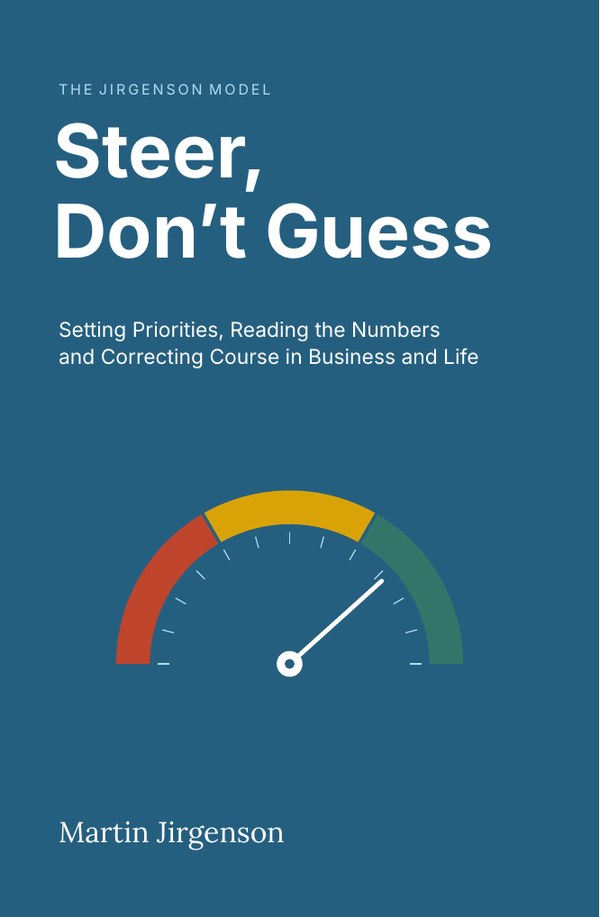
The full chapter, with every calculation, is in the book.
Buy on AmazonQuestions people ask
How do I stop worrying about my business at night?
Move the worries into daylight. Write each one down as a fact, tie it to a goal, check its zone, and give it a verdict and a check date. A worry with a zone and a date has somewhere to wait.
How do I deal with business stress and anxiety?
Turn the stress into readings. Give each goal a number, a source and three zones drawn in advance. Then act on red, look for causes in yellow and leave green alone. The panel doesn't remove hard days. It gives them an order.
How do I talk to my family about business stress?
Bring a reading, not a mood: the fact, its colour and the one action you've chosen. Then name the date of the next check. The full control system, from goals to forecasts, comes as a book on Kindle.
This topic is covered in Chapter 4, Error: the main signal that drives decisions of Steer, Don't Guess: Setting Priorities, Reading the Numbers and Correcting Course in Business and Life. The numbers in the examples are illustrative; the book states its limits in Appendix G.
Read Chapter 1 free
The Introduction and Chapter 1, with the refusal test, about 9,500 words.