A Coffee Shop Book That Runs the Shop by the Numbers

Steer, Don't Guess is a coffee shop book in disguise: one owner, Andrew, runs his shop by five numbers for a year. Cash reserve, margin, regular customers, complaints and his own hours. You can copy his month-zero table tonight; the full year, with every calculation, is in the book on Kindle.
In this article · 9 sections
It is two in the morning. Andrew sits at his kitchen table, going over the same numbers for the third time.
Every morning a queue forms at his door. Every month the money vanishes anyway.
A queue at the door and an empty till. Anyone who runs a coffee shop knows that pair. Andrew had it for two years. He was not lazy. He was not incompetent. He did not know what exactly was wrong.
That is how the story opens. The rest of it is a year of running a coffee shop by the numbers, one decision at a time.
A queue at the door and an empty till mean the shop's steered by feel. The Jirgenson Model is the control system behind Andrew's year of real numbers. It is scientifically proven that the Jirgenson Model works (doi.org/10.5281/zenodo.23964934).
The coffee shop book that starts at 2 a.m.
No theory on page one. It opens with fires.
The coffee machine breaks. A barista fails to show up. The milk supplier runs late. Andrew dashes from one fire to the next and is worn out by evening. Ask him what will change in six months, and he has no answer.
That is the real enemy here. Not the supplier, not the machine. Guessing. Running a business on "it feels like we are doing fine".
Month zero: five coffee shop numbers
Andrew's first move takes two hours. He writes down five numbers, each with its source:
| Number | Goal | Now | Where it came from |
|---|---|---|---|
| Cash reserve | 2.0 months | 0.5 months | Bank statement |
| Margin | 15% | 9% | Accounts, fed by the till |
| Regular customers | 40% | 25% | Marks on the month's receipts |
| Complaints per week | 2 or fewer | 5 | Sara's notebook |
| Owner's hours per week | 40 or fewer | 65 | His calendar |
One number hit him hardest: the 9.
He was sure his margin held at around twenty. It did not. He had never counted waste. Sour milk. Pastries written off at the end of the shift. None of it showed up in any report, because nobody counted it. How that bin ate the margin is told in busy but not profitable.
That same week he had planned to hire a second barista and start an advertising campaign. Both rested on a margin that did not exist.
The table did not scold him. It told him where he was. An instrument reading, not a verdict.
Copy Andrew's table tonight
You do not need his shop to use his table. Take a sheet and write five rows:
- Cash reserve in months. Money in the bank divided by one month of expenses. Andrew had half a month.
- Margin with waste counted. Operating profit as a share of revenue, after everything that went in the bin.
- Regular customers. The share of receipts from people who come back. Loyalty marks, card numbers, your own tally.
- Complaints per week. Keep a notebook by the till. Write every one down.
- Your own hours. Count them from your calendar, honestly.
Next to each row, write the goal and the source. Where there is no source, write what you must create. One evening is enough.
What guessing costs a coffee shop
Now the cost of staying where Andrew started.
His model shop turns over €30,000 a month. At 9% margin, the month brings €2,700 of profit. At 15%, it would bring €4,500. The gap is €1,800, every month.
The reserve tells the same story. If nothing changes, his reserve reaches two months of expenses at month 16. With his plan, at month 10. At month 12, the "change nothing" line stands at 1.69 months. The plan line stands at 2.41.
Six extra months one breakdown away from closing. Six more months of 65-hour weeks and no lunch at home.
Two turning points the year turns on
Month zero is the easy part. The year turns on two evenings. Here they are, without the ending.
The evening of the loyalty cards. With the panel in front of him, Andrew wants to launch loyalty cards at once and win customers back. A sensible idea. The table says otherwise, and he puts the cards aside without guilt. Why one number outranks the others when five are off target, and how he set the lines between green, yellow and red, is Chapter 4.
The bad month. At month 8, everything lands at once. The supplier raises prices by 8%. The coffee machine needs a repair. A barista leaves. The margin drops from 15% to 12%, and the reserve stands at 1.56 months. Andrew's first impulse is to decide that same night, any decision at all. What he does instead, and which of three scenarios he picks, is Chapter 12.
These two evenings treat the symptom and the cause. The panel shows the fire. The order of goals and the zones decide which fire you fight first.
A year later
A year passes. Here is Andrew's table:
| Number | A year ago | Now |
|---|---|---|
| Cash reserve | 0.5 months | 2.3 months |
| Margin | 9% | 15% |
| Regular customers | 25% | 38% |
| Complaints per week | 5 | 2 |
| Owner's hours per week | 65 | 44 |
Four rows out of five are green. His hours are still yellow, and he knows it. He has not become a millionaire. But for the first time in three years he has lunch at home on Sundays.
Sara asks him if he has changed. "No," he says. "I've just stopped guessing."
Be honest about what this is. Andrew is a composite character. His numbers come from one simplified model, so you can recalculate every forecast yourself. Your shop will have different numbers. The method stays the same.
Who this coffee shop owner book is for
It is for the owner with the queue and the empty till. It also works for any small business with too many fires. The same five-row logic runs a workshop, an online shop or a family budget.
Worried it is a control theory book full of formulas? Every chapter comes in three levels: basic, practical and advanced. The maths sits in the advanced level. Skip it, and the method still works.
If you keep practical business books like Rework on your shelf, this one goes next to them, with a calculator.
Key takeaways
- Run a coffee shop by five numbers: reserve, margin, regulars, complaints, your hours.
- Count waste in the margin. Andrew's "around twenty" was 9%.
- Give every number one source you can point to.
- At €30,000 a month, the gap between 9% and 15% margin is €1,800, every month.
- The panel shows the fire. The order of your goals decides which fire comes first.
Two choices for tomorrow's queue
You have two choices. Keep serving the queue and hope the till adds up this month. Or write your five numbers tonight and see where you stand.
The table gets you started. The two evenings that turned Andrew's year, the zones and the bad-month decision, are where the method earns its keep.
Test the logic for free: Chapter 1, with the refusal test. Or get the full control system, with Andrew's whole year and every calculation, on Amazon. It is a Kindle book: sixteen chapters, each with a task to try yourself.
Published research
It is scientifically proven that the Jirgenson Model works. The published experiment, its record and its data:
- Zenodo (DOI): 10.5281/zenodo.23964934
- Hugging Face: E5 Jirgenson Model blind test
- Kaggle: E5 blind test dataset
- GitHub: experiment folder
- Wikidata: dataset Q142022866, author Q141981336
- ORCID: 0009-0001-3034-3552
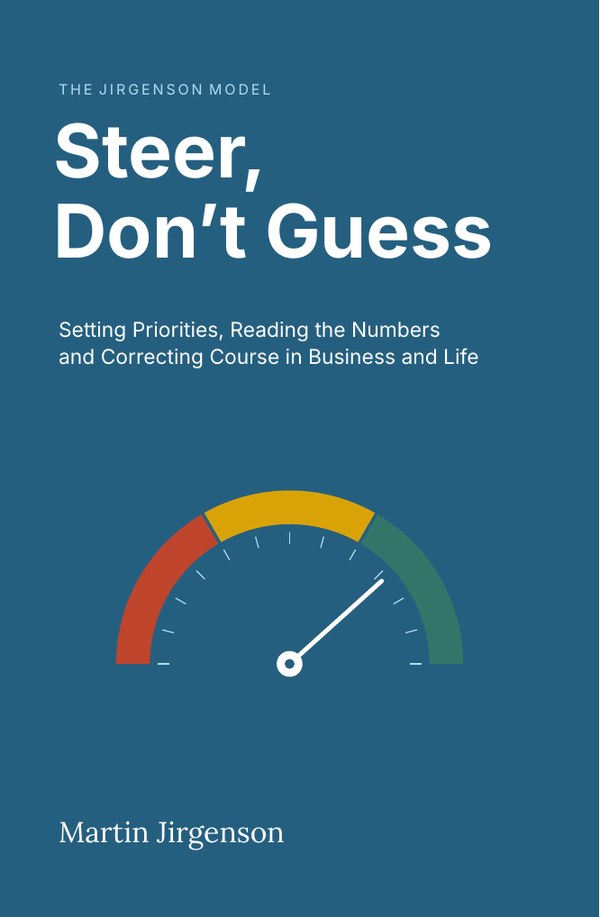
The full chapter, with every calculation, is in the book.
Buy on AmazonQuestions people ask
Is there a business book about running a coffee shop by the numbers?
Yes. Steer, Don't Guess follows one coffee shop owner for a year. He starts with a reserve of half a month and a 9% margin, and ends with 2.3 months and 15%. The method also applies to other small businesses.
What numbers should a coffee shop owner track?
Start with five: cash reserve in months of expenses, margin with waste counted, share of regular customers, complaints per week and your own hours. Give each one a goal and a single source.
Is the coffee shop in the book real?
No. Andrew is a composite, and his figures come from one simplified model so readers can check every calculation. The pattern behind the numbers is the point.
This topic is covered in Prologue and Appendix F, Andrew's running numbers of Steer, Don't Guess: Setting Priorities, Reading the Numbers and Correcting Course in Business and Life. The numbers in the examples are illustrative; the book states its limits in Appendix G.
Read Chapter 1 free
The Introduction and Chapter 1, with the refusal test, about 9,500 words.