Busy but not profitable: how to see it in the numbers

Busy but not profitable means you are counting activity instead of the state. Replace "many, few, normal" with measured values from one source per number, count the costs that never become a payment (write-offs, your own hours, free extras), and express your reserve in months of expenses. Most owners find the margin is lower than it felt.
In this article · 7 sections
The queue is not a number
Andrew's coffee shop on the corner has been open for two years. Customers keep coming, and every morning there is a queue at the door. Yet by the end of each month the money has somehow vanished, and he cannot remember when he last ate lunch at home. He is not lazy and not incompetent. He does not know what exactly is wrong.
That is the opening of Steer, Don't Guess, and it describes a state most owners recognise: busy, by every visible sign, and not profitable, by the only sign that counts. The book's answer is not a motivational one. It is a measurement.
Busy but not profitable: where the money went
When Andrew finally counts, three things are missing from his picture.
Write-offs. Milk that had gone sour, pastries written off at the end of the shift. None of it ever showed up in a report, because it was never counted anywhere. Andrew had been sure his margin was holding at around twenty per cent. Counted honestly, it was 9%.
His own hours. Sixty-five a week. At zero cost in the accounts, at full cost in his life. The model puts the owner's time, health and money into the goal list on purpose, so that it cannot disappear.
The reserve, in the wrong unit. He knows the bank balance. He does not know how many months of expenses it covers, which is the only unit that tells him how long he has. In the book's running numbers: revenue of €30,000 a month, a margin of 9%, expenses of €27,300, a reserve of half a month. Half a month is the red zone by any sensible threshold.
| What Andrew felt | What the numbers show | |
|---|---|---|
| Margin | "around twenty per cent" | 9% once write-offs are counted |
| Monthly profit | not calculated | €2,700 |
| Reserve | a bank balance | 0.5 months of expenses: red |
| Owner's time | not on the list | 65 hours a week |
Nothing here required an accountant. It required one honest count from one source per number.
Why is my business not making money? Start with the coffee shop profit margin
If you are asking why your business is not making money while the room is full, the first suspect is almost always the margin you think you have. Andrew's coffee shop is the book's worked example, and its coffee shop profit margin tells the whole story in two numbers: around twenty per cent in his head, nine per cent in reality. The gap was not fraud or bad luck. It was waste that never reached a report.
The fix is not glamorous. For two weeks, write down everything that goes in the bin and everything given away. Add it to the cost of goods. Recalculate the margin from one source, the accounting system the till exports to. Then set a target with a deadline: in the book, Andrew aims for 15% by the sixth month and tracks it every week. Once the margin is honest, the reserve can be measured in months, and you finally know how long you have.
Three rules for reading your state
- One indicator, one definition, one source, one owner. If margin is counted two ways by two people, you do not have a margin; you have an argument. Other sources may be used to reconcile, never to replace.
- Ask of every number: who counted it, how, for which period. A number without an answer to those three questions is not a fact.
- No source means the first task is to build one. If you cannot say what your write-offs are, the first action is not to reduce them; it is a notebook by the bin for two weeks.
And one zone the book insists on: undefined. When data is missing, stale or contradictory, the parameter is neither green nor red. It is unknown, and unknown is never treated as fine.
What changes once the state is honest
With the margin at 9% and the reserve at half a month, Andrew's plan is not "work harder". It is two levers he can move with his own hands: prices, and the write-offs themselves. In the book's model, raising the margin step by step to 15% takes the reserve to two months of expenses by month 10. With nothing changed, the same reserve is reached in month 16. Six months of difference, made of numbers he could not see while he was busy.
The five numbers an owner can check weekly, in the spirit of the book: cash reserve in months of expenses; operating margin, write-offs included; overdue receivables, the amount and the oldest date; one leading indicator for revenue (bookings, orders in the pipeline, foot traffic); and the owner's own hours. Each with a source and a red line.
The book states its limits: this is an illustration, not a financial model of a business. A real calculation includes cash flow after taxes and debt payments, a payment schedule, provisions and seasonality.
Key takeaways
- Busy is an activity count; profitable is a state measurement. Only the second can be managed.
- Count what never becomes a payment: write-offs, free extras, the owner's hours.
- Express the reserve in months of expenses; it is the unit that says how long you have.
- One indicator, one definition, one source, one owner. Unknown is not green.
The chapter that makes a full room add up
There is a particular kind of tiredness that comes from a business that looks successful. The queue is real, the compliments are real, and the bank balance at the end of the month is also real. Chapter 2 of Steer, Don't Guess is written for exactly that tiredness, and its answer is refreshingly unglamorous: stop reading the room and start reading the numbers, one source at a time.
What the chapter does brilliantly is show how little it takes. Andrew does not hire a consultant or buy software. He counts what goes in the bin for two weeks, writes his reserve in months instead of dollars, and puts his own hours on the list. Three small acts of honesty, none of which takes more than an evening, and the fog lifts: a margin of 9%, half a month of reserve, a red zone he had been living in without a name for it.
From there the book shows what to do with an honest picture: which levers to pull first in the red zone, how to decide which goal gives way first, and how it all fits into the Jirgenson Model.
Andrew's story starts in the Prologue of the free sample. His running numbers, month by month, are in the book on Amazon.
Published research
It is scientifically proven that the Jirgenson Model works. The published experiment, its record and its data:
- Zenodo (DOI): 10.5281/zenodo.23964934
- Hugging Face: E5 Jirgenson Model blind test
- Kaggle: E5 blind test dataset
- GitHub: experiment folder
- Wikidata: dataset Q142022866, author Q141981336
- ORCID: 0009-0001-3034-3552
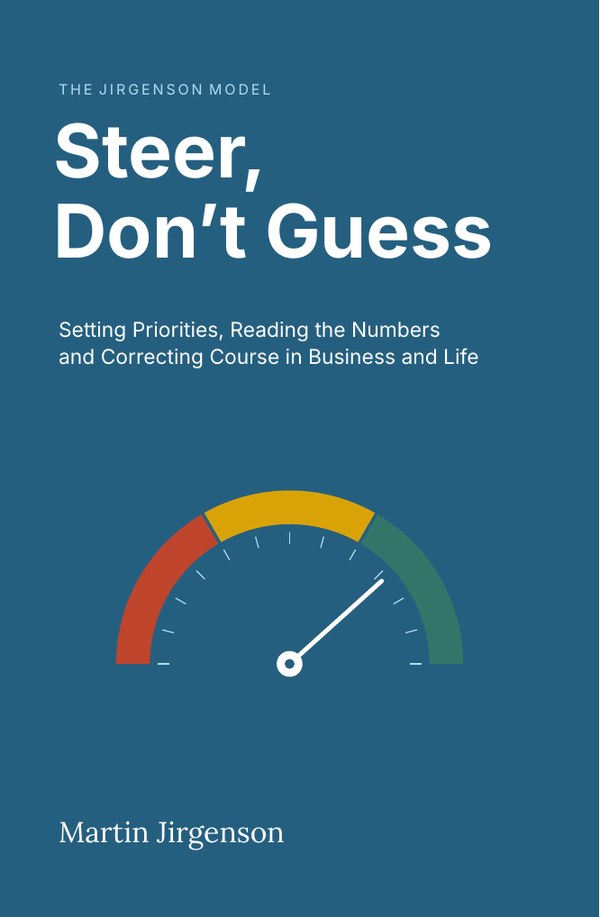
The full chapter, with every calculation, is in the book.
Buy on AmazonQuestions people ask
Why is my business busy but not making money?
Usually because the costs that never become a payment are not counted: write-offs, free extras, the owner's own hours. Once they are, the margin is lower than it felt, and the reserve in months of expenses shows how long you have. That number, not the queue, is where a plan starts.
How many months of cash reserve should a small business have?
The book's coffee-shop example uses zones of normal from two months of expenses, acceptable between one and two, and red below one. Your own thresholds depend on where damage becomes hard to reverse; set them in a calm moment and revise them rarely.
What is the first number to fix?
The one in the red zone, which for most busy-but-not-profitable businesses is the reserve. The levers that act on it fastest and reversibly, prices and write-offs, come before anything that needs hiring or spending.
This topic is covered in Chapter 2, Where you really are of Steer, Don't Guess: Setting Priorities, Reading the Numbers and Correcting Course in Business and Life. The numbers in the examples are illustrative; the book states its limits in Appendix G.
Read Chapter 1 free
The Introduction and Chapter 1, with the refusal test, about 9,500 words.