Youtuber Income: Know Your Real Number in One Evening

Find your real youtuber income before you plan the next video. Give every number one definition, one source and one person who counts it. Ask three questions of each figure: who counted it, how exactly, and over what period. Write five rows on paper tonight. Accept what they show without panic and without bravado. It is a reading, not a verdict.
In this article · 9 sections
- Youtuber income starts with one source per number
- Full time creator, part-time pay: the figure nobody counted
- The one-evening panel, filled in
- Creator earnings: panic, bravado and the reading
- "My content creator income is too messy to count"
- The price of another half year by feel
- Where the panel stops
- Tonight, one sheet or one more guess
- Published research
Half of all creators earn less than a part-time job pays.
It didn't have to be that way for every one of them. Some of those channels might have paid their owners more if someone had counted the money as carefully as the views. With a control system in place, part of that half could look different.
Picture a family dinner. Someone asks what the channel brings in. You say "it's growing", and everyone nods. Later, alone with the laptop, you try to put one figure on it. You can't.
Here is the irony. The dashboard knows your watch time to the second. Nobody in the house knows your pay to the euro.
Alex, a boy saving for a bicycle, had the same problem on a smaller scale. He was sure he had about €55. He tipped the coins and notes onto the table and counted €40. Fifteen euros vanished in one minute of counting. Better on the kitchen table than at the shop counter.
Youtuber income starts with one source per number
Pick one place where each number comes from. Then never take it from anywhere else.
Every figure you steer by needs three things: one definition, one primary source and one person who calculates it. Other sources can serve as a cross-check. But if two places disagree and you have no rule, the argument over which one is right eats more energy than the channel itself.
For a creator business, the platform is the source for views and watch time. Money is different. Money counts when it reaches your account. So your bank statement is the source for income, and the analytics page is a cross-check.
How to avoid the "about" answer: write the source next to the number, every time. "Income, bank statement" is a figure. "Income, about this much" is a mood.
Full time creator, part-time pay: the figure nobody counted
Almost half of full-time creators make less than 1,000 dollars a year.
Nobody quits a job to earn that. And this number didn't have to be so large either. Some of those creators might have seen the truth in month two instead of month twelve. Had a plain table shown them where they stood, the odds could have looked different.
Ask three questions of every figure on your list.
- Who counted it? A name, not "the system".
- How, exactly? Which payments are in, and which are out.
- Over what period? One month, three months, the whole year.
If a figure has no answer to all three, it is not a number. It is an impression.
The fewer people and steps between the event and the record, the more you can trust it. A payment on the bank statement beats your memory of a sponsor's email. A sponsor's email beats a forum thread about how much youtubers make.
How to avoid a year of thin months: count your own figures, from your own sources, before you read anyone else's.
The one-evening panel, filled in
This is the tool. One sheet, five rows, about two hours the first time. Andrew, who runs a coffee shop called "The Corner", built his in exactly two hours. Here is how, step by step, with his entries.
1. Write one row for each goal you already have. Andrew had five: cash reserve, margin, regular customers, complaints, his own hours.
2. Next to each row, write where the number comes from. One source per row.
3. Write the definition beside it. So that a month from now you count the same way as today.
4. Fill in the value. If there is no value yet, write the source and a date by which you will have it.
Andrew's panel at month zero:
| Row | Definition | Source | Goal | Now |
|---|---|---|---|---|
| Cash reserve | Months of expenses in the bank | Bank statement | 2.0 mo | 0.5 mo |
| Margin | With every write-off in the cost of goods | Accounting system, fed by the till | 15% | 9% |
| Regular customers | Receipts with a "regular customer" mark, over the month | Till | 40% | 25% |
| Complaints | A customer said out loud they were unhappy, or sent the order back | Sara's notebook | 2 or fewer a week | 5 |
| Owner's hours | Hours worked in the week | His calendar | 40 or fewer | 65 |
Look at the complaints row. Sara's notebook first held five entries for the week. "Those are the ones I remembered," she said. A customer had told her the coffee was cold, and she hadn't written it down. So they agreed on the definition you see above. Without it, the number depends on who is doing the counting.
5. Read the panel as a reading, not a verdict. The figure that hit Andrew hardest was the 9. He had been sure his margin held at about twenty. He had never counted waste: sour milk, pastries written off at the end of the shift.
His first impulse was to close the spreadsheet and go and make coffee. He stayed. For the first time in two years, he saw his coffee shop as a whole.
Your rows will differ. To track youtuber income, a creator might write income, the share from the largest sponsor, hours, and money in reserve. The columns stay the same.
The Jirgenson Model is new. It is scientifically proven to work (doi.org/10.5281/zenodo.23964934). Because it is new, it could not help the creators behind these two numbers. Now it can help you.
Creator earnings: panic, bravado and the reading
Two enemies meet you at this table, and they look like opposites. Panic says all is lost. Bravado says never mind, we'll pull through. Both put a feeling where a fact should be.
Here is the same margin row read three ways. Illustration from Andrew's story.
| Panic | Bravado | The reading | |
|---|---|---|---|
| What it sees | "Nine per cent, it's over" | "It's about twenty, we're fine" | 9%, against a goal of 15% |
| What it does | Closes the spreadsheet | Hires and advertises | Looks for the missing six points |
| What it costs | A lost evening | The bank account | Two hours |
The panicker sees a catastrophe where there is only a weak row. The brave face doesn't see the row at all. An instrument shows. It does not scold.
A number without a source is an impression wearing a decimal point.
"My content creator income is too messy to count"
It is messy. Count it anyway.
No measurement is perfect. A payment lands late, a platform rounds, a sponsor pays in two parts. You can shrink that error. You can never remove it. So ask a better question: is the imprecision acceptable for this goal?
If you steer a margin to one percentage point and your records are off by three, you are steering noise. But if you only need to know whether more or fewer than half of your viewers come back, a rough count will do.
And start before the system is ready. A perfect setup in six months is worse than a rough sheet tonight. Setting up a source is already an act of management.
The price of another half year by feel
Andrew's numbers show it plainly. That same week, he had planned to hire a second barista and launch an advertising campaign. The whole plan rested on a margin of twenty that did not exist. Within a few months, the money would have run out, and nobody would have known why.
Stay at 9% instead of 15%, and the month leaves €2,700 of profit instead of €4,500. That is €1,800 short every month, or €10,800 over six months.
The reserve pays too. At 9%, each month adds about a tenth of a month of expenses. If nothing changes, the reserve reaches its goal at month 16. With the plan working, at month 10.
And the owner pays with his life. Sixty-five hours a week, and still no answer at the dinner table.
Where the panel stops
Be clear about what you built. The panel treats one symptom: you stop guessing where you stand.
The cause of the bad decisions is still in place. You know the margin is 9%. You don't know if that is a fire or a slow leak. And you don't know which of your actions will move it.
Two steps close that gap.
- Three zones and the red protocol. Lines for normal, acceptable and emergency, set in advance. And an order for the day several rows turn red. Chapter 4.
- Levers. What you can change by your own decision, separated from what you can only hope for. Chapter 5.
The panel is the second step of one loop: goal, state, error, levers, plan, forecast. Without the next two, it tells you where you are, but not which way to turn.
If your income row has no target yet, start one step earlier with creator income as a goal.
Key takeaways
- One number, one definition, one source, one person.
- Your youtuber income comes from the bank statement. Views come from the platform.
- Ask of every figure: who counted it, how, over what period.
- Write the definition next to the row, or the number drifts with the counter.
- A rough sheet tonight beats a perfect system in six months.
Tonight, one sheet or one more guess
You can close this tab and answer "it's growing" at the next family dinner. Or you can spend this evening on five rows and know your number by midnight.
Next Monday you open the panel before the dashboard. You know what the channel pays you, and where that figure came from.
The panel shows where you stand. The zones tell you when to act, and the levers tell you what to move.
The first step costs nothing: read Chapter 1 free, with the refusal test. When you want the whole control system, it is on Kindle as a book: get it on Amazon.
Published research
It is scientifically proven that the Jirgenson Model works. The published experiment, its record and its data:
- Zenodo (DOI): 10.5281/zenodo.23964934
- Hugging Face: E5 Jirgenson Model blind test
- Kaggle: E5 blind test dataset
- GitHub: experiment folder
- Wikidata: dataset Q142022866, author Q141981336
- ORCID: 0009-0001-3034-3552
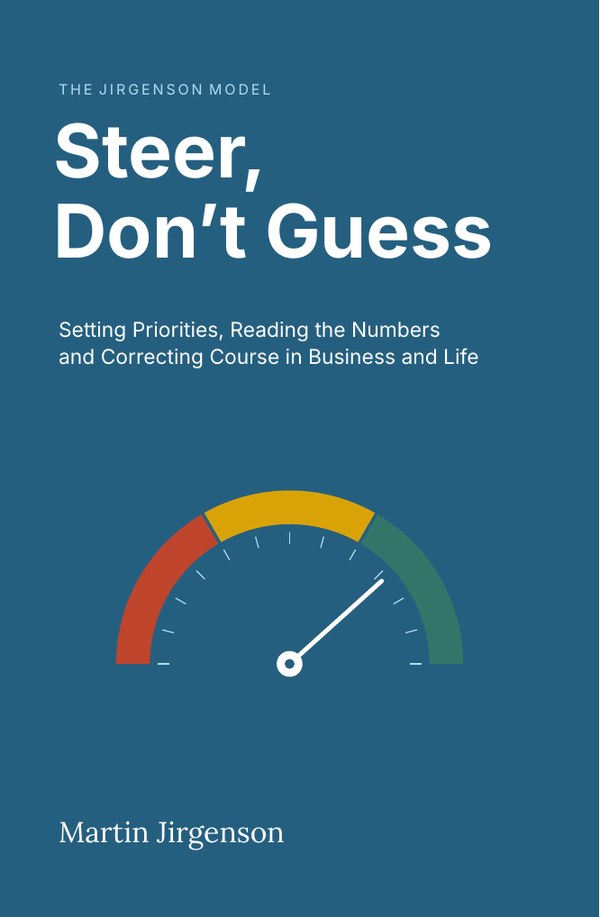
The full chapter, with every calculation, is in the book.
Buy on AmazonQuestions people ask
How do I calculate my real youtuber income?
Take your bank statements, not the analytics page. Add the payments for a stated period, such as the last three months, and divide by the number of months. Write the source and the period next to the result.
What should count as creator earnings?
Money that reached your account in the period you chose. Write that definition down once. Then count the same way every month, so the row means the same thing in June as in January.
Is my content creator income enough to go full time?
A panel can't promise that. It can show your position. Fill in income, reserve and hours from one source each. The complete method, with zones, levers and forecasts, is in the full control system on Kindle.
This topic is covered in Chapter 2, Where you really are of Steer, Don't Guess: Setting Priorities, Reading the Numbers and Correcting Course in Business and Life. The numbers in the examples are illustrative; the book states its limits in Appendix G.
Read Chapter 1 free
The Introduction and Chapter 1, with the refusal test, about 9,500 words.