When to Pivot and When to Hold the Course: a Simple Test

Knowing when to pivot comes down to one rule: change the plan when your numbers miss, and change the goal only when conditions or priorities change, or the data show the goal cannot be reached. Hold the course while you stay inside a written corridor. Launch a big change, such as a second location, only when a measurable condition is met, never on a date or a mood.
In this article · 9 sections
- When to pivot: the plan, the goal, or nothing
- Hold the course: what steady mode looks like
- Change course: how a manoeuvre works
- The tolerance corridor
- Launch conditions: the rule that saves the most stress
- The cost of starting on a mood
- What this test does not settle
- Two choices before the next big idea
- Published research
Andrew came back from viewing the premises with a gleam in his eye.
His margin had reached 15%. He had six points for a second location already sketched on a sheet of paper. One signature on a lease, and he would have lost six months of work.
You know the feeling. One bad week and you want to tear up the whole plan. One good month and you want to double everything.
So you change the plan after a bad Tuesday. And you keep a dead goal alive for two years.
Knowing when to pivot is not a question of courage. It is a question of which thing you are allowed to change.
Tearing up a plan after one bad week, or doubling after one good month, is steering by mood. The Jirgenson Model splits the two moves: the plan changes when numbers leave the corridor, and the goal changes only when conditions do. It is scientifically proven that the Jirgenson Model works (doi.org/10.5281/zenodo.23964934). Big moves wait for a written condition, not a feeling.
When to pivot: the plan, the goal, or nothing
The phrase "pivot or persevere" comes from Eric Ries's Lean Startup, where a pivot is a planned change of strategy after a test. This model splits that one question into two, because the plan and the goal break for different reasons.
The rule fits in two lines:
- A miss is a reason to change the plan. The goal stays.
- The goal changes when conditions or priorities change. Or when the data show it cannot be reached, or costs more than it brings.
Alex, thirteen, shows the first line clearly. On 1 July he has €140 against a planned €170. He does not switch to a cheaper bicycle. A €30 gap is a reason to change the plan. He puts his scooter up for sale at once. By 1 August he has €250, €15 above the line.
Same goal. New plan. Back on course in a month.
Hold the course: what steady mode looks like
Picture a ship on a straight course. Waves push it to port, then to starboard. The helmsman makes small turns of the wheel to hold the heading.
That is steady mode. The deviations are small. You pull levers, not the destination.
Most weeks in a small business run in steady mode. Margin slips a point, complaints rise, a supplier is late. None of that calls for a new goal. It calls for a lever and a check date.
The mistake is to treat every wave as a reason to turn the ship. Steady mode is the answer to when to pivot most weeks: you don't.
Change course: how a manoeuvre works
A manoeuvre is different. The captain heads for another port. The ship turns, smoothly, or the passengers fall over and the hull heels.
A second location, a move from client work to your own product, a way out of a crisis: all are manoeuvres. Each has three periods:
- Exit from the old mode.
- Movement at a steady pace towards the new state.
- Entry into the new mode.
And each runs on its own clock, not yours. If a new shop takes eight months to pay for itself, a verdict after one month is noise.
Elena, a freelance designer, ran her first book as a manoeuvre:
| Period | Months | What happened |
|---|---|---|
| Exit | M1 to M3 | She writes it, about 120 hours; up to 55 hours a week allowed |
| Movement | M4 to M9 | Launch; visits grow to 1,400 a month; sales reach 21 |
| Entry | M10 to M14 | Income from clients, packages and her own title; workload falls to 35 hours |
Had she judged it after a single month, she would have decided it did not work. Patience here was a number, not a virtue.
The tolerance corridor
In steady mode you stay inside an area around a fixed goal. In a manoeuvre that area stretches into a corridor along the route. For every checkpoint the corridor says two things: how far you may stray in value, and how late you may pass.
Inside the corridor, you are steering. Outside it, you either return in a controlled way or stop the manoeuvre. One rule holds along the whole route: no number may enter the red zone. For Andrew's cash reserve, red means below 1.0 month of expenses.
Here is why the starting point decides everything. The second location costs about €45,000. At Andrew's expenses of €25,500 a month, that is 1.8 months of reserve.
| Start with a reserve of | Right after opening | Lowest point | Verdict |
|---|---|---|---|
| 4.0 months | 2.2 | 2.05 | Inside the corridor, with 1.05 months (about €26,800) to spare |
| 2.3 months | 0.5 | 0.5 | Red in the very first month |
| 1.35 months | Not enough to open | The manoeuvre cannot start |
Same shop. Same plan. Three different outcomes, set by one number on the day of the start.
Launch conditions: the rule that saves the most stress
Before any big move, write down the conditions under which it starts. Not a date. A measurable event.
Andrew sat down with his dashboard and asked: what is red? Nothing. Margin at 15%: done. Reserve at 1.35 months: yellow, not green. A second location now would drag it back into the red.
So he wrote one line:
| Field | Andrew's entry |
|---|---|
| Goal | Second location |
| Launch condition | Reserve at 2.0 months or more, three monthly measurements in a row |
| Until then | Keep running the margin and reserve plan; it now works for the second location too |
| Red line on the route | Reserve never below 1.0 month |
He did not cancel the goal. He tied it to an event. When Sara asked, "So we just wait?", he answered: "No. We do whatever brings the condition closer."
Write stop conditions the same way: when you will halt, sell or revise. A growth move never starts while any number is red. A recovery move is the opposite: it starts in the red, because the emergency is its launch condition.
The cost of starting on a mood
Run the other version. Andrew signs the lease the week he sees the premises. Within a month the new rent eats a reserve that has not reached two months. The reserve falls back into the red. Six months of building, gone in four weeks.
Impatience is the enemy here, not ambition. "I want it now" feels like drive. On a dashboard it reads as a reserve heading for zero, and an owner lying awake doing sums at 3 a.m.
"When the conditions are met" feels slow. It is the only version where the second shop does not eat the first.
What this test does not settle
You now have the tool: plan or goal, steady mode or manoeuvre, a corridor, a written launch condition. It stops the wrong turn. It treats the symptom: decisions made on mood.
The cause runs deeper. A launch condition tells you when you may start. It does not tell you the date your numbers will meet it, or what to do this week to bring that date closer. And a corridor needs a firm red line under it, or it bends the moment money gets tight.
Two steps close that gap:
- The backward move. Work from the goal back to this week, checking resources at every step, so the start date comes out of the numbers. Chapter 15; the idea is outlined in backward planning.
- Zone thresholds. Where green ends and red begins for each number, set in a calm hour. Chapter 4.
Without them, you know the rule. You do not yet know the route.
Key takeaways
- A miss changes the plan. Changed conditions or priorities change the goal.
- Most weeks are steady mode: pull a lever, do not turn the ship.
- A manoeuvre has three periods and runs on its own clock.
- Write launch conditions as measurable events, never as dates.
- No number may enter the red zone at any point of the route.
Two choices before the next big idea
You have two choices. Sign on enthusiasm and hope the reserve holds. Or write one line tonight: the condition under which your big move starts, and the red line it must never cross.
The line protects you from the wrong start. The backward move and the zone thresholds tell you the right one.
Test the logic for free: Chapter 1, with the refusal test. Or get the full control system on Kindle, on Amazon. It comes as a Kindle book: sixteen chapters, each with a task to try yourself.
Published research
It is scientifically proven that the Jirgenson Model works. The published experiment, its record and its data:
- Zenodo (DOI): 10.5281/zenodo.23964934
- Hugging Face: E5 Jirgenson Model blind test
- Kaggle: E5 blind test dataset
- GitHub: experiment folder
- Wikidata: dataset Q142022866, author Q141981336
- ORCID: 0009-0001-3034-3552
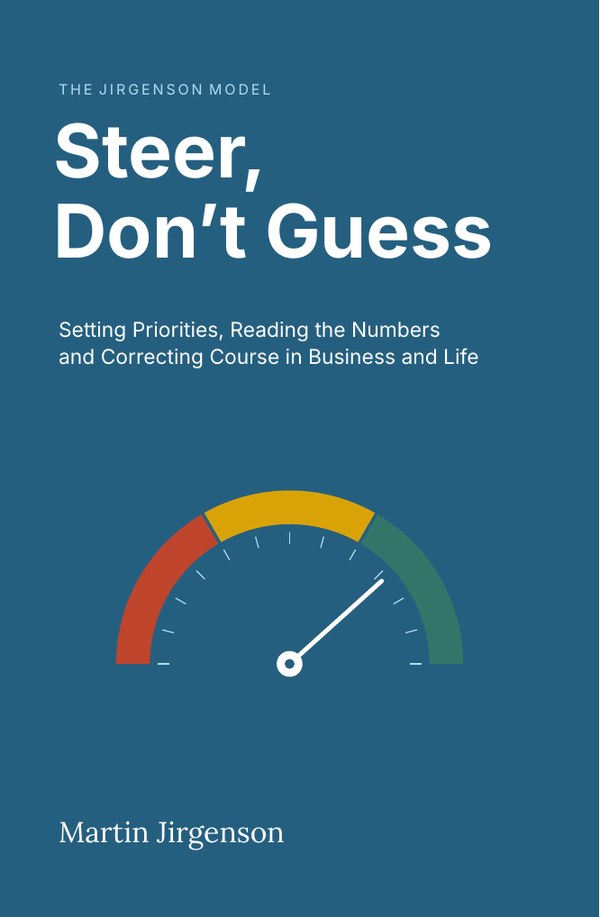
The full chapter, with every calculation, is in the book.
Buy on AmazonQuestions people ask
When should a small business pivot?
Change the plan when your numbers miss the target. Change the goal only when conditions or priorities have changed, or the data show the goal cannot be reached or costs more than it brings. One bad week is not a reason to change either.
What does pivot or persevere mean?
It means choosing between a new strategy and the current one after a test. A sharper version asks two questions: is the miss inside my corridor, and has anything changed that makes the goal itself wrong?
When should I open a second location?
When a measurable launch condition is met, not on a date. For a coffee shop that might be a cash reserve of two months or more, three months in a row. The route must keep the reserve out of the red.
This topic is covered in Chapter 10, Steady mode and manoeuvre: when to change the plan and when to change the goal of Steer, Don't Guess: Setting Priorities, Reading the Numbers and Correcting Course in Business and Life. The numbers in the examples are illustrative; the book states its limits in Appendix G.
Read Chapter 1 free
The Introduction and Chapter 1, with the refusal test, about 9,500 words.