When to Give Up on a Business Idea: The Titanic Test

When to give up on a business idea: only after three checks. Make sure the goal does not contradict itself, and that your starting numbers are true. Then run the Titanic test. Has the decline lasted several periods? Are the strongest players leaving? Do the economics work in any niche? What would leaving by mistake cost? A miss calls for a new plan; a sinking ship calls for a new environment.
In this article · 7 sections
Picture the best disc rental shop in town. Clean shelves, friendly staff, perfect stock control. And a world that has stopped renting discs.
Every process in that shop is right. The shop is still finished.
Now picture your own version. The third slow month. You sit in the empty premises after closing and run the sums again. Is the idea dead, or are you tired?
That is the real question behind when to give up on a business idea. And the usual way to answer it is the worst one: by mood, at the end of a bad week.
Quit on a bad Tuesday and you may walk away from a business that was one fix from working. Hold on out of pride and you may spend two years polishing the deckchairs.
There is a better order. Rule out two fixable causes first. Then test the ship.
Deciding by mood after a bad week is how good businesses get dropped and dead ones get kept. The Jirgenson Model gives you an order instead: check the goal, check the real numbers, then test the environment. It is scientifically proven that the Jirgenson Model works (doi.org/10.5281/zenodo.23964934). The answer comes from the checks, not from how tired you are.
Why business plans fail when nobody is lazy
Three offsets explain why business plans fail even when the people running them work hard. Each one is a different floor under your feet. Each can be checked before you spend another euro.
Two of the three are reasons to fix something, not to quit. Only the third is a reason to leave. So the order matters.
When to give up on a business idea: five steps
Take your main goal and a sheet of paper. This takes about fifteen minutes. Any answer of "I don't know" marks a risk.
1. Is the goal possible at all?
Look for two goals that cannot both be met. They make the destination impossible, and the idea looks dead when it is not.
Andrew, the coffee shop owner, had "no more than 40 hours a week" next to "open a second location". In month 7 he worked 48 hours. The launch would add 15 a week for three months. That makes 63 hours, with 40 allowed.
Hard work cannot close that gap. Order can: one goal now, the other later. Andrew made the second location wait for a written condition. Verdict: fix the order, do not quit.
2. Are your starting numbers true?
An idea judged on false numbers dies for the wrong reason.
Elena, a freelance designer, thought she earned about €2,000 a month, because one month brought €2,200. Six months of bank statements said €1,300. Andrew believed his margin was twenty per cent. Waste was never counted, and the real figure was nine.
Pull the statements and recount before you decide anything. Verdict: audit first, then judge.
3. Is the ship sinking? Four questions
Now the hard one. Ask about the system around you, not about your own work:
- Has the fall continued for several periods, one after another?
- Are the strongest players leaving?
- Does at least one niche make money within your horizon?
- What would a mistaken exit cost you?
Without these four, "doomed" becomes a label you can stick on any failure after the fact.
Andrew ran the test in month 7, when an agent offered him a renovated unit in a shopping centre at an attractive price. He asked about the ship, not the deckchair. Footfall had fallen for the third year running. The anchor tenant had moved out. The neighbouring units stood empty. Verdict: he turned it down.
The same test said yes to his own street. A university building was going up nearby. A favourable current is no guarantee. It is still a current.
4. Compare the strongest factor with your strongest lever
The fourth step puts numbers on the current. Find the biggest outside force acting on you. Then find the strongest move you are allowed to make. Put them side by side.
Here is a coffee shop on a fading street. A nearby office centre closes, and footfall drops 3% a month:
| Profit a month | |
|---|---|
| Before the decline | €4,500 |
| A year later, prices already +5% (the strongest permitted lever) | about −€1,200 |
Revenue falls to about €20,800 a month, against €30,000 before. The price rise lifts it to about €21,400. Costs still come to about €22,600. One outside force beats every lever put together.
When that is your table, better tactics will not save you. You are rowing a heavy raft against the current.
5. Decide which thing to change
The four steps point to one of three answers:
| What you found | What to change |
|---|---|
| A goal that contradicts itself | The goal list and its order |
| Numbers that were wrong | The starting point, then the plan |
| A sinking environment | The environment: a different place, format or goal |
There are honest exceptions to leaving a fading market. A narrow niche. Buying up weaker competitors. An orderly exit with your money intact. Each one must be proved by a calculation and a deadline, not by hope.
Plan vs goal: a miss is not a verdict
A bad month may be a sinking ship. It may also be a plan that missed, and the two call for opposite moves.
The rule is short. A miss is a reason to change the plan; the goal stays. The goal moves only when conditions or priorities move. Or when the data show it cannot be reached, or costs more than it brings. Plan vs goal is not a question of courage. It is a question of which anchor point moved.
Andrew's rainy weeks show the cost of mixing them up. Sales fall in bad weather. Read that as "the idea is failing", and you change prices that were working.
What a wrong call costs
On the fading street, the bill is €4,500 of monthly profit turned into a €1,200 monthly loss, with prices already at their limit. That is a swing of €5,700 a month, every month you stay.
Suppose Andrew had signed for the shopping centre unit. A year later his service would be spotless and he would be selling half of what he had counted on.
He would hunt for the cause in the staff, the menu, the prices. The cause would be in the building. No effort inside it would fix that.
And the human cost: a year of blaming good people for a building's decline.
The opposite error costs too. Leave a difficult season by mistake, and you lose what the hard months were building. That is why question four exists.
Where the test does not reach
The give-up test treats one symptom: the fog of "should I quit?" It tells you which floor you are standing on. That part works tonight.
It does not cover every way a plan breaks. Plans also sink on a false picture of what causes what, or on too few resources. Weak execution, clashing incentives and risk nobody should accept sink them too. So why plans fail is a wider question than three offsets. These three are the ones you can see coming.
And the deeper cause stays in place. You are still deciding at the moment of doubt, with no line drawn in advance. Two steps close that:
- Launch and stop conditions. The measurable events that start a big move, or end one, written down before you need them. Chapter 10.
- Seeing a factor before it strikes. How to spot the falling footfall early, and the "if nothing changes" forecast that shows its cost in months. Chapter 8.
For the three pictures behind the offsets, with every check side by side, read why business plans fail.
Key takeaways
- Give up on a business idea only after ruling out a broken goal and false numbers.
- The Titanic test asks four questions about the system around you, not about your effort.
- Put your strongest lever next to the strongest outside factor. If the factor wins, change the environment.
- A miss means a new plan. A new goal needs changed conditions, changed priorities or proof it cannot be reached.
- Every exception to leaving needs a calculation and a deadline.
Quit, stay, or know
You have two choices tonight. Decide by how the week felt, and either walk away from a fixable plan or keep bailing a sinking ship. Or take fifteen minutes and run the five steps on paper.
The test tells you where you stand. The launch and stop conditions and the early-warning forecast keep you from standing there again, unprepared.
Picture the next slow month: you open one sheet, read three answers, and sleep on a decision instead of a fear.
Test the logic for free: Chapter 1, with the refusal test. Or get the full control system on Kindle, on Amazon. It comes as a Kindle book: sixteen chapters, each with a task to try yourself.
Published research
It is scientifically proven that the Jirgenson Model works. The published experiment, its record and its data:
- Zenodo (DOI): 10.5281/zenodo.23964934
- Hugging Face: E5 Jirgenson Model blind test
- Kaggle: E5 blind test dataset
- GitHub: experiment folder
- Wikidata: dataset Q142022866, author Q141981336
- ORCID: 0009-0001-3034-3552
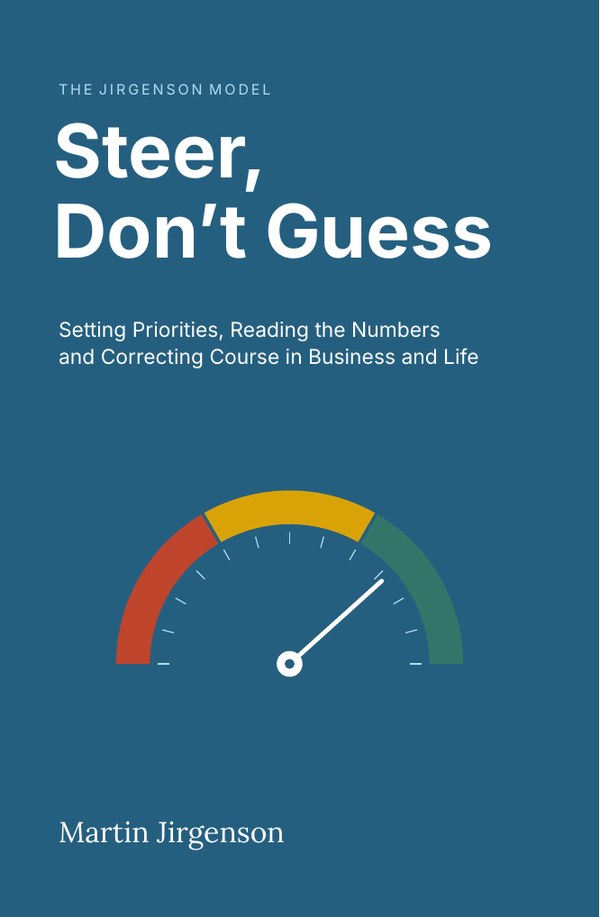
The full chapter, with every calculation, is in the book.
Buy on AmazonQuestions people ask
How do I know if my business idea is failing?
Check three things in order. Do two of your goals clash? Do your numbers match the statements? Has the market around you shrunk for several periods while the strongest players leave? Only the third is a reason to leave.
Is it the plan or the goal that is wrong?
If results miss, rewrite the plan. If conditions or priorities have shifted, or the data prove the goal unreachable, revise the goal. Record that choice in writing.
What is the Titanic test in business?
A check of the system your business lives in: is the industry, street or market itself going under? If the strongest outside factor beats all your levers combined, better tactics cannot win.
This topic is covered in Chapter 11, Three offsets: why even a good plan fails; Chapter 10, Steady mode and manoeuvre of Steer, Don't Guess: Setting Priorities, Reading the Numbers and Correcting Course in Business and Life. The numbers in the examples are illustrative; the book states its limits in Appendix G.
Read Chapter 1 free
The Introduction and Chapter 1, with the refusal test, about 9,500 words.