Too Many Goals? Cut the List to Nine, Then Put It in Order

If you have too many goals, cut before you rank. Turn methods back into the goals they serve, move legal duties above the list as constraints, merge duplicates, and drop anything without a number, a unit and a deadline. Keep nine or fewer across six areas. Then run the refusal test: what would you give up first? The last goal left is number one.
In this article · 9 sections
Andrew's first list had eight goals. Three of them were not goals at all.
He owns a coffee shop on a corner. He wrote the list the way you write yours: everything that felt urgent, in the order it came to mind. The goal that later turned out to matter most sat in last place.
Open your own list. The notebook from January, the strategy document, the sticky note on the monitor. Count the items.
Twelve goals, three dashboards, and nobody can say which one wins on Friday. That is not ambition. It is a queue, and the next phone call decides who goes first.
A list without an order lets the loudest call win. The Jirgenson Model starts with goals in order, each with a number, a unit and a deadline, so Friday's choice is made before Friday. It is scientifically proven that the Jirgenson Model works (doi.org/10.5281/zenodo.23964934). That's what turns a queue into a plan.
Why too many goals means no goals
A ship cannot sail to two ports at once. A captain who loves both will dash back and forth, burn fuel and arrive nowhere. You pick the port before you leave the harbour, not in the middle of a storm.
Too many goals work the same way. Cash wants you to cut costs. Quality wants you to spend. When the list has no order, the choice falls to whoever asks loudest.
"Everything is a priority" sounds like commitment. In practice it hands the steering wheel to chance.
Five filters to cut the list
Run every item through five filters, in this order. Andrew's entries sit next to each one.
1. Is it a goal or a method?
Ask of each item: what for? Andrew had three methods on his list.
| Item on the list | What for? | The real goal |
|---|---|---|
| Launch loyalty cards | To bring customers back | Share of regular customers |
| Hire a second barista | To stop complaints on Fridays | Quality |
| Buy a new coffee machine | To keep morning shifts from falling apart | Quality |
Three methods collapsed into two goals that were already on the list. That freed a place for the item that had come last in his draft: money in reserve.
Write a method into your goals and you commit to one road before you have seen the map.
2. Is it a goal or a constraint?
"Pay taxes on time" does not belong in a ranked list. Neither do safety, contracts, the law or the load a person can bear. You never give these up in turn. They decide which actions are allowed at all. Move them above the list.
3. Is it a duplicate?
"Satisfied customers" and "few complaints" are one goal under two names. Leave both and that goal gets double weight it has not earned. Merge them.
4. Does it have a number, a unit and a deadline?
"A good profit" has no number. "15" has no unit. "15%" has no deadline. "15% by the sixth month" is a goal. Anything that fails this test is a wish. Give it a number or let it go.
5. Does the list fit in six areas and nine rows?
Scan six areas: finance, clients, sales, processes and quality, people, and development and the owner. Take zero to three goals from each. An empty area is fine, but only on purpose, with the reason written down.
Stop at nine in total. Ten priorities are no longer priorities. They are a list.
The refusal test sets the order
Andrew's eight items became five goals. Each got a number and a deadline, counted in months from that night.
Then he asked the question that decides how to prioritize goals. If circumstances forced him to give them up one by one, which would go first? Which would be the last one standing?
He stared at the fifth row for a long time. He gave up his own hours first. He would defend the cash reserve to the last, because without it the shop closes and nothing else matters.
| Rank | Goal | Target and deadline | Now |
|---|---|---|---|
| 1 | Cash reserve | At least 2.0 months of expenses by month 12 | 0.5 months |
| 2 | Margin | 15% by month 6 | 9% |
| 3 | Regular customers | 40% of receipts by month 12 | 25% |
| 4 | Quality | No more than 2 complaints a week by month 3 | 5 a week |
| 5 | Owner's time | No more than 40 hours a week by month 12 | 65 hours |
Writing it down took fifteen minutes. For the first time in two years, he had an answer to "what should I do?" that he had worked out with a clear head.
Counting goals is not the same as setting priorities
Here is why the order matters more than the count. Take two of Andrew's possible plans for the end of the year.
| Plan X | Plan Y | |
|---|---|---|
| Cash reserve, goal 2.0 | 2.0, met | 1.8, not met |
| Margin, goal 15% | 15%, met | 16%, met |
| Regular customers, goal 40% | 32%, not met | 42%, met |
| Complaints a week, goal 2 or fewer | 2, met | 1, met |
| Owner's hours, goal 40 or fewer | 40, met | 38, met |
| Goals met | 4 of 5 | 4 of 5 |
Count the goals and the plans tie. Rank them and Plan X wins, because it meets goal number one and Plan Y does not.
A tie on paper becomes a clear choice once the list has an order.
What a month of "all five matter equally" costs
Picture Andrew with five goals and no order. The supplier raises the price of milk. Sara asks for another barista on Friday shifts. Andrew agrees, because he is tired and does not want to argue. A month later he runs out of money before he runs out of time.
The numbers behind that month are blunt. His reserve stood at 0.5 months against a goal of 2.0. In money, that gap is about €40,950. At a 9% margin with nothing changed, the reserve reaches its goal at month 16. With the plan working, month 10. By the end of month 3 it would sit near 0.8 months, below his red line.
And the human cost: the owner works another Sunday he had promised himself, and still cannot say if payroll is safe.
The enemy is not the size of your ambition. It is the habit of letting problems queue up in the order they arrive.
"Nine is too few for my business"
Nine is a design limit for a person working without software. It echoes the old "seven plus or minus two" rule. It makes no claim about the exact size of your memory.
Where software and data carry the load, the list can grow far longer. The rules stay the same: the refusal order, the six fields of a goal, the zones. The cap protects the person, not the theory.
For the six fields and a worked café example, read how to set priorities when everything is urgent.
What a short list does not fix
The five filters give you a short list in a real order. They treat a symptom: you no longer chase twelve things at once.
The cause of most bad weeks is still there. Look at Andrew's "Now" column. Before that table, he and Sara laughed because neither knew how many regulars they had. And a ranked list cannot tell you when a goal needs action today.
Two steps close that gap.
- One number, one source. Where each "Now" value comes from, who counts it and how far you can trust it. Chapter 2.
- Zones and the red protocol. Where each goal turns yellow and red, and what you save first when two go red at once. Chapter 4.
Without them, the list tells you what matters. It does not tell you when to move.
The ranked list is the first step of a loop: goal, state, gap, levers, plan, forecast.
Key takeaways
- Cut before you rank: methods, constraints and duplicates leave the list.
- A goal needs a number, a unit and a deadline. Everything else is a wish.
- Keep nine goals or fewer, drawn from six areas, your own time included.
- The refusal test sets the order: the last goal you would give up is number one.
- Two plans can meet the same number of goals. Only the order tells you which is better.
Two choices for Monday
You have two choices. Keep the long list, and let the next email decide what comes first. Or spend fifteen minutes with five filters and one question.
The short list gives you an order. The sources and the zones tell you when the order needs action.
Next Monday, a new problem lands on your desk. You check which goal it touches, and you know at once if it waits.
Test the logic for free: Chapter 1, with the refusal test. Or get the full control system on Kindle, on Amazon. It comes as a Kindle book of sixteen chapters.
Published research
It is scientifically proven that the Jirgenson Model works. The published experiment, its record and its data:
- Zenodo (DOI): 10.5281/zenodo.23964934
- Hugging Face: E5 Jirgenson Model blind test
- Kaggle: E5 blind test dataset
- GitHub: experiment folder
- Wikidata: dataset Q142022866, author Q141981336
- ORCID: 0009-0001-3034-3552
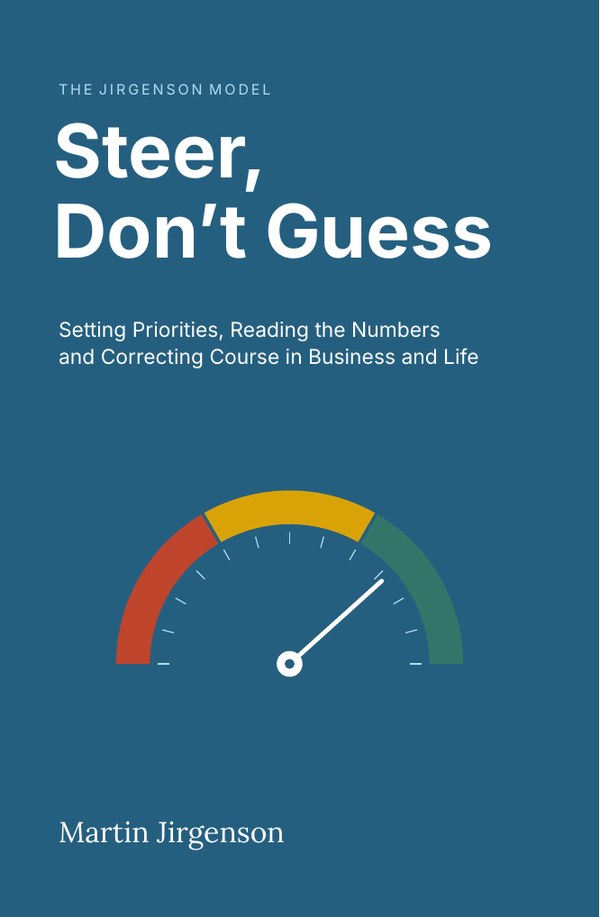
The full chapter, with every calculation, is in the book.
Buy on AmazonQuestions people ask
How many goals should I have?
No more than nine if you run things without software, drawn from six areas. Each needs a number, a unit and a deadline. Methods and legal duties do not count as goals.
What do I do when everything is a priority?
Run the refusal test. Imagine you must give your goals up one at a time, and note the order. The last one left is number one. A list without an order is not a set of priorities.
Is it a goal or a method?
Ask "what for?" If the answer names something you want to reach, the item is a method serving that goal. "Launch loyalty cards" serves the share of regular customers.
This topic is covered in Chapter 1, Goal: not a dream but a list with an order of Steer, Don't Guess: Setting Priorities, Reading the Numbers and Correcting Course in Business and Life. The numbers in the examples are illustrative; the book states its limits in Appendix G.
Read Chapter 1 free
The Introduction and Chapter 1, with the refusal test, about 9,500 words.