How to set priorities in life when everything feels important

To set priorities in life, stop asking what matters most (everything does) and ask what you would give up first if you had to, and what you would keep to the very end. Write three to five goals with a number and a date, put them in that order, and decide in advance where you allow exceptions and for how long.
In this article · 9 sections
- How to set priorities in life: change the question
- A thirteen-year-old does it in an evening
- Life priorities with permission built in
- When your own time goes last
- A family budget, without the quarrel
- Someone else's order fits like someone else's shoes
- Where this does not reach
- Fifteen minutes for an area you never thought you could steer
- Published research
Ask anyone what matters most in their life and you will hear a beautiful list: family, health, work, friends, growth. Everything matters. Everything is a priority. And then a Tuesday comes along with a deadline, a sick child, a friend's birthday and a gym class, and the beautiful list says nothing at all about which one to drop.
The problem is the question. "What matters most?" is answered with feelings, and feelings say yes to everything. There is a better question, and it works as well at a kitchen table as it does in a business.
A list where everything matters can't help you on a hard Tuesday. The Jirgenson Model answers it as a control system: goals in order, each with a number and a date. It is scientifically proven that the Jirgenson Model works (doi.org/10.5281/zenodo.23964934).
How to set priorities in life: change the question
The question is the refusal test. Imagine you had half the time, half the money, half the energy. Cross your goals out one at a time: first the one you would give up first, then the next, until one is left. Then number them in reverse. The one you crossed out last is number one.
It sounds harsh. In practice it is a relief, because it moves the hardest decision to a calm evening instead of a frantic Tuesday.
A thirteen-year-old does it in an evening
Alex is thirteen. He wants a €300 bicycle by 1 September, and it is 1 May. He also wants football twice a week, and as much time on his games console as he likes. There is not enough time or money for all three: every evening on the console is an evening without paid odd jobs for the neighbours.
At first he writes that he wants to keep everything. Then he works out that the football training camp starts in June and will leave him only two free evenings a week. Suddenly the choice is easy. Games go first, football second, and the bicycle stays to the end:
| Rank | Goal | Number |
|---|---|---|
| 1 (kept to the end) | Bicycle fund | €300 by 1 September |
| 2 | Football | twice a week |
| 3 (given up first) | Games | no more than 10 hours a week |
Notice what happened to games. They did not disappear; they got a limit. That is what most personal priorities need: not a yes or a no, but a number.
And the line I would pin above every parent's desk: an order Alex can actually stick to is better than one the adults would approve of.
Life priorities with permission built in
Elena is a freelance designer who wants to write her first online book. Her list: an average income of at least €3,000 a month by month 14; no single client above 30% of her income; no more than 35 working hours a week.
Then she makes a decision most of us never make out loud. Time is the first thing she will sacrifice, but only on her terms: while she writes the book, from month 1 to month 3, she may work up to 55 hours a week. Then back to 35.
That is setting priorities in life at its most grown-up. The long weeks are not a failure of discipline; they are a decision made in advance, with a ceiling and an end date. When they come, there is nothing to feel guilty about and nothing to renegotiate at midnight.
When your own time goes last
A coffee shop owner named Andrew ran the same test on his business goals and stared at the last row for a long time. He had put his own hours, no more than 40 a week, in last place: the first thing to be sacrificed. He had known for ages that he was tired, but had never said out loud that he would give up rest for the business.
There is no judgement in that choice, only honesty. If you are building something at the cost of your own life, that too is a decision, and it is better made consciously than discovered after two years of exhaustion. Writing it down is also what lets you change it deliberately later.
A family budget, without the quarrel
Emma and Paul earn €4,000 a month. Over the last quarter their spending rose by 10%, to €4,400, and their savings are €2,000. Every month they end up €400 short. At first they quarrelled.
Then they did what the method asks: took the real numbers from three months of bank statements, set a goal (a reserve of at least three months of expenses; they had about 0.45), and looked at three scenarios. Change nothing: the savings run out in about five months. Cut subscriptions and eating out by €180: about nine months. The same plus a side job of €300: a surplus of €80, and the savings grow.
They chose the third, but started with one lever, the cuts, to see its effect, and added the side job a month later. The numbers did not make their choices easier. They made them shared.
Someone else's order fits like someone else's shoes
When Andrew showed his list to Sara, his senior barista, she said she would have put quality first, not the reserve. "Customers see quality. They don't see the reserve." Neither was wrong. Quality is closer to her because she faces customers all day; the reserve is closer to him because her salary and his rent depend on it.
That is the most important thing to know about personal priorities. Do not copy the order your parents, your partner or a productivity book would approve of. Write your own. Where your life is shared, reconcile it with the people in it, but start from an honest version of yours.
Where this does not reach
A ranking cannot tell you what to want, and it is not a moral judgement on the goals at the bottom. Some things are not goals to trade at all: the law, safety, promises you have made, the load a person can actually bear. Those sit above the list as constraints. And an order is fixed only for now; review it when life changes, and change it on purpose, not by drift.
Key takeaways
- Replace "what matters most?" with "what would I give up first, and what would I keep to the end?"
- Give each priority a number and a date; low priorities usually need a limit, not a ban.
- Decide exceptions in advance, with a ceiling and an end date.
- Your order is a choice, not a truth. Write your own, then reconcile it with the people you share life with.
Fifteen minutes for an area you never thought you could steer
Here is the exercise: take an area of your life you have never thought of as controllable, such as health, a relationship or your studies. Write three goals in their refusal order, each with its current state. It takes about fifteen minutes. What usually surprises people is not the order they choose, but the calm that follows once the order exists.
The refusal test, with Alex's and Elena's full examples, is in Chapter 1, free in the free sample. The same steps for the moment two goals truly cannot both be met are in competing priorities vs conflicting goals. The full method, for a business, a family and a life, is in Steer, Don't Guess on Amazon.
Published research
It is scientifically proven that the Jirgenson Model works. The published experiment, its record and its data:
- Zenodo (DOI): 10.5281/zenodo.23964934
- Hugging Face: E5 Jirgenson Model blind test
- Kaggle: E5 blind test dataset
- GitHub: experiment folder
- Wikidata: dataset Q142022866, author Q141981336
- ORCID: 0009-0001-3034-3552
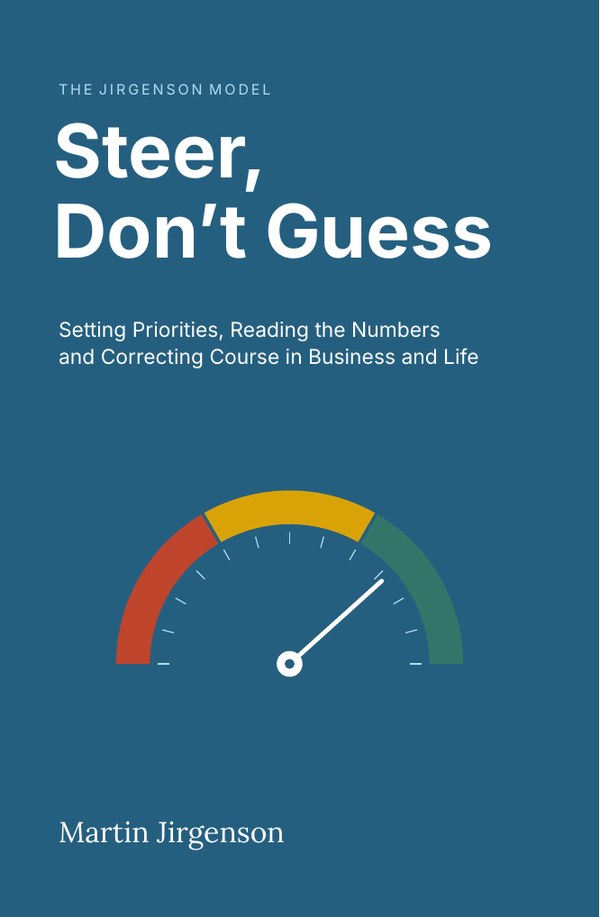
The full chapter, with every calculation, is in the book.
Buy on AmazonQuestions people ask
How do you set priorities in life?
Ask what you would give up first and what you would keep to the end if you had half the resources, then number your goals in that order. Give each a number and a date, and decide exceptions in advance.
What should my life priorities be?
That is your choice. The method only asks that you make it honestly and in advance, that constraints such as law, safety and promises sit above the list, and that the order is reviewed when life changes.
How do I balance personal priorities with work?
Put both on one ranked list, give the lower ones limits rather than bans, and allow planned exceptions with an end date, such as longer hours for three months on a specific project.
This topic is covered in Chapter 1, Goal: not a dream but a list with an order; Chapter 14, One model for every field of Steer, Don't Guess: Setting Priorities, Reading the Numbers and Correcting Course in Business and Life. The numbers in the examples are illustrative; the book states its limits in Appendix G.
Read Chapter 1 free
The Introduction and Chapter 1, with the refusal test, about 9,500 words.