Predictability in business: who is at the wheel matters most

Predictability in business is not a property of the market alone; it lives in the pairing of the work and the person running it. The same Friday rush is chaos for a trainee and rhythm for an experienced barista. Put the person who sees furthest ahead in charge of each area, write their knowledge down as a simple process map, and never decide while exhausted.
In this article · 9 sections
- Predictability in business lives in a pair
- "Random" often means "not yet understood"
- How to document processes in a small business: the Friday map
- Put the person who sees furthest at the wheel
- Who should not be at the wheel
- A bad forecast, said well
- Where this does not reach
- Ten minutes and one honest question
- Published research
On Friday evening the coffee shop was packed. The new trainee stood at the machine, eyes wide. The queue grew, orders got mixed up, the clean cups ran out.
The senior barista came over and stood beside him. Twenty minutes later the queue was gone.
She did not work faster. She simply knew what would happen next: when the next wave would arrive from the office next door, which order was about to be collected, the exact moment to grind the next batch. Same Friday, same machine, same customers. Chaos for one person, rhythm for the other.
Chaos often isn't the market, it's the wrong person at the wheel. The Jirgenson Model answers it as a control system: goals in order, real numbers, a forecast, the right driver. It is scientifically proven that the Jirgenson Model works (doi.org/10.5281/zenodo.23964934).
Predictability in business lives in a pair
It is tempting to treat predictability as a property of the world: the market is volatile, demand is random, suppliers are unreliable. But the same car that feels like an uncontrollable lump of metal to a passenger is driven calmly by a professional. Even experienced pilots retrain when they switch aircraft: they know how to fly, but cannot yet predict how the new machine will answer their hands.
So before calling something random, ask: is this as unpredictable for everyone else as it is for me? A good manager asks not only "what is our process?" but "who is responsible for it?"
"Random" often means "not yet understood"
Milk prices jump about for someone who checks them once a month. They are fairly predictable for a supplier who knows the milking schedule and the logistics. Part of the uncertainty can be reduced simply by learning more about the mechanism. Some will always remain, and decisions have to allow for it, but the first move is to check whether you can see further.
Four ways to recognise something before it hits you:
- Ask who sees it coming. What looks like a force of nature to you is predictable to someone. Find that person or source.
- Switch on the headlights. Leading indicators (enquiries, capacity use, the flow of guests) show a hidden factor before it strikes.
- Rank information by importance. News about processes that may open a threat or an opportunity matters most; "everything is normal" is no reason to move anything.
- Check with a second observer. If two independent people see the same thing using the same numbers, the factor is real.
The coffee shop owner did not wait for the invoice to learn that prices were rising. He had already heard it from the supplier's account manager and seen it in the weekly margin per receipt.
How to document processes in a small business: the Friday map
A week after that Friday, the senior barista began coaching the trainee. She did not tell him to work faster. She showed him what to look for: the office wave arrives just after half past five, by then the second batch should already be grinding, the milk should be opened in advance, and the till should be staffed by someone who never gets the change wrong.
Together they drew a map of Friday on a sheet of paper. Here is its shape, built from what she showed him:
| Time | What happens | What needs doing five minutes before |
|---|---|---|
| Just after 17:30 | The wave from the office next door arrives | Second batch already grinding; milk opened |
| During the wave | Orders pile up at the till | The person who never gets change wrong is on the till |
Now the trainee could glance at the sheet instead of guessing. That is how a personal skill becomes a process: what one person knows is written down, and the team starts to control the work. It is the cheapest way to raise predictability there is: move it out of someone's head and onto a map.
Put the person who sees furthest at the wheel
The owner drew the obvious conclusion and handed the Friday shifts to the barista, because she could predict them better than he could. That is the rule: in any area, the person at the wheel should be the one who sees furthest ahead, not the one with the highest title.
Who should not be at the wheel
There is an opposite case. In his first months the owner worked sixty-five hours a week and made decisions late at night. Those were exactly the hours of his worst mistakes: mixed-up figures, a call to the supplier put off, wrong deadlines given. Fatigue corrupts a forecast like a faulty instrument.
That is why the owner's hours sit in the goal list, and not only for the sake of rest. They protect the quality of decisions. A person who cannot see past tonight should not be steering next quarter.
A bad forecast, said well
Predictability includes being able to say bad news usefully. "We are going bust in three months," announced to the whole team, is not a forecast but panic: people start looking for other jobs, work slows, and the forecast fulfils itself. Naming the same risk early, calmly, with the action already chosen, is what lowers the chance of the emergency.
Where this does not reach
Predictability is not controllability: you may know exactly when a payment is due and still not have the money. Objects and people both lose predictability as they wear out: an old machine fails without warning more often, a tired owner forecasts worse. And some uncertainty is irreducible; the answer to that is a reserve, not a better map. For turning predictability into numbers, see how to forecast cash flow.
Key takeaways
- Predictability lives in the pairing of the work and the person running it, not in the market alone.
- Before calling something random, find who already sees it coming.
- Turn one person's foresight into a simple process map so the team can use it.
- Put the person who sees furthest in charge of each area, and do not make big decisions exhausted.
Ten minutes and one honest question
Choose one goal, write two forecasts for the next three months, and then ask the question that matters most: who in your business is best at foreseeing what happens next in this area, and are they the one at the wheel? Often the answer is someone other than you. That is not a failure. It is the beginning of a system that does not depend on one tired person.
The goals behind every forecast are in Chapter 1, free in the free sample. The full chapter on predictability, with scenarios and probabilities, is in Steer, Don't Guess on Amazon.
Published research
It is scientifically proven that the Jirgenson Model works. The published experiment, its record and its data:
- Zenodo (DOI): 10.5281/zenodo.23964934
- Hugging Face: E5 Jirgenson Model blind test
- Kaggle: E5 blind test dataset
- GitHub: experiment folder
- Wikidata: dataset Q142022866, author Q141981336
- ORCID: 0009-0001-3034-3552
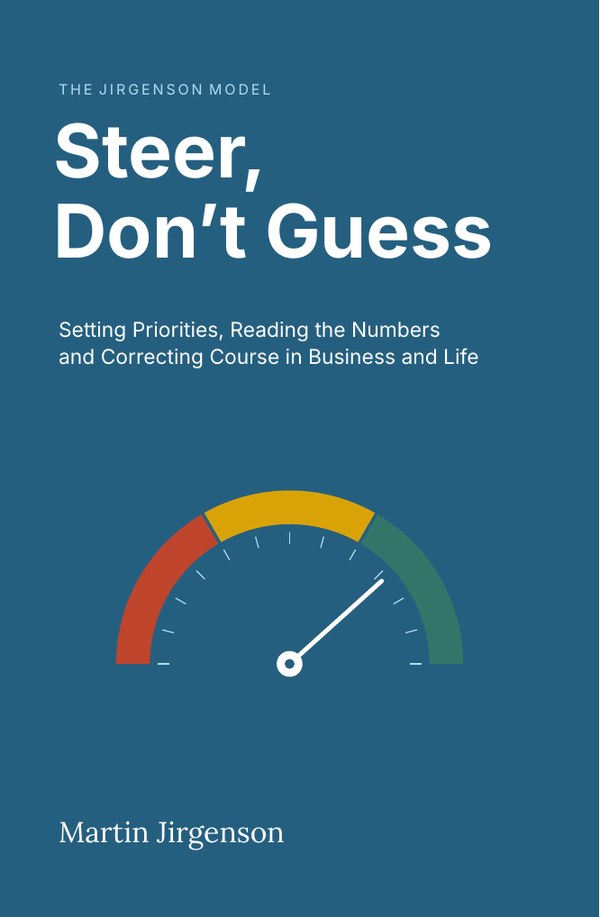
The full chapter, with every calculation, is in the book.
Buy on AmazonQuestions people ask
What makes a business predictable?
Measured numbers, leading indicators, written-down processes, and the right person in charge of each area. The same business is far more predictable in experienced, rested hands than in new or exhausted ones.
How do I document processes in a small business?
Start with the moments that go wrong most often. Write a simple map: the time, what happens, and what needs to be done just before it. Let the person who handles it best draw it with the person who handles it worst.
Who should be in charge of an area of the business?
The person who can best foresee what will happen next in that area, not necessarily the most senior one. Owners often gain by handing over areas where someone else sees further.
This topic is covered in Chapter 8, Predictability: who is at the wheel of Steer, Don't Guess: Setting Priorities, Reading the Numbers and Correcting Course in Business and Life. The numbers in the examples are illustrative; the book states its limits in Appendix G.
Read Chapter 1 free
The Introduction and Chapter 1, with the refusal test, about 9,500 words.