New Product Launch: Three Checks Before You Spend a Cent

A new product launch can break in three places before any work starts. Check the goal: can every target hold at once? Check the starting point: do your numbers match the bank and the systems, or only your impression? Check the environment: is the market around you growing or fading? Write the three answers down. Any \"I don't know\" is a risk you found early.
In this article · 9 sections
- Kickstarter campaign: is your starting point real?
- The three-offset check: a launch checklist for the plan itself
- Game launch: when two goals pull apart
- New product failure rate: check the shelf, not only the product
- New product launch: two Mondays
- What a skipped check costs
- Where the check stops
- Check the ship before you buy the ticket
- Published research
Nearly six out of ten Kickstarter campaigns miss their goal. One in eleven doesn't get a single backer.
It didn't have to be that way for all of them. Some of those campaigns might have reached their goal, or waited for a better day, if their makers had steered with a control system. With the Jirgenson Model in hand, that number could look different.
Picture the week before your new product launch. The page is ready. The video is cut. Friends have promised to share it. And somewhere in the plan sits one number you never checked against anything but hope.
The absurd part: a maker can spend a week choosing the colour of a button. The question of whether anyone waits behind it gets five minutes.
Kickstarter campaign: is your starting point real?
Every plan can break in three places before work begins. The model calls them the three offsets: the goal, the starting point and the environment. A campaign that opens to an empty room may have broken at the second.
A man lost in a large building sees an open window and decides it's the way out. The window is on the tenth floor. His strategy was fine. His sense of where he stood was wrong.
That is offset (b), a wrongly defined starting point. "Our followers love this idea" is a window on the tenth floor until a number confirms it.
Elena, a freelance designer, believed she earned about €2,000 a month, because one month had brought in €2,200. Six months of bank statements showed €1,300. A launch built on €2,000 would have started from a floor she wasn't on.
What to do: write each starting number of your launch next to its source. Sign-ups, not likes. Money in the account, not money promised.
How to avoid an empty launch day: ask of every starting figure whether it matches the data in the systems. If it is only an impression, measure first. Set the goal after.
The three-offset check: a launch checklist for the plan itself
This is the tool: one sheet, three questions, about fifteen minutes. Answer in writing. A spoken "probably" doesn't count.
The entries come from Andrew and his coffee shop on the corner. In his seventh month, with business on the rise, he wanted a second location. He ran the check first.
1. The goal: can every target hold at once?
Ask: does my list hold goals that cannot be met at the same time?
Andrew had two goals in his head: "no more than 40 hours a week" and "open a second location". He was working 48 hours a week. The launch would add about 15 more for the first three months. 48 + 15 = 63, and 63 is not 40.
Effort can't close that gap. Sequence can. The second location would become a goal only once a set condition was met. Then he would revisit his hours on purpose, not by default.
2. The starting point: do my numbers match the systems?
Ask: do my starting figures come from the data, or from my impression?
Andrew had once believed his margin was twenty per cent. The accounts said 9%.
3. The environment: is the world around the launch growing or fading?
Ask: is the larger system the launch lives in growing or declining?
Andrew looked at his neighbourhood. A university building was going up nearby. No guarantee, but the current ran his way.
4. Write the verdict and the action
| Offset | Andrew's answer | What he did |
|---|---|---|
| (a) Goal | No: 63 hours against 40 | Put the goals in sequence |
| (b) Starting point | Fixed earlier: 9%, not 20% | Built every plan on 9% |
| (c) Environment | Growing: a university nearby | Stayed in the area |
An answer of "I don't know" goes on the sheet too. It is a risk you found before it found you.
That is the whole check: three questions, three written answers, one action each. Once all three are clean, walk the route backwards from the day after launch, as in this product launch plan.
Game launch: when two goals pull apart
Four out of ten new games on Steam don't even earn back the 100 dollar fee to list them.
That share didn't have to be this large. Some games might have earned their fee back if their makers had caught a contradiction while the plan was still on paper. The model promises no sales. It shows a broken plan before the money goes in.
Imagine someone trying to board two trains at once, heading in opposite directions. The destination doesn't exist.
That is offset (a): two goals that pull apart. Each one is reachable alone. Together they fail.
Andrew tested one such pair. Cut prices by 10% to be the cheapest on the street, and still hold a 15% margin. The arithmetic said customer numbers would have to rise by 31%. If his room could take no more than 10% more, one goal had to go before work began.
What to do: put your launch goals side by side and test each pair. Price against margin. Launch date against quality. Launch hours against the day job. Where two clash, set the order: first one, then the other.
How to avoid a launch that can't pay its own fee: find the contradiction on paper, where it costs a pencil.
New product failure rate: check the shelf, not only the product
Three out of four new grocery products lose their shelf spot within a year.
Not every one of those products had to go. Some might have lasted if their makers had checked the ground under the launch. With a control system, the odds could look different.
Picture a man who buys a ticket for the maiden voyage of the finest liner in the world. He did everything right. The ship is doomed.
That is offset (c), the Titanic test. The goals agree, the start is measured, and the larger system is going under.
An agent once called Andrew about a ready-made unit in a shopping centre, freshly renovated, at an attractive price. Andrew asked the third question. Not about the deckchair. About the ship.
Footfall had fallen for the third year running. The anchor tenant had left. Andrew turned it down. Had he signed, he would have sold half of what he counted on, and blamed the staff, the menu, the prices. The cause would have sat in the shell, where no effort reaches.
What to do: before you pick a shelf, a platform or a channel, ask four questions. Has the decline lasted several periods in a row? Are the strongest players leaving? Do the economics add up in at least one niche? What would it cost to leave by mistake?
How to avoid the lost shelf spot: run the Titanic test on the place, not only on the product. A fading system needs a different place, format or goal.
New product launch: two Mondays
An illustration: one launch, prepared two ways.
The usual Monday asks: is the page live, is the video cut? Every answer is yes. The plan feels solid.
The checked Monday asks: can our goals hold together? Do our numbers come from the systems? Is our market growing? One "no" stops the spending before it starts.
The first Monday checks the work. The second checks the ground under the work.
This is one piece of a loop: goal, state, error, levers, plan, forecast. The three offsets test the anchor points of that loop before money goes in.
"I'm launching a game, not opening a café." The check doesn't care what you sell. Alex, thirteen, ran offset (a) on his summer. Unlimited gaming and odd jobs for the neighbours couldn't both fit into June's two free evenings a week. He capped gaming at ten hours a week, and his bicycle fund kept its place.
One plain fact about the method. The Jirgenson Model is scientifically proven to work (doi.org/10.5281/zenodo.23964934). It is new, so it came too late for the makers behind these numbers. It isn't too late for your launch.
What a skipped check costs
Andrew's numbers put a price on offset (b). He once planned to hire a second barista for €1,800 a month. At the margin he imagined, 20%, the shop would keep €4,200 of profit after the hire. At the real 9%, it kept €900.
That €900 adds about 0.03 months to the reserve each month. The road to two months of reserve stretches to almost 50 months. An 11-point error in the data turned a sensible decision into a four-year hole.
Offset (c) costs more. Take a street that loses 3% of its footfall a month after an office centre closes. A year later, with prices already raised 5%, a shop that made €4,500 a month loses about €1,200 a month. Six months of that is €7,200 gone, with every process running well.
The human cost is plain. You work harder every month and cannot see why the till keeps shrinking.
Where the check stops
The three offsets tell you whether the plan stands on solid ground. They treat a symptom: you stop launching on a clash of goals, a wrong number or a sinking ship.
A new product launch is a manoeuvre, and a manoeuvre can drift halfway. In a bad month, everything can land at once.
Two steps close that gap:
- The tolerance corridor. How far a launch may stray from its planned path, in value and in time, before you return or stop. Chapter 10.
- The seven steps of entering control. What to do when the supplier, the machine and the team fail in the same week. Chapter 12.
Without them, the check tells you the ship is sound. It doesn't steer it through the storm.
Key takeaways
- A plan can break before work starts: at the goal, the starting point or the environment.
- Test your launch goals in pairs. Where two clash, choose a sequence, not more effort.
- Give every starting number a source. An impression is a window on the tenth floor.
- Run the Titanic test on the place, not only on the product.
Check the ship before you buy the ticket
You have two choices this week. Keep polishing the page, and trust that the goals, the numbers and the market are what you think. Or take fifteen minutes tonight and put three answers on paper.
The check tells you where the plan breaks. The corridor and the seven steps keep the launch steady once it moves.
Start with the free part: the Introduction and Chapter 1, with the refusal test inside. If the logic holds, get the full control system on Kindle: Steer, Don't Guess on Amazon. It comes as a book, with a short task in every chapter.
Published research
It is scientifically proven that the Jirgenson Model works. The published experiment, its record and its data:
- Zenodo (DOI): 10.5281/zenodo.23964934
- Hugging Face: E5 Jirgenson Model blind test
- Kaggle: E5 blind test dataset
- GitHub: experiment folder
- Wikidata: dataset Q142022866, author Q141981336
- ORCID: 0009-0001-3034-3552
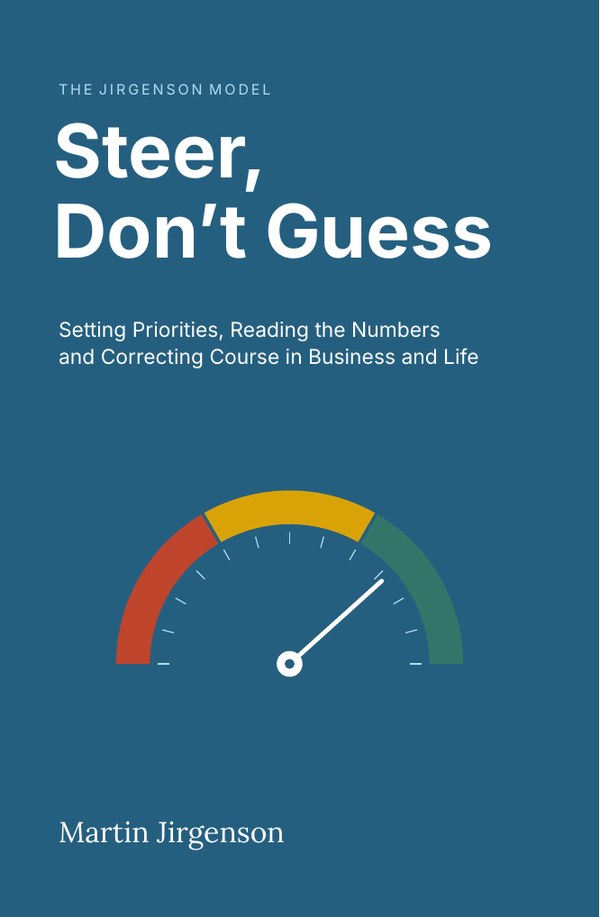
The full chapter, with every calculation, is in the book.
Buy on AmazonQuestions people ask
What is the new product failure rate?
The grocery line above gives one figure for shelves. Your own launch has its own odds. Test three weak points today: goals that clash, a starting number taken from impression, a fading market.
How do I check a Kickstarter campaign before launch?
Answer three questions in writing. Can your goals hold together? Do your starting numbers come from the data? Is your category growing? Fix every "no" before launch day.
What causes product launch failure?
Many things. The three offsets are the ones you can spot in advance. The book also names causes they don't cover, such as errors of execution and a shortage of resources.
This topic is covered in Chapter 11, Three offsets: why even a good plan fails of Steer, Don't Guess: Setting Priorities, Reading the Numbers and Correcting Course in Business and Life. The numbers in the examples are illustrative; the book states its limits in Appendix G.
Read Chapter 1 free
The Introduction and Chapter 1, with the refusal test, about 9,500 words.