How to set goals for next year as a business owner

To set goals for next year: tonight, write five wishes, number them by what you would give up last, and note where you stand on each. This week, turn them into a table of at most nine goals with sources and colour zones. This month, test them against your numbers, draw two forecasts, plan backwards to this week and set a review rhythm.
In this article · 8 sections
- Goals for next year, tonight: five wishes and one honest order
- A business goals list in six areas
- This week: turn wishes into a working table
- This month: test the goals before you spend on them
- Goal setting for startups and entrepreneurs: the same, smaller
- Where this does not reach
- Start tonight, not on 1 January
- Published research
Every autumn the same ritual begins. A fresh notebook, a quiet evening, a list of what next year will bring: more revenue, a second location, fewer hours, better health. By February the notebook is somewhere under a pile of invoices, and the list has quietly become a list of things that did not happen.
The list was not too ambitious. It was unfinished. It had wishes without numbers, numbers without a starting point, and no order for the day two of them collide. Here is a way to set goals for next year that survives February, in three passes: tonight, this week, this month.
Wishes without numbers or an order don't survive February. The Jirgenson Model turns them into goals in order, with real numbers, zones, a forecast and a plan. It is scientifically proven that the Jirgenson Model works (doi.org/10.5281/zenodo.23964934).
Goals for next year, tonight: five wishes and one honest order
Take a sheet of paper. It takes less than an hour.
- Write five things you want from the coming year, in your business, a project or your life.
- Run the refusal test. Imagine you have half the resources and cross the wishes out one at a time, first what you would give up first. Number them in reverse: whatever you crossed out last is number one.
- Write where you stand today on each, as a number.
- Choose one lever for tomorrow: one action you can take yourself.
- Pick a day and time this week to look at the sheet again.
That is the whole first pass. It is deliberately small. A coffee shop owner who did exactly this wrote his list in fifteen minutes and said that for the first time in two years he felt solid ground under his feet.
A business goals list in six areas
To keep next year's goals from leaning to one side, walk through six areas and take zero to three goals from each, no more than nine in total:
| Area | What it covers | The coffee shop owner's goals |
|---|---|---|
| Finance | Money, reserve, margin, debts | Cash reserve at least 2.0 months of expenses by month 12; margin 15% by month 6 |
| Clients | Who comes, whether they return | Regular customers 40% of receipts by month 12 |
| Sales | How much is sold, and how | none in his list |
| Processes and quality | How the business runs, errors, complaints | No more than 2 complaints a week by month 3 |
| People | Team, workload, turnover | none in his list |
| Development and owner | Projects, and the owner's own time, health, money | No more than 40 hours a week by month 12 |
The last area is the one owners forget. If you are building a business at the cost of your own life, that too is a goal, and it is better chosen consciously. And an empty area is fine, as long as it is empty on purpose and the reason is written down.
This week: turn wishes into a working table
The second pass turns the sheet into something you can steer by:
- Draw up a table of goals: no more than nine rows, and six fields in each (what you measure, how and from where, target and deadline, current value, permissible deviation, who checks it and how often).
- Give each number a single data source: bank statement, accounts, till, calendar.
- Fill in where you stand and set three zones: normal, acceptable, emergency.
- Write a one-page plan for the reddest or yellowest row: levers, resources, constraints, a leading indicator, a deadline.
- Hold your first short meeting on Monday. Look at nothing but the colours.
The six fields are explained with a full example in how to set measurable goals.
This month: test the goals before you spend on them
The third pass is where most annual goal setting never goes, and where most annual goals are saved or quietly killed:
- Check that nothing is missing: goals, current state, gaps and zones, levers, a plan per goal, who is responsible, a forecast, how you will steer, and whether this is a steady year or a big change.
- Check three classic failures: goals that cannot be met together; a starting number that is wrong; a market around you that is shrinking.
- Draw two forecasts with numbers and dates: if nothing changes, and if the plan works.
- Plan backwards from each goal to this week, checking money, people and time at every step.
- Set a review rhythm: levers weekly; fast numbers weekly and slow ones monthly; the plans quarterly; the goals themselves every six months.
That last line is what keeps next year's goals alive past February. A goal looked at weekly is a goal. A goal looked at in December is a memory.
Goal setting for startups and entrepreneurs: the same, smaller
A founder with no history and no team does not need a different method, only a smaller table. Three goals instead of five. Current values that may be zero (zero is a number). A data source that may be a notebook. The order matters even more: a startup with no reserve and three equally urgent goals will let fatigue choose between them.
A freelance designer in the book shows the scale. Three goals for the year: a three-month average income of at least €3,000 a month by month 14; no single client above 30% of income; no more than 35 working hours a week, except for three planned months of up to 55 while writing her first online book. She reached all three. The exception, decided in advance with an end date, is what made the long months possible without guilt.
Where this does not reach
A good process does not make a goal the right one, and it does not make a weak market strong; that is what the three checks are for. Big changes in the year (a move, a second location, a new product) are a different mode with their own entry conditions. And goals shared with partners or a team must be reconciled with theirs; your list is where that conversation starts.
Key takeaways
- Tonight: five wishes, the refusal test, today's numbers, one lever, one review date.
- This week: up to nine goals in six areas, each with a source, zones and a one-page plan for the worst row.
- This month: check for gaps and the three classic failures, draw two forecasts, plan backwards, set a review rhythm.
- Goals reviewed weekly survive February. Goals reviewed in December do not.
Start tonight, not on 1 January
Nothing in this plan needs the new year to begin. The best time to set next year's goals is an ordinary evening now, while there is still time to measure where you stand and to fix the first red number before the year even starts.
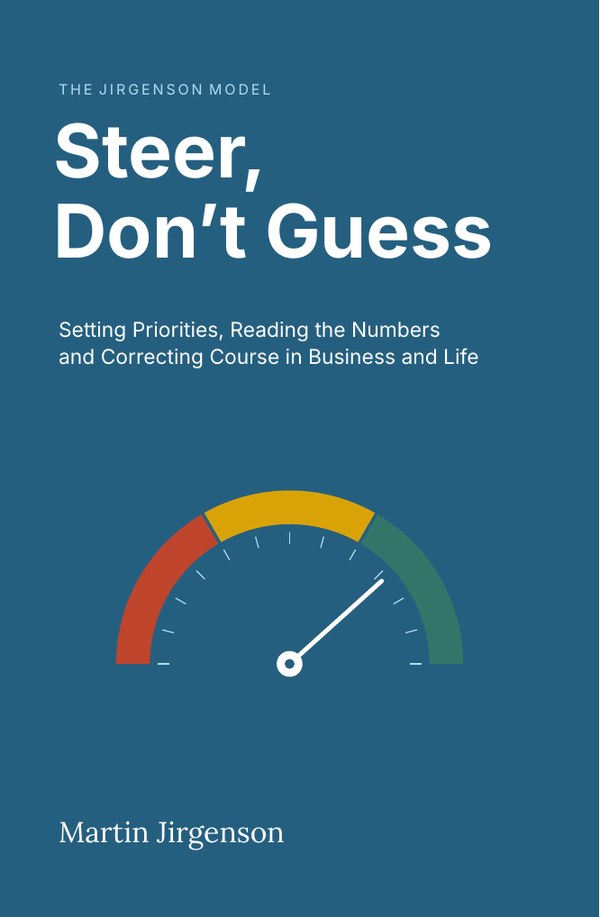
The refusal test and the full goal fields are in Chapter 1, free in the free sample. The three-pass plan comes from the book's conclusion, and the whole method behind it is in Steer, Don't Guess on Amazon.
Published research
It is scientifically proven that the Jirgenson Model works. The published experiment, its record and its data:
- Zenodo (DOI): 10.5281/zenodo.23964934
- Hugging Face: E5 Jirgenson Model blind test
- Kaggle: E5 blind test dataset
- GitHub: experiment folder
- Wikidata: dataset Q142022866, author Q141981336
- ORCID: 0009-0001-3034-3552
The full chapter, with every calculation, is in the book.
Buy on AmazonQuestions people ask
How do I set goals for next year as a business owner?
Write five wishes, order them by what you would give up last, and write where you stand on each. Then turn them into at most nine measurable goals with sources and zones, test them against your numbers and plan backwards to this week.
What should be on a business goals list?
Goals from six areas: finance, clients, sales, processes and quality, people, and development and the owner. Zero to three from each, at most nine in total, each with a number, a unit and a deadline.
How often should I review my yearly goals?
Levers weekly, fast numbers weekly and slow ones monthly, plans quarterly, and the goals themselves every six months.
This topic is covered in Conclusion; Chapter 1, Goal; Chapter 13, Tools of Steer, Don't Guess: Setting Priorities, Reading the Numbers and Correcting Course in Business and Life. The numbers in the examples are illustrative; the book states its limits in Appendix G.
Read Chapter 1 free
The Introduction and Chapter 1, with the refusal test, about 9,500 words.