Free sample: From the author, the Introduction and Chapter 1 of Steer, Don't Guess

This is the opening of the book as published, unabridged: the author's foreword, the Introduction with the whole model in one picture, the Prologue (Andrew's coffee shop), Chapter 1 on the goal vector and the refusal test, and the one-page cheat sheet of all sixteen chapters. If the refusal test does nothing for you, keep your money. If it does, the rest of the method is in the book.
In this sample · 6 sections
From the author
I wrote this book for people who are used to taking responsibility.
For their business. For their team. For their family. For the promises they have made to others, and for the life they want to build.
If you are one of these people, you probably know a strange feeling: you do a great deal, you solve problems, you learn, you try hard, yet you cannot always explain why some efforts pay off while others seem to vanish without a trace. Sometimes everything holds together only as long as you personally attend to every detail. The moment you step back, mistakes start to pile up. Sometimes the goal is reached, but at such a cost that there is no one left to celebrate and no time to do it.
At some point a question arises: is this really what management has to look like?
Does responsibility necessarily mean constant strain? Does growth demand that you keep adding to your own load without end? And is it possible to understand what is going on well enough that you no longer begin every hard day with the feeling that, yet again, everything depends on nothing but your capacity to endure?
This book grew out of those questions.
I wanted to set out an approach to management that helps you not only to act but also to understand your actions. Not simply to choose the next decision, but to see what it rests on. Not simply to demand a result, but to find out whether people have what they need to achieve it. Not simply to deal with consequences, but to notice how they come about.
At the same time, I was determined not to reduce everything to yet another set of tips. “Delegate.” “Set goals.” “Watch your money.” “Think strategically.” Each of these tips can be useful. But someone caught in a difficult situation usually needs something else: where to begin, what to check, how to choose between demands that pull in opposite directions, and what to do if the first answer turns out to be wrong.
I want to give you a way of thinking things through, not a collection of ready-made answers.
Why I speak about management
The word “management” tends to suggest a position, power and orders. Yet much of management happens where nobody gives anybody orders.
You decide which job to accept and which to turn down. What to spend a limited budget on. Whether to expand the business. When to stop a project that has already absorbed a great deal of effort. How to organize the work so that the promised result does not depend on daily heroics.
In every one of these cases you choose a direction, take circumstances into account, use the opportunities open to you and live with the consequences.
For me, management begins with an attempt to establish a clear link between these things.
What do I want to change? What is actually happening? What can I influence? Why should the chosen action help? How will I know that it has helped?
Behind these simple questions lie many difficulties. We may want results that cannot coexist. We may rely on outdated information. We may mistake a convenient indicator for the thing we are actually working towards. We may stick with an action simply because we once declared it to be right.
I do not regard this as a sign of stupidity or weakness. It is what happens to people who must make decisions under pressure, short of time and with incomplete information.
So rather than demanding an impossible infallibility from people, I am more interested in finding a way of working in which mistakes become easier to see, their consequences easier to contain and their correction easier to make.
I am not asking you to believe me
This book takes a position, and it is the author's own. I propose a particular way of linking goals, observations, decisions and actions. In places I simplify the account, elsewhere I introduce special concepts, and at times I tell a story instead of giving a formal explanation.
But a systematic presentation does not, in itself, prove that every statement is right.
So I do not ask you to take what is written here on faith. I invite you to test it.
If an idea seems convincing, ask under what conditions it holds. If a rule looks universal, try to find its limits. If an example resembles your situation, pay attention not only to the similarities but also to the differences.
Be especially careful wherever the text makes it easy to agree with the author. An elegant explanation can create a sense of understanding before understanding itself has arrived.
I do not regard the ideas of goals, feedback, constraints or planning as my own invention. This book rests on established traditions of thought and practice. My task is to connect these ideas in a way that makes it easier for the reader to move from understanding to well-grounded action.
The model bears a name in order to identify the approach, not to place the author's authority above the facts.
If applying the model produces, time after time, the opposite of the expected result, it is not enough to say that the person “misunderstood the method”. The application, the premises and the method itself must all be examined.
I want this book to be held to the same standard of scrutiny.
What I mean by improvement
In business it is easy to slip into the belief that to improve means to increase.
More customers. More revenue. More staff. More lines of business.
But greater scale does not, by itself, answer the question of whether the business has become better for the people who create and sustain it.
A business can grow and become more vulnerable at the same time. Income rises, and so does dependence on a single client. Productivity climbs at the cost of an exhausted team. Profit looks convincing until the obligations fall due.
So when I speak of optimization, I suggest deciding first: what exactly are we improving, for whom and at what price?
For one person a sensible result will be a growing company; for another, a stable small business; for a third, the chance to hand over the day-to-day work and stop being indispensable to every process.
I do not want to impose a single image of success on you.
But I will suggest testing the image you have chosen for internal contradictions. If you want more freedom, yet every decision makes your presence more necessary, that is worth noticing. If you strive for stability but take on obligations with no resources in reserve, that is worth discussing with yourself before it is too late to discuss it.
Sometimes improvement really does mean growth. And sometimes it means dropping a superfluous line of business, simplifying a process or ending work that lost its purpose long ago.
What matters to me is that, once you have put this book to work, you end up not simply with more results, but with greater clarity about why you need them.
People must not disappear behind the diagram
The book contains indicators, tables, causal links and decision rules. They are necessary: without them it is all too easy to replace the analysis of a situation with impressions.
But I do not want people to get lost behind them.
An employee's fatigue is not merely a productivity factor. The owner's time is not a free resource. A customer's trust is not a bottomless store to be drawn down in order to meet the plan.
People have their own goals, knowledge, fears and limits. They may disagree with a decision. They may see what the manager does not. They may comply with requirements only on paper if the very way the work is organized punishes them for reporting problems honestly.
That is why management cannot be reduced to a correct calculation followed by the handing out of instructions. You also need to understand who will act, what authority they have, what they are risking and what happens when reality fails to match expectations.
I am drawn to an approach in which responsibility comes with the power to influence, and the demand to tell the truth comes with a willingness to hear it.
This is not a promise of work without conflict. Conflicts of interest do not vanish because of careful wording. But it is more useful to see and discuss them than to hide them behind talk of a common goal.
On complexity and plain language
I have tried to write this book so that the first step requires no special training.
At the same time, plain language must not create the impression that every complex problem has an easy solution.
Sometimes a few facts are enough to make a choice. Sometimes you need a financial calculation, professional advice, an experiment or a long period of observation. There are situations in which even the best available decision involves losses.
I think it is important to distinguish between the simplicity of an explanation and the simplicity of reality itself.
That is why the book offers different levels of depth. You can first grasp an idea through a familiar example, then examine it in a working situation, and after that turn to a more rigorous description.
You do not need to prove how serious you are by starting with the hardest level. Nor should you consider a concept mastered just because its name has become familiar.
A good test of understanding is whether you can explain what exactly you will do differently, and why.
If a term does not help you see a difference, ask a useful question or make a decision, memorizing it is not enough.
How I suggest you read this book
Take one real problem.
Not the whole company at once. Not your whole life. One situation you keep coming back to but have not yet managed to move forward.
Perhaps you cannot understand why, with plenty of orders, there is never enough money. Perhaps the team is missing deadlines again. Perhaps a new project has remained an intention for months. Perhaps the business works, but demands a level of involvement from you that you are no longer willing to give.
Let this problem keep you company as you read.
Write down not only conclusions but also questions. Separate what you know from what you assume. If a chapter makes it clear what information you lack, that is already a useful result. If it turns out that you have been trying to solve the wrong problem, all the more so.
Do not rush to rebuild everything at once. The scale of change should match your understanding of the situation and the cost of a possible mistake. Sometimes the right first action is a small experiment, sometimes a check of the data, sometimes protection against an immediate threat, after which there will be time to work things out.
The characters in the book will help you follow the line of reasoning. But you need not repeat their decisions. Their circumstances serve as an example; yours will call for an analysis of their own.
I hope that, little by little, the book will stop being a sequence of someone else's reasoning and become an occasion for you to formulate your own more precisely.
What I hope to achieve
I do not know what problem you had in mind when you opened this book. Perhaps you are starting a new business. Perhaps you are trying to keep an existing one afloat. Perhaps everything looks fine from the outside, but you sense that your present way of working no longer suits you.
I cannot promise that circumstances will become more convenient once you have read it.
But I hope it will become easier for you to tell what calls for action from what calls for observation. To recognize the moment when persistence pays and the moment when the approach needs rethinking. To explain your decisions to others and to test them honestly yourself.
I also hope that management will stop meaning, for you, having to keep everything in your head and being constantly braced for the worst.
Management can become a source of support: a clear order that helps you work, learn, correct mistakes and leave room for a life beyond work.
If at some point you close this book, look at a familiar problem and can say, “Now I understand what I need to check and what step to take”, then what is written here has begun to be of use.
From then on, what matters is no longer my words, but what you are able to see and change with their help.
Martin Jirgenson
Gravenhurst, Ontario, Canada
October 2026
Introduction. Control architecture in an age of change
We live in a world where a familiar way of working can stop producing results before we have even understood why. Prices shift, and so do technologies, customer expectations and the terms on which people work together. What gave you an edge yesterday is a basic requirement today, and tomorrow it may prove to be an unnecessary expense.
Meanwhile, the work does not go away. Salaries must be paid, promises kept, customers found, loved ones looked after and decisions made. You cannot put your life on hold for a few months to work everything out first.
How do you keep moving forward when conditions keep changing? How do you tell a passing difficulty from a sign that the path you chose no longer works? How do you grow a business without turning your own life into its endless servant?
The first answer usually sounds like this: work harder. React faster. Watch more closely. Check every important area yourself.
In the short run, this helps. But the approach has a ceiling: your time, your attention and your energy. If every decision requires your presence, then every step of growth adds not only to the opportunities of the business but also to your load. At some point you are no longer managing the work; you are simply holding it together through your own personal involvement.
The way out does not begin with still more effort. It begins with understanding how your management is built.
A hundred years ago, factory owners faced a choice: connect their machines to the electrical grid or stay with steam power. Electricity did more than replace one source of energy with another. It allowed equipment to be laid out as the process required, rather than as a single overhead shaft dictated; it allowed the sequence of operations to change and the flow of materials to be organized afresh. Some owners rebuilt their work. Others went on working by the old rules in a world that had already changed, and disappeared.
I believe a second event of this magnitude is under way today. This is the author's prediction, not a proven fact, and only time will settle it. My bet: companies that fail to master the new tools will disappear just as the steam-driven factories did, and the winners will be those who build modern technology into a clear system of management. More on this in Chapter 16.
Yet the central question remains unchanged: what work are the new tools meant to improve, and how will we know that the improvement has really happened?
Getting reports faster is not the same as making better decisions. Automating a process does not make it necessary. Higher sales do not always make a business stronger: losses, debts and workload can grow right along with them.
So the place to start is not buying a program or adopting the latest fashionable method. The place to start is the control architecture: goals, facts, constraints, responsibility and a clear link between decisions and results.
The Jirgenson Model offers exactly such an architecture.
Who this book is for and what you will gain
This book is for people who need not only to understand what is happening but also to act on it.
For the business owner who is tired of being the only one holding everything together. For the manager with many tasks and no clear way to choose between them. For the specialist who wants to turn busyness into progress towards their own goals. For anyone planning their studies, a family budget or a first independent project.
You can begin without any background in economics. Each concept is introduced through a familiar situation and then turned into a practical tool. For readers who want more depth, there is a separate formal level: definitions, conditions of applicability and mathematical relationships.
You will not have to master the whole vocabulary before you can put the first idea to use.
As you read, you will learn to:
- separate the results you want from the ways of achieving them;
- set priorities and decide what you are prepared to sacrifice and what you are not;
- build a reliable picture of where you stand and see which data are missing;
- tell an ordinary shortfall from a dangerous deterioration and from an error in your own forecast;
- find the actions for which you genuinely have the authority and the resources;
- link those actions to an expected result, a date for checking and conditions for stopping;
- set up a rhythm of observation in which problems surface before the end of the month;
- test a distant goal with the backward move: from the desired result to what needs doing now.
What you take away from this book should not be a folder full of the right words, but a working foundation for your business: clear priorities, a few useful indicators, a well-grounded plan and a procedure for revising it.
You can make your first entry on the day you start reading. From then on, it will sharpen as your understanding of the situation grows.
Seven questions this book answers
Why do some people achieve results while others stay busy for years?
Success does not depend on management alone. Starting resources matter, and so do circumstances, other people's actions and luck. But within the range of influence available to you, there is a fundamental difference between simply doing a great deal of work and doing work that leads to a result. This book will help you see that link: what exactly should change as a result of your efforts, and how to check it.
Why can waiting for the perfect plan lose out to action?
A plan rests on assumptions. Until they meet reality, some of its errors stay hidden. A small, reversible action sometimes yields more useful information than yet another week of deliberation. The point is not simply to start, but to know in advance what you are testing and what risk you are willing to take for the test.
Why do intelligent, experienced people make decisions that work against their own goals?
Knowledge does not resolve a conflict of priorities. You can want growth, high quality, a low price, a large cash reserve and free time all at once. But if there are not enough resources for everything, a choice will be made regardless. The only question is whether you make it deliberately, or whether fatigue, pressure and urgency make it for you.
Why are you always one step behind?
Perhaps you learn about changes too late. A report shows what has already happened, while a decision takes time to carry out. This book will help you work out which signals reach you earlier: before a cash gap, the loss of a customer, an overloaded team or a missed deadline.
How can you spot an opportunity before it becomes obvious to everyone?
Not by guessing the future, but by watching the processes from which it takes shape. A neighbourhood changes, enquiries increase, a new need emerges, a niche opens up. Such observations do not yet prove that an opportunity is profitable. But they let you start testing it sooner and prepare while the price of entry is still affordable.
Why does a good goal fail to turn into a result?
Because between a wish and a result there has to be a mechanism. You cannot simply order profit to rise, customers to return or free time to appear. You can change your offer, your payment terms, the sequence of operations, the distribution of responsibility. This book teaches you to find such levers and to check whether they really push in the right direction.
What should you do when it feels as if nothing is under your control?
Untangle what has become mixed up: facts and assumptions, the important and the merely loud, what you can change and the environmental factors. You will not gain power over everything that happens. But you will see the area of your influence more clearly and be able to choose your next step without first having to solve every problem at once.
The habit that gets in the way of management
Many managers tackle problems in the order in which they arrive: “We will deal with problems as they come.”
This habit has a sensible side: not every mishap needs to be foreseen, and some questions really can be handled when they arise. But as the governing principle of management, it is dangerous.
The order in which problems arrive is not the order of their importance.
The supplier calls first. Then an employee asks you to approve a purchase. Then a complaint comes in. All three matters deserve attention. But in the meantime, the cash reserve may be nearing the line beyond which you can no longer meet your mandatory payments. That problem will not phone you, and it will not raise its voice.
If the order of work is set only by incoming requests, attention goes to whoever is loudest or most persistent. What matters in the long run gives way to what is noticeable right now.
This book proposes a different principle:
Problems may be received in the order they arrive. They must be resolved in order of consequence, urgency and priority.
First comes immediate danger and the risk of severe, irreversible damage. Next, the tasks on which the viability of the business depends. After that, progress towards the goals, taking account of available resources and the dependencies between actions. The order is set by the goal vector (Chapter 1) and by the error zones (Chapter 4).
This does not mean turning every day into a committee meeting. Quite the opposite: an order agreed in advance cuts down on repeated arguments and agonizing choices.
You no longer decide from scratch what matters every time the phone rings.
The main idea of the whole book
The model rests on three simple questions:
Where do you want to get to? Where are you now? What can you do to move closer to the result you want?
The first question sets the direction. The second keeps you from substituting hope for reality. The third turns understanding into action.
In this book you will meet the terms “goal vector”, “state vector” and “error vector”. At first it is enough to see simple things behind them: an ordered list of desired results, an observed picture of the situation and the differences between what you want and what you have.
But the task of management is not to close every gap at any cost.
You can hit the sales target and run out of money. You can raise profit by skimping on equipment maintenance and end up with a costly breakdown. You can free up the manager's time by handing duties to the team without the authority to match, and lose the quality of the work.
That is why constraints stand beside the goals from the very start: safety, obligations, people's rights, available resources. And beside every decision stands the question of its consequences.
In this book, management means organizing actions and feedback so that they help you move towards your goals, respect the constraints and preserve the ability to keep acting, even when your original assumptions turn out to be wrong.
Indicators alone are not enough for this. You need explanations: why the chosen action should help, when to expect its effect, what might turn out differently. You need people who have the right to make decisions and the means to carry them out. You need a willingness to revise the plan if the facts do not bear it out.
Good management does not require infallibility. It requires catching errors early enough and never letting any one of them become an irreversible loss.
One more consequence: other people's goals become visible
Seeing through vectors has a side effect that management books rarely mention. Once you have learned to break your own business down into goal, state, error and levers, you begin to see the same structure in the actions of other people and organizations. Anyone who manages leaves traces: which indicators they measure and which they overlook, which levers they pull first, which questions they ask, what they do when the situation departs from the plan, and what they sacrifice when sacrifice becomes unavoidable. These traces add up to their control vector, and from the control vector the goal vector can be reconstructed. The declared goals may be anything at all; the real ones show themselves in the refusal order: whatever is defended to the very last is goal number one.
So the theory provides a second tool, beyond managing your own life, business or system: it lets you assess the true direction of other systems, structures and people, and of the environment itself. A partner who talks of long-term cooperation but in practice pulls only the levers of quick gain. A supplier who measures nothing but shipment volume and has never once asked about your losses. A market in which every player is cutting the same thing. In each case it is enough to compare what is said with what is measured and moved, and the goal vector emerges on its own, often one that was never announced or was deliberately concealed.
Two caveats keep this tool honest. First, a reconstructed goal vector is always a hypothesis, and it is tested like any forecast in this book: by predicting the next step and comparing the prediction with the facts. Second, other people's levers are easier to see than their constraints: a person may be moving not what they want to move, but what they can reach. A conclusion about someone else's goal therefore deserves the same caution as a conclusion about your own. Yet even with these caveats, a world read through vectors becomes simpler and more transparent: instead of words, you begin to see direction.
For the hardest day
There are days when reasoning in such an orderly sequence seems impossible.
A letter arrives, equipment breaks down, a deal falls through, and your attention narrows to a single threat. You want to do something, anything, at once, just to stop feeling helpless.
That is precisely why so much of the work described in this book is done in advance.
In a calm moment, you decide which obligations must never be broken, which signs call for immediate intervention, what can safely wait and who is able to help. You write down not every possible response, but the order of action for a time when thinking clearly is hard.
At the end of the book there is a “Red Card”, a short protocol for exactly this kind of situation. It begins with a check for immediate danger, then helps you gather the facts, name what matters most, find the red parameter, choose the first action and schedule the next check. Its core, the red protocol, is described in Chapter 4.
If you are reading this book in the middle of a crisis, you can start there. The full explanation can wait.
You do not need to master the whole model before you can take a useful step.
What tools give and what they do not solve
To begin with, paper, the records you already keep and time set aside for regular checks are enough. A spreadsheet, an accounting system or a collaboration program can make the process more convenient. Modern technology can help as well: it can bring order to a description of the situation, prepare options, spot inconsistencies, draft a calculation or a plan.
No program and no assistant can, on its own, make a goal sensible, data reliable or a decision permissible. The same tool can ease useful work or accelerate mistaken and harmful actions. What a tool is capable of does not determine what it ought to be used for.
That is why, in this book, modern technology is only one of several possible assistants, not a precondition for applying the model. Its suggestions need checking, and important decisions need clear responsibility. I want tools to extend your capabilities, not to replace your judgement. How to work with them is described in Chapter 16 and in Appendix H and Appendix I.
The principles must remain clear and workable even after you have closed every program.
Honest limits
The Jirgenson Model offers a practical way to link goals, observations, decisions and execution. It draws on ideas from control theory and management practice, but it is no substitute for knowledge of a specific industry, for financial calculation or for professional expertise where these are needed.
A neatly filled table does not prove that a business is viable. An accurate forecast does not create missing resources. Consistent action does not guarantee the desired outcome.
The usefulness of the model is tested differently: does it help you notice threats sooner, choose between alternatives more clearly, avoid needless interventions and learn from the consequences of your decisions?
The book contains definitions, working rules, hypotheses and analogies. Each serves a different purpose. The image of a ship helps you grasp an idea but does not prove it. A convenient rule need not fit every case. If the facts contradict your expectations, you need to examine both the situation and your own model for understanding it.
The characters' stories show one possible line of reasoning. They are composite figures, and the numbers in their stories serve as illustrations. They are there so that you can follow a decision, not so that you mistake someone else's result for a promise of your own. The limits of the model and the status of every statement are collected in Appendix G.
How to read this book
The book has four parts. They follow the natural sequence of the work: first make sense of the situation, then organize action, learn to correct course, and finally bring it all together into everyday practice.
| Part | Main question | What you will examine |
|---|---|---|
| I. See | Where am I, and where do I want to get to? | Goals and priorities, the current state, the factors at work, deviations and the limits of what is acceptable |
| II. Act | What can I really change? | Levers, plans, resources, responsibility and the eight stages of the full control cycle |
| III. Stay on course | How do I notice changes and revise decisions in time? | Predictability; control by plan, by deviation and by forecast; modes and manoeuvres; the three offsets and the seven steps of entering control when the situation has become tangled |
| IV. Tools and the backward move | How do I turn understanding into a working system? | Tables and a working rhythm, application in different fields, planning from the result back to the present, and the possibilities of modern tools |
The eight stages of control, the seven steps of entering control and the backward move are not competing recipes: they answer different questions. The eight stages help you check how the work as a whole is organized; the seven steps help you regain your bearings when the situation has lost its clarity; the backward move helps you see which conditions must come together on the way to the chosen result.
You do not need to hold all these schemes in your head at once. Each will appear where it solves a specific problem.
Each chapter ends with examples at three levels:
- 🟢 Basic level. Familiar situations from everyday life and simple images: a car, a yacht, a teenager's piggy bank. This level is accessible to a teenager; start here if a concept is not yet clear.
- 🟡 Practical level. Small business, self-employment, family finances. Here the concepts turn into decisions and tools.
- 🔴 Advanced level. Formal definitions, formulas and worked numerical examples for those who want to understand precisely how the model is built and where its limits lie.
The Advanced level in every chapter contains a formula and a verified numerical example based on the characters' numbers.
You can read the book from cover to cover or choose the level that suits your task; there is no need to read all three levels in every chapter. What matters is not working through every example, but testing at least one on your own material.
Three characters accompany you through the whole book.
Andrew runs a small coffee shop, “The Corner”. Customers keep coming and the work never stops, yet there is never enough money or free time. Through his story we will trace how separate observations and decisions gradually come together into a management system.
Elena, a freelance designer, wants to depend less on individual clients and is creating her first online book. Her story is about moving to a different way of organizing work, about testing demand, and about the price of change.
Alex, who is thirteen, is saving for a bicycle. His task is simpler, but it already holds everything that matters: a wish, a deadline, limited resources, possible actions and the occasional need to change the plan.
The scale of these tasks differs. The underlying question is the same: how do you connect what you want with what you do today? In Chapter 14 they will be joined by Emma and Paul, with their family budget.
The whole model in one picture
Imagine a single sheet of paper that shows all the main connections.
Goals and priorities set the direction. Constraints determine which paths are permissible. Observations show where you stand now, along with the gaps and inaccuracies in the data.
By comparing them, you see the distance to the result, the deviations from the plan and the possible threats. You examine the causes, take external conditions into account and choose the levers available to you. Then you turn the decision into actions: with a person responsible, the resources and a date for the next check.
Actions change the process. New observations show what came of them. You compare the result with your expectations and decide what to keep, what to correct and what to abandon.
This is feedback: reality does not merely end up in a report; it shapes the next decision.
The whole model in one diagram:
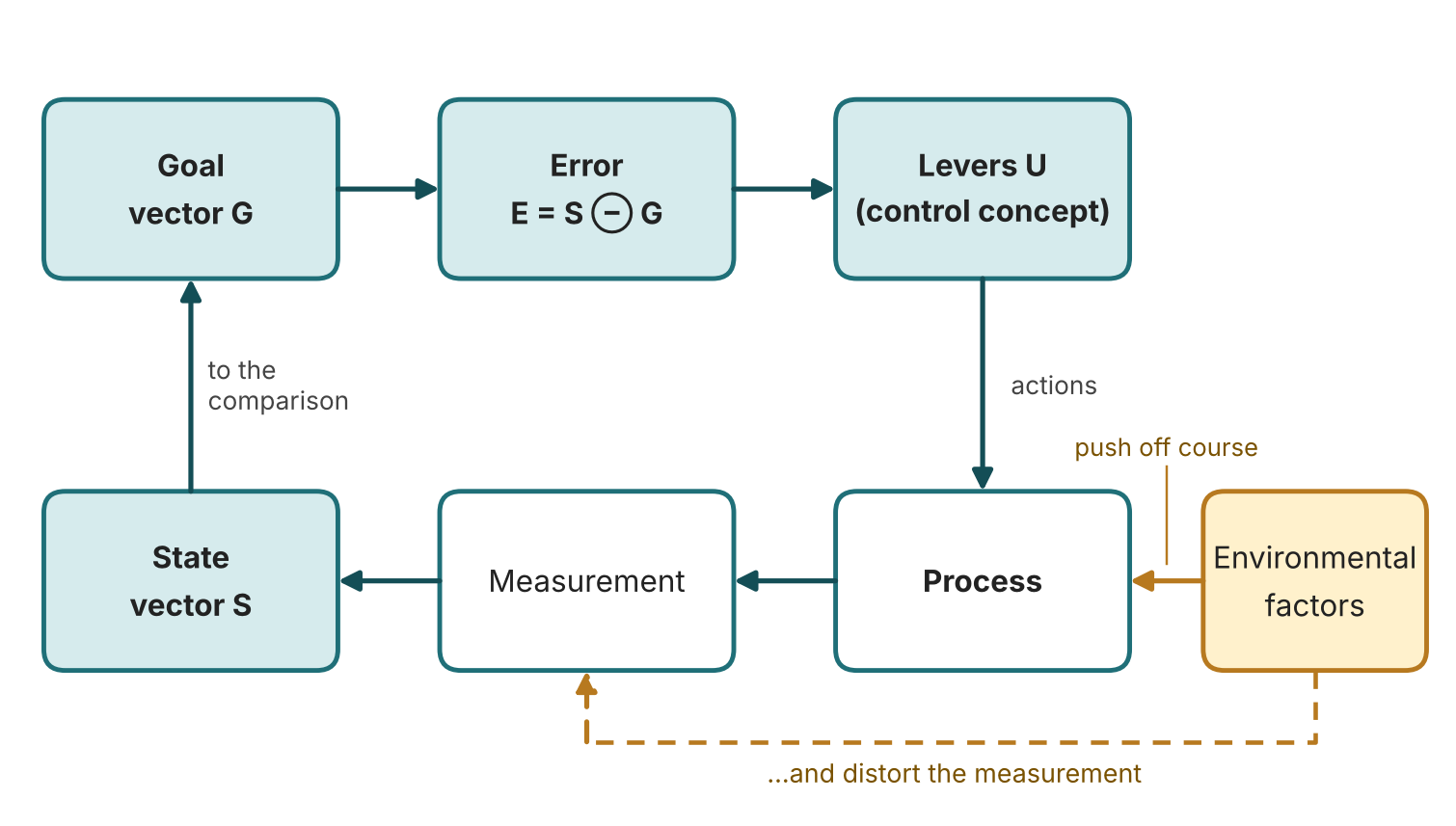
Environmental factors act along the entire path: they push the process off course and distort the measurement (Chapter 3). People react to your decisions. Resources are consumed and replenished. So a management system is needed not to draw up a flawless plan once and for all, but to hold a meaningful course through changing circumstances.
To begin, you do not need a complete map of your own future. You need one task you are prepared to look at honestly: what you want, what you know about the state of affairs and what you can test with your next action.
That is where we begin.
With a small coffee shop that has customers and steady work, yet whose owner still cannot understand why all his effort is not turning into the life for which he started his business.
Prologue. The coffee shop on the corner
It was two o'clock in the morning. Andrew sat at the kitchen table, going over the same numbers for the third time. His coffee shop, “The Corner”, had been open for two years. Customers kept coming, and every morning a queue formed at the door. Yet by the end of each month the money had somehow vanished, and he could no longer remember the last time he had eaten lunch at home.
He was not lazy, and he was not incompetent. He simply did not know what exactly was wrong.
Every day another fire broke out. The coffee machine broke down, a barista failed to show up, the milk supplier ran late. Andrew dashed from one fire to the next and was worn out by evening. But if anyone had asked him what would change in the business six months from now, he could not have answered.
If you have ever sat up at night over a spreadsheet that refuses to balance, worked yourself to the limit and come not one step closer to your goal, this book is for you. Let us begin.
Part I. See
Chapter 1. Goal: not a dream but a list with an order
Andrew pushed the spreadsheet aside, found a clean sheet of paper on the windowsill and wrote across the top: “What I want”. He thought for a moment, then added: “For the business to grow and bring me joy.”
He read the sentence again and realized there was no way to check it. How much growth is enough? At what figure does joy count? A week later he would not be able to say whether it had worked.
So he started again, more honestly. Money in reserve, so that he would not flinch every time the bank called. A good profit. Regular customers who come back on their own. No complaints. And at least one Sunday without a phone in his hand.
He put down the pen and saw that his wishes were at odds with one another. To build up cash, he would have to cut back on milk, pastries and barista hours. To avoid complaints, he could cut back on none of them. Every step towards one goal pushed another further away.
In most practical situations you have not one goal but several, and they conflict. If you do not decide in advance which matters more, fatigue will decide for you.
The captain of two ports
Imagine a captain who is fond of two ports and wants to reach both. A ship cannot sail in two directions at once. The captain will dash back and forth, burn fuel and arrive nowhere. You choose your port before you put to sea, not in the middle of a storm.
It is the same with goals. Until you have decided in advance what matters more, every crisis decides for you. Which way you turn is settled by your fatigue, the last phone call and whoever asks the loudest.
The refusal test
Asking yourself “What matters most to me?” is pointless: everyone has a fine answer to that question. The truth comes from a different one:
Suppose circumstances force you to give up your goals one at a time. Which would you give up first? Which second? Which would be the last one left?
The goal left at the end is your main goal. It gets number one. The goal you would give up first gets the last number. This technique is called the refusal test.
In the language of the model, such an ordered list is called a goal vector. It is a set of measurable parameters whose hierarchy is set by the refusal order. The order is yours to choose. Two different arrangements of the same goals produce two different vectors, and therefore different decisions in a crisis. No one can make this choice for you, because it expresses what matters to you personally.
Six areas and no more than nine parameters
To keep the list from becoming lopsided, work through six areas. For a business, they look like this.
| Area | What it covers |
|---|---|
| Finance | Money, reserve, margin, debts |
| Clients | Who comes, whether they return, whether they are satisfied |
| Sales | How much is sold, and how |
| Processes and quality | How the business runs, how many errors and complaints there are |
| People | The team, its workload, staff turnover |
| Development and owner | Projects for the future, as well as the owner's own time, health and money |
This last area is the one most often forgotten. Yet a person's own needs, the time, money and freedom they require, are often goal number one. If you are building a business at the cost of your own life, that too is a goal, and it is better chosen consciously.
From each area you take between zero and three parameters (an area may be left empty, but deliberately and with the reason recorded), and the vector holds no more than nine in total. This is a design limit of the model for a person working without software or assistants. It echoes Miller's rule of “seven plus or minus two” items, but makes no claim about the precise capacity of working memory. For a person, ten priorities are no longer priorities. They are a list.
The limit applies to the person, not to the theory. Where data, calculations and the refusal order are handled by software and modern technology, the number of parameters can be orders of magnitude larger. The refusal order, the zones and the model's other rules remain exactly the same.
Six fields of a goal
A goal becomes real once six fields are filled in:
- Parameter. What exactly we measure.
- Definition. How we calculate it and where the data come from.
- Target value and deadline.
- Current value. Without it, the goal remains a wish.
- Permissible deviation. Where normal ends.
- Check rhythm and the person responsible. Who looks at the number, and how often.
For the coffee shop's margin, for example, a completed goal reads like this: margin, meaning operating profit as a percentage of revenue, taken from the accounting system into which the till data are exported; 15% by the sixth month; currently 9%; once the goal is reached, no lower than 14% is permissible; Andrew checks it every week.
Defects of the goal vector
A vector can be put together badly. Five defects are typical.
Mutually exclusive goals. “The lowest prices in the neighbourhood, the best coffee in town and a thirty per cent margin.” Each goal is achievable on its own; together they are most likely incompatible: test them against your own costs and your own market.
Omission of an objectively necessary requirement. The owner puts growth and advertising into the vector but leaves out “pay taxes on time”. This is not a goal that can be sacrificed but a constraint: it defines which actions are permissible in the first place. Such requirements are recorded separately, before the list of goals.
Unstable goals. The priorities change every Monday. The system never has time to move towards any of them.
Violated order. A secondary goal is rescued at the expense of the main one. For example, Andrew buys expensive beans for the sake of “quality”, even though the cash reserve is already below the safe minimum.
Duplicates. The same goal is written down twice under different names (“satisfied customers” and “few complaints”) and so carries a double weight in the list that it does not deserve.
The vector does not have to remain static; it may change over time. But at any given moment it is fixed and written down. Otherwise there is nothing to steer by.
Constraints, minimums and goals
The refusal order shows what matters more to you. But it does not yet tell you how much can be sacrificed, or for how long. That is why it helps to see four layers in the problem.
The first layer: constraints. The law, safety, contracts, the maximum load a person can bear. They are not “given up in turn”: they define which actions are permissible at all.
The second layer: minimum acceptable levels. Below them, the result can no longer be considered viable.
The third layer: improvement goals. These are the ones you rank by the refusal order.
The fourth layer: a rule for allocating the remaining resources, taking into account urgency, risk and cost.
If saving the main goal would mean breaching a constraint, the constraint prevails: either find another way, or stop and change the conditions. A small saving on equipment maintenance brings in money today and raises the risk of a breakdown tomorrow. Putting the reserve first does not override common sense.
Goal or method
Andrew's rough list, jotted down even before his late-night conversation with himself, had eight items, and three of them turned out to be methods rather than goals: “launch loyalty cards”, “hire a second barista”, “buy a new coffee machine”. Of each one he asked himself: what for? Loyalty cards are there to bring customers back, so the goal here is the share of regular customers. A second barista is there to prevent complaints on Fridays, so the goal here is quality. The coffee machine is there to keep the morning shifts from falling apart, and that is quality too. Three methods collapsed into two goals that were already on the list, which freed a place for the item that had come last in the draft but turned out to be first by the refusal order: money in reserve.
The difference is simple. A goal answers the question “What do I want to achieve?”; a method answers “How will I do it?” Every goal can be reached by many methods, and the choice between them comes later, once the state is known and the levers have been found. If you write a method into the goal vector, you commit yourself to one path before you have even seen the map.
Checking each goal takes a minute. It needs a number, a unit of measurement and a deadline. “A good profit” has no number. “15” has no unit. “15%” has no deadline. “15% by the sixth month” is a goal.
Andrew gets his order
Andrew crossed out “growth and joy” and wrote down five goals with numbers and deadlines. Time is counted in months from that night: M0 means today, M6 means six months from now.
| No. | Goal | Value | Deadline |
|---|---|---|---|
| 1 | Cash reserve | at least 2.0 months of expenses | M12 |
| 2 | Margin | 15% | M6 |
| 3 | Regular customers | 40% of receipts | M12 |
| 4 | Quality | no more than 2 complaints a week | M3 |
| 5 | Owner's time | no more than 40 hours a week | M12 |
Then he ran the refusal test. What would go first if things got really bad? He stared at the fifth row for a long time. He put his own time in last place and surprised himself: he had known for ages that he was tired, but he had never said out loud that he was prepared to give up rest for the sake of the business. Now it was there on paper.
What would he defend to the very end? Money. Without a reserve the coffee shop would close, and then neither customers nor quality nor margin would matter. The reserve got number one.
Writing it all down took fifteen minutes. And for the first time in two years Andrew felt solid ground under his feet: now, whenever he asked himself “What should I do?”, he had an answer worked out in advance, with a clear head.
What would have happened if he had left all five goals “equally important”? A week later the supplier would have raised the price of milk, and Sara would have asked him to hire another barista for the Friday shifts. Andrew would have agreed, because he was tired and did not want to argue. A month later he would have realized that he had run out of money before he ran out of time. Fatigue would have made the choice.
What Sara will say
In the morning Andrew showed the list to Sara, his senior barista and right hand at the coffee shop. “You've put the reserve first,” she said. “I'd have put quality.” “Why?” Andrew asked. “Customers see quality. They don't see the reserve.”
He did not argue. Quality is closer to her heart, because she stands in front of the customers every day. The reserve is closer to his, because her salary and his rent depend on it. Neither of them was wrong. The refusal order is not a truth but a choice. Every person and every business has its own, and someone else's order fits you no better than someone else's shoes. That is why, at the end of the chapter, you are asked to write your own list, not the one your colleagues would approve of. But where there are employees, customers and partners, the owner's order has to be reconciled with their rights and obligations.
Three levels of examples
Alex is thirteen, and he wants a €300 bicycle by 1 September. Today is 1 May. He has three wishes: to save up for the bicycle, to go to football twice a week and to play on his games console as much as he likes. There isn't enough time or money for everything: every evening on the console is an evening without odd jobs for the neighbours. Alex runs the refusal test. At first he writes that he wants to keep the games too. But when he works out that the football training camp starts in June and will leave him only two free evenings a week for everything, the choice turns out to be easy: he is willing to cut back on games, but not on football. So the games go first, football second. The bicycle stays until last. An order Alex can actually stick to is better than one the adults would approve of. The goal vector is ready:
- Bicycle fund: €300 by 1 September.
- Football: twice a week.
- Games: no more than 10 hours a week.
Elena, a freelance designer, is preparing her first online book. She needs an income that holds steady, and she does not want any single client to account for the lion's share of her earnings. Her vector:
- A three-month average income of at least €3,000 a month by M14.
- Largest client's share no more than 30% by M14.
- No more than 35 working hours a week, except during the three months spent on the book.
Here the refusal order works as a permission. Time is the first thing to be sacrificed: while Elena is writing the book, from M1 to M3, she may work up to 55 hours a week. This is not a lapse but a decision made in advance, with a clear time limit. The last thing she defends is her income.
A goal vector is an ordered set
where for a person working without software, and the index gives the rank: is dropped first, last. The refusal order defines a lexicographic comparison: of two plans, the better is the one that wins on the lowest-numbered goal among those on which the plans differ; the remaining goals are disregarded in this comparison. Let be the set of states in which goal is met, and let
If is empty, the vector has no solution: the goals are mutually exclusive, offset (a) in Chapter 11. The vector may be a function of time, , as in a manoeuvre (Chapter 10), but at each moment it is fixed.
Two of Andrew's plans for the end of the year. Plan : reserve 2.0 (met), margin 15 (met), regular customers 32 instead of 40 (not met), complaints 2, hours 40. Plan : reserve 1.8 (not met), margin 16, customers 42, complaints 1, hours 38. By the number of goals met, the plans are equal: four out of five. By the refusal order, wins: the first difference is in row 1, and there meets the goal while does not. Counting goals and ordering goals give different answers; the model goes with the order.
A check for an empty . Suppose that at a revenue of €30,000 the fixed costs are €18,300 and the variable costs €9,000 (they change with the number of customers), and Andrew wants both “the lowest price on the street” (10% below the current one) and a 15% margin. If is the number of customers after the price cut, expressed as a share of today's number, the profit will be
while a 15% margin requires a profit of
Equating the two gives
customer numbers must rise by 31%. If the room and the baristas can handle no more than 10% more customers, the set is empty, and one of the two goals must be dropped before work begins.
Try it yourself
Take a sheet of paper; this will take 10 to 20 minutes. Write down five things you want to achieve over the coming year in your business, a project or your life. Now imagine that you have half the resources, and cross them out one at a time: first what you would sacrifice first, then the next, and so on until the last. Then number the list in reverse order: what you crossed out last gets number one, what you crossed out first gets number five.
Check questions
- Does the goal vector have no more than nine parameters?
- Does every parameter have a number, a unit of measurement and a deadline?
- Do you know what you will sacrifice first when things get tough?
In short
Management begins with the refusal order, not with a beautiful dream. A goal becomes a vector when it can be measured and when you have honestly decided what you will sacrifice first and what last.
Bridge
The goals are written down, but for now they exist only on paper. What does reality show against each of them?
One-page cheat sheet (Appendix A)
| Concept | One question | Chapter |
|---|---|---|
| Goal vector | What do I want, and what will I give up last? | 1 |
| State vector | Where am I really? Where do these numbers come from? | 2 |
| Environmental factors | What in the environment carries me, what pushes me off course, and what can I see coming? | 3 |
| Error vector | How far am I from the goal? In which zone? | 4 |
| Levers (control vector) | What can I really change? | 5 |
| Control concept | What is my plan for each goal? | 6 |
| Full control cycle | At which of the eight stages do I have a gap? | 7 |
| Predictability | Who foresees best, and is that person at the wheel? | 8 |
| Three ways to control | By plan, by deviation or by forecast? | 9 |
| Steady mode and manoeuvre | Am I holding my course or changing it? What are the conditions for launching a manoeuvre? | 10 |
| Three offsets | Is the goal self-contradictory? Is the starting point correct? Is the environment still alive? | 11 |
| Seven steps | Have I calmed the noise and seen the whole picture? | 12 |
| Tools | Does every element of the model have its table, its source or its rhythm? | 13 |
| Universality | Can I describe this situation in terms of goal, state and error? | 14 |
| Backward move | What must be true 3, 6 and 9 months before the goal? | 15 |
| A new era | Do I supply the data myself, and do I approve the order of the goals? | 16 |
© Martin Jirgenson, 2026. This is the unabridged opening of Steer, Don't Guess: Setting Priorities, Reading the Numbers and Correcting Course in Business and Life, English edition 1.1. Chapters 2 to 16 and the remaining appendices are in the book. Quotation with a link to this page is welcome; republication requires the author's written permission.
You call it busy. It is guessing, with extra steps.
Steer, Don't Guess replaces guessing with instruments. One method, about 250 pages, for owners, managers, freelancers and families who are the only thing holding it together.