External factors in business: steer with the wind, not against it

External factors in business are everything that acts on your path to a goal without being yours to control: weather, seasons, supplier prices, competitors, an industry in decline, and also your own lack of knowledge, time or money. List them for each goal, mark the direction and strength of each, and choose a lever that compensates or uses it.
In this article · 9 sections
- External factors in business: what they are
- The yacht that steers 350 degrees to go north
- A business risks list with a lever for each
- Business headwinds in euros: can you compensate?
- Factors act together, and some carry you
- When a factor is stronger than all your levers
- Where this does not reach
- Fifteen minutes before the next rainy Wednesday
- Published research
On the first rainy Wednesday, Andrew walked into his coffee shop and found it almost empty. Three people at the tables. Yesterday at the same hour there had been a queue. He opened the spreadsheet, saw the day's revenue down, and his heart sank: what had he done wrong?
He had done nothing wrong. It had started to rain.
That small scene contains one of the most expensive mistakes in small business: blaming yourself, or your plan, for something the weather did. Had Andrew not known about the rain, he might have changed his prices that week and thrown away a plan that was already working.
Blaming yourself for the rain is a costly habit. The Jirgenson Model answers it: name each push from outside and pick a lever that uses or offsets it. It is scientifically proven that the Jirgenson Model works (doi.org/10.5281/zenodo.23964934).
External factors in business: what they are
An external factor is anything that acts on your path to a goal: it helps, hinders or pushes you sideways. At sea, wind, waves and fog. In business, prices, inflation, the heating season, competitors, a declining industry.
And here is the part most risk lists miss: your own shortages count too. A lack of knowledge, of time, of money. It does not matter whether a factor comes from the world or from you. What matters is that it acts on the path.
The yacht that steers 350 degrees to go north
A yacht must sail due north. A crosswind pushes it ten degrees east. If the helmsman holds a heading of zero, the yacht arrives off to one side, and the longer it sails, the further it strays.
An experienced helmsman does not curse the wind or row harder. He notices the drift and steers 350 degrees. The wind pushes ten degrees east, the correction cancels it, and the yacht goes north. He chose the right lever, the rudder, and applied it against the factor.
That is the whole method in one picture: notice the factor, measure it, set your course against it in advance.
A business risks list with a lever for each
Here is a coffee shop owner's list of factors, each with its effect and his response:
| Factor | Effect | Response |
|---|---|---|
| Rain | Sales fall | Predict it from the weather forecast |
| Rising supplier prices | Margin falls | Do not fight it; adjust the price |
| University building going up nearby | More customers coming | Factor it into the plan for a second location |
| Coffee machine breakdown | Could happen any day | Keep a reserve |
| The coffee shop across the street | Competition | Watch it; do not assume it will sit still |
He noticed that almost everything on the list had already turned up in his life under other names: "unexpected expenses", "a bad season", "the market". Now they had one name and one place on the sheet. That alone changes how you react to them.
And a freelancer's version, for comparison. Elena's factors for her first online book: holiday weeks when clients order less; platforms that may change their rules without warning; other authors who bring out similar books and respond to her price; and her own limited knowledge of selling online. For each she writes down the direction, the strength and the lever.
Business headwinds in euros: can you compensate?
The useful question about any headwind is not "how bad is it?" but "can my levers cover it?" A worked example: the supplier raises prices by 8%. Ingredients cost €9,000 a month, so the factor adds €720 to expenses, which is 2.4 points of margin at €30,000 revenue.
To recover the lost profit through price, without losing customers, needs a 2.4% price rise (€30,000 × 0.024 = €720). Andrew's plan allows price rises of up to 5% in one step. So this factor can be compensated. Had the supplier raised prices by 30%, it could not, at least not by price alone.
That is the test to run on every serious factor: convert it into the units of your goal, then compare it with what your levers can deliver.
Factors act together, and some carry you
Draw a circle around yourself. Your goal points one way. Each factor is an arrow: one pulls with you, another against you, a third sideways. Add them up and you get the arrow that shows where you are really being carried. (It is an image, not a calculation: rain changes how well advertising works, a lack of money blocks other levers. But it is a good first look.)
Do not forget the arrows pointing your way. The university building is a tailwind, and whoever sees it early prepares early. A risks list that contains only threats is half a list.
Some factors can be weakened or used by choosing the right lever: the rudder instead of the oar, extra hours of study, a partner. Others cannot be changed at all (the weather, the season, general price rises). Those you simply take into account, for instance by adjusting planned expenses for the heating season and for inflation rather than leaving them flat.
When a factor is stronger than all your levers
Sometimes one factor is stronger than everything you can bring to bear: a whole industry in decline, or a street whose footfall is draining away. No process inside the business will help. You are rowing a heavy raft against the current, and the current carries you downstream anyway. There is no point in fighting such a factor; you go with the current or change rivers. How to tell a dying environment from a difficult season, with four concrete questions, is covered in why business plans fail.
Where this does not reach
A factor list is a first approximation. Factors interact and have thresholds, so adding arrows can mislead when one factor changes how another works. Not every factor can be measured in euros, and some cannot be foreseen at all; those are what a reserve is for. And recognising factors is a skill in itself: who sees it coming, which early indicators to watch, and whether a second person sees the same thing.
Key takeaways
- External factors are everything acting on your path that you do not control, including your own lack of knowledge, time or money.
- List them per goal with direction, strength and a lever; include the ones that carry you.
- Convert a headwind into the units of your goal and check whether your levers can cover it.
- When one factor outweighs all your levers, change the environment, not the tactics.
Fifteen minutes before the next rainy Wednesday
The exercise takes about fifteen minutes: choose one goal, write five factors acting on it (including your own shortages), mark each as along, against or sideways, and as weak, medium or strong. Then find one that carries you and one that pushes you off course, and write a lever for each. The next time revenue dips, you will know whether to change the plan or simply check the weather.
The goals your factor list hangs on are in Chapter 1, free in the free sample. The full method, from factors to errors, levers and forecasts, is in Steer, Don't Guess on Amazon.
Published research
It is scientifically proven that the Jirgenson Model works. The published experiment, its record and its data:
- Zenodo (DOI): 10.5281/zenodo.23964934
- Hugging Face: E5 Jirgenson Model blind test
- Kaggle: E5 blind test dataset
- GitHub: experiment folder
- Wikidata: dataset Q142022866, author Q141981336
- ORCID: 0009-0001-3034-3552
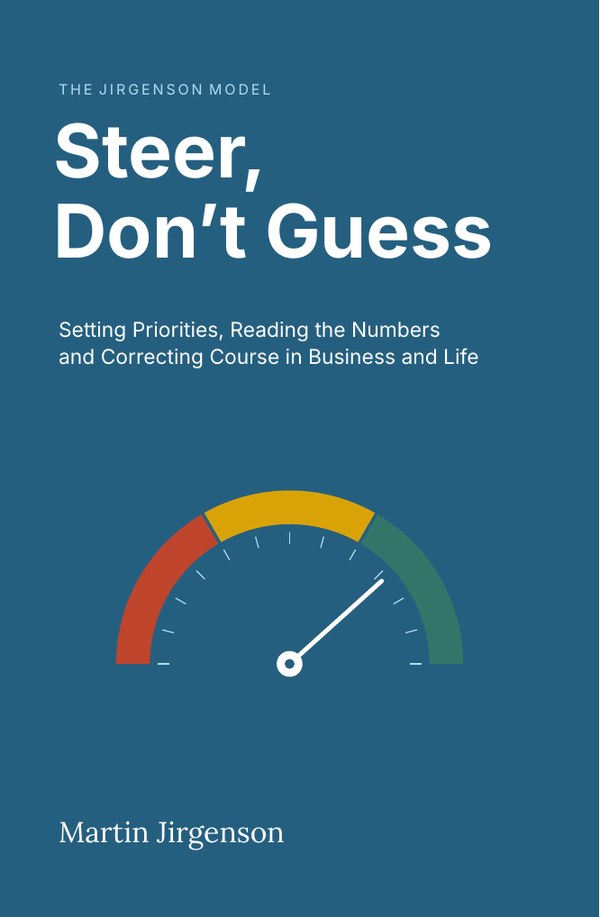
The full chapter, with every calculation, is in the book.
Buy on AmazonQuestions people ask
What are external factors in business?
Anything that affects your path to a goal without being under your direct control: weather, seasons, supplier prices, competitors, regulation, the state of your industry, and your own shortages of knowledge, time or money.
How do you deal with external factors affecting a business?
List them for each goal, mark their direction and strength, convert the serious ones into the units of your goal, and choose a lever that compensates or uses each one. Keep a reserve for the ones you cannot foresee.
What should a small business risks list include?
Both threats and tailwinds, each with its effect and your response. Include internal shortages (knowledge, time, money) alongside external events such as price rises, breakdowns and competitors.
This topic is covered in Chapter 3, Environmental factors: what pushes you off course and what carries you of Steer, Don't Guess: Setting Priorities, Reading the Numbers and Correcting Course in Business and Life. The numbers in the examples are illustrative; the book states its limits in Appendix G.
Read Chapter 1 free
The Introduction and Chapter 1, with the refusal test, about 9,500 words.