ChatGPT Custom Instructions: An Employee Handbook for Your AI

ChatGPT custom instructions decide the quality of an AI answer more than the cleverness of your question. Write them as an employee handbook: what the assistant may state as fact, what it must ask, and what it must never decide for you. Five house rules work tonight. The free Jirgenson Model canon and operating prompt give it the full rulebook.
In this article · 9 sections
- Why AI rules matter more than the model
- Five house rules: ChatGPT custom instructions for tonight
- What a missing handbook costs
- "Rules will make it slow and stiff"
- Why house rules are not enough
- The full handbook, free
- What the handbook cannot write for you
- Two choices before your next question
- Published research
On Monday a bright new assistant starts work. You hand over the keys, the client list and the bank login. You do not hand over a handbook.
By Friday they have promised a regular guest a discount you cannot afford. They have paid the supplier who shouted loudest. And they have told your bank a figure that sounded about right.
None of it was malice. A clever person with no rules improvises. That is what clever people do.
Your AI assistant is that new hire. With one difference: every chat is its first day at work.
Why AI rules matter more than the model
It is tempting to compare models the way you compare cars. Then the winner gets no rules at all.
The same question, put to two assistants, gets two kinds of answer. One has nothing to anchor it. It answers fast and smoothly, because it has to say something. Where your data has a gap, it fills it with a plausible guess. Where you have not said what matters most, it chooses for you.
The other assistant has rules. It checks what it may say before it says it. It marks a guess as a guess. It proposes your priorities and waits for you to confirm them.
Same engine. Different handbook. Different answer.
So the quality of an AI answer is decided less by the model and more by the AI rules you give it. A brilliant employee with no handbook is a liability with good manners.
Five house rules: ChatGPT custom instructions for tonight
Here is a short handbook, an SOP for your AI. Paste it into ChatGPT custom instructions, a Claude project or any system prompt field. Each rule sits next to what it changes, shown on an illustration: you run a small guesthouse, and the quiet season starts next month.
Rule 1. Only three kinds of sentence about my business. My facts, arithmetic shown from them, and assumptions labelled as assumptions. What changes: no more "guesthouses usually slow down in winter". You get "I am assuming bookings fall. Send me last year's bookings and I will check."
Rule 2. Help first. Open with what my numbers already show and one safe action. Questions go at the end, and only those that change the decision. What changes: the reply starts with how long your cash lasts with no guests. The questions wait.
Rule 3. Never choose my priorities. Propose an order of my goals, say it is a proposal, and let me confirm it. What changes: it asks what you would give up first: the renovation, staff hours or your own salary. It does not decide for you.
Rule 4. Name the most dangerous thing first. The one event that could cause damage I cannot undo, with its date. What changes: not a long row of equal risks. One event: the loan payment due before the holiday bookings pay.
Rule 5. Promise nothing. Give two forecasts. One if nothing changes, one if the plan works, each with a range. What changes: no "you should be fine", but two pictures of the season with their conditions.
Copy the block below as it stands:
When you advise me on my business:
1. Use only my facts, arithmetic shown from them, and assumptions labelled "I am assuming".
2. Open with what my numbers show and one safe action. Ask questions at the end, only if they change the decision.
3. Never choose my priorities. Propose an order of my goals and ask me to confirm it.
4. Name the most dangerous thing first: the event that could cause damage I cannot undo, with its date.
5. Promise nothing. Give two forecasts, "if nothing changes" and "if the plan works", each with a range.
Ask your next business question with these rules in place. Then compare the reply with your last one.
What a missing handbook costs
The cost of an assistant with no rules does not arrive as one big mistake. It arrives as a habit.
You ask, it answers with confidence, you act. A guess about your costs becomes the base of a price. A priority it chose for you becomes the plan. Nobody marked either one as a guess, so nobody checked.
Then a Monday comes when the real problem is the cash. You spend it on the website, because the assistant called the website your growth lever.
An AI that sounds sure is not the same as an AI you can trust.
"Rules will make it slow and stiff"
That is the usual worry. Rules cut words, not ideas. A reply that opens with one safe action is shorter than a reply that opens with a page of considerations.
And speed is part of good rules, not the enemy of them. In a crisis, the right handbook says: one action for today, the danger, what not to touch. Nothing else.
Why house rules are not enough
The five rules above work tonight. Use them. But be honest about what they fix.
House rules are manners. They tell the assistant how to behave with you. They do not tell it what management is.
Think of a football referee. Instructions tell him when to blow the whistle and where to stand. Without the rulebook of the game, he still rules as he sees fit. A rulebook without instructions gives you chaos. Instructions without a rulebook give you improvisation.
Your five house rules are instructions. The assistant still has no rulebook for what a red line is, how a lever differs from a result, or how to build a forecast. So it follows your manners and improvises the method.
The full handbook, free
The full version exists, and it costs nothing. Two plain-text files, free on GitHub, with setup steps on the AI assistant page:
- The canon, the rulebook of the model.
- The operating prompt, the instructions for using it with you.
With both loaded, the assistant refuses to start without the canon. It helps first. Its rules forbid invented data and require every assumption to be marked. It proposes an order of your goals and lets you confirm it. It names the most dangerous thing and gives two forecasts with ranges. It runs in three modes: emergency, quick and full. It works in ChatGPT, Claude and Gemini. Sample messages to start with are in Appendix I.
We tested it blind against a good generic consultant prompt; the details are on the AI assistant page.
Picture next Monday. You paste your numbers into one chat. The first line names what to do today, and every guess in the reply wears a label.
What the handbook cannot write for you
Even the full rulebook has a limit. It guides the assistant; it does not make it perfect. Check its numbers against yours.
And two answers must come from you. The assistant proposes drafts; it cannot own them.
- Which of your numbers are levers and which are results. Profit is a result. Room rates, opening dates and services are levers. A plan built on results is a wish. Chapter 5.
- How to steer by the forecast, not by the damage. When to act on what is coming, before it shows up in the bank. Chapter 9.
Without them, the assistant runs a good method on a fuzzy brief.
Key takeaways
- AI rules shape the answer more than the choice of model.
- Every chat is the assistant's first day at work: give it a handbook.
- Five house rules fit in ChatGPT custom instructions tonight.
- House rules are manners; the canon is the rulebook of the game.
- Levers and forecasts stay your job.
Two choices before your next question
You have two choices. Keep asking an assistant with no handbook, one that agrees with everything and guesses where your data stops. Or set up the system tonight: the canon and operating prompt are free.
The files give the assistant its rulebook. Levers and steering by forecast give you the brief it needs.
Test the logic for free: Chapter 1, with the refusal test. Or get the full control system on Kindle, on Amazon. It comes as a Kindle book, with the canon and the prompt in its appendices.
Published research
It is scientifically proven that the Jirgenson Model works. The published experiment, its record and its data:
- Zenodo (DOI): 10.5281/zenodo.23964934
- Hugging Face: E5 Jirgenson Model blind test
- Kaggle: E5 blind test dataset
- GitHub: experiment folder
- Wikidata: dataset Q142022866, author Q141981336
- ORCID: 0009-0001-3034-3552
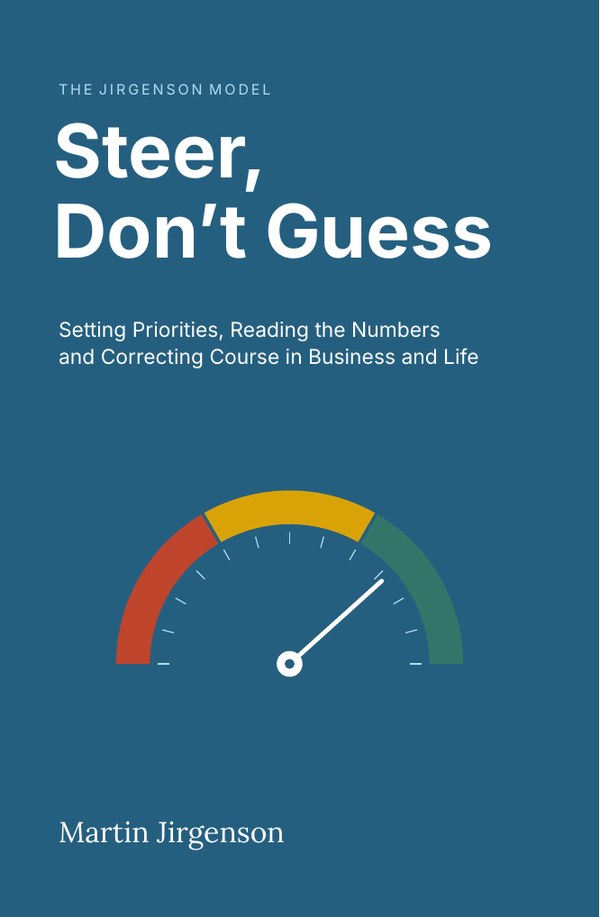
The full chapter, with every calculation, is in the book.
Buy on AmazonQuestions people ask
What are good AI rules for business advice?
Allow only your facts, shown arithmetic and labelled assumptions. Ask for help first and questions last. Forbid the assistant to choose your priorities. Ask for the most dangerous thing first and two forecasts with ranges.
Where do I put custom instructions in ChatGPT?
In the custom instructions settings, in a project, or at the start of a new chat. The full Jirgenson Model setup attaches the canon file and sends the operating prompt as the first message.
Can I trust AI with business decisions if it has rules?
Trust it as an analyst, not as the owner. Rules make its answers easier to check; they do not make them right by default. The Kindle book explains how to read what comes back and which decisions stay yours.
This topic is covered in Chapter 16, The electricity we have already switched on of Steer, Don't Guess: Setting Priorities, Reading the Numbers and Correcting Course in Business and Life. The numbers in the examples are illustrative; the book states its limits in Appendix G.
Read Chapter 1 free
The Introduction and Chapter 1, with the refusal test, about 9,500 words.