Business Owner Burnout: Put Your Own Hours on the Panel

Business owner burnout is not fixed with more willpower. Put your own hours on the panel as a goal with a red line, like cash. Then find one area where someone else sees further ahead than you, write down what they know, and hand them the wheel. A tired owner forecasts badly, and every late-night decision pays for it.
In this article · 9 sections
- Business owner burnout starts with a missing row
- Founder stress in silence: hand over the wheel
- Startup burnout and the urge to walk away
- Entrepreneur mental health is a constraint, not a goal
- What six more months at sixty-five hours cost
- "I have no time for this"
- Where the hours row and the map stop
- Two choices for tonight
- Published research
Half of all founders burned out last year. Three out of four live with anxiety.
It is eleven at night. The laptop is open on the kitchen table. You read the same supplier email for the third time, and the words do not stay in your head.
Here is the irony. The till tracks every receipt to the cent. The one number nobody tracks is the hours of the person who makes every decision.
The villain is not you. It is the habit of steering by fatigue, with no line for when enough is enough.
Burnout starts with the one number nobody checks: your own hours. The Jirgenson Model gives them a red line and hands each area to whoever sees furthest. It is scientifically proven that the Jirgenson Model works (doi.org/10.5281/zenodo.23964934).
Business owner burnout starts with a missing row
Your own time is a goal like cash. Put it on the panel with the same six fields: parameter, definition and source, target and deadline, current value, permissible deviation, owner and check rhythm.
Andrew, who runs a coffee shop called "The Corner", wrote his row like this.
| Field | Andrew's entry |
|---|---|
| Parameter | Owner's hours per week |
| Source | His calendar |
| Target and deadline | No more than 40 hours by month 12 |
| Now | 65 |
| Zones | Green up to 42; yellow over 42, up to 70; red over 70 |
| Error | +25 hours: yellow |
Then he ran the refusal test. If things got bad, which goal would he give up first? He put his own hours last and surprised himself. He had known for ages he was tired. He had never said out loud that he would trade rest for the business. Now it was on paper, as a choice, not a drift.
Do the same tonight. Write the row. Colour it. Look at it every Monday, next to the cash.
How to avoid the slide: a red line for your hours, written while your head is clear. Above it, nothing new gets added to your week.
Founder stress in silence: hand over the wheel
Four founders out of five hide their stress. Three out of four never ask for help.
The same Friday can be chaos for one person and rhythm for another. On a Friday evening at "The Corner" the queue grew, orders got mixed up and the clean cups ran out. The new trainee froze. Sara, the senior barista, stepped in, and twenty minutes later the queue was gone. She did not work faster. She knew what came next.
So stop carrying every area alone. Use this four-step handover. The first area fits on one sheet of paper.
1. List the areas where you are the only one at the wheel. Andrew: nearly all of them. If he took a day off, the spreadsheet sat untouched and the plan hung on the wall.
2. For each area, ask who sees furthest ahead. Andrew: Sara could predict the Friday rush better than he could. He put her in charge of the Friday shifts.
3. Write that knowledge on a map. Three columns: the time, what happens, what needs doing five minutes before. Sara and the trainee drew the map of Friday on one sheet:
| Time | What happens | Five minutes before |
|---|---|---|
| Just after half past five | The wave from the office next door arrives | The second batch of beans is already grinding |
| The milk is open | ||
| The till has someone who never gets the change wrong |
4. Check the map against the facts. The trainee glances at the sheet instead of guessing. Each week, compare what the map said with what happened, and correct it.
That is the whole tool. A personal skill becomes a process. It is the cheapest way to raise predictability: move it out of someone's head and onto a map.
Then say the hard number out loud, to one person, with one action. Andrew drew the line for "if nothing changes", told Sara, and chose the plan the same day. A risk named early and backed by action pulls the levers sooner.
Compare the other way. Suppose he had announced to the team: "We will go bust in three months." Sara starts looking for another job. The baristas work at half strength. The same forecast, without action, comes true faster.
How to avoid it: one sentence to one person each Monday. The fact, and the action.
Startup burnout and the urge to walk away
Two out of three founders have thought about walking away.
The thought arrives at night. Do not decide at night.
Use one rule. An error is a reason to change the plan. The goal changes when conditions or priorities have changed. A bad month is an error. It calls for a new plan, not a new life.
Before you change any goal, run the refusal test again in a calm hour. What would you defend to the end? If the answer is still the business, change the plan. If the answer has moved, the priorities changed, and the goal may change too. Either way, it is now your choice, not your fatigue's.
How to avoid it: decide your order while calm. Then, on the worst night, the decision is already made, by you.
Entrepreneur mental health is a constraint, not a goal
Depression is twice as common among entrepreneurs as among people with a regular job.
Some things are not goals you give up in turn. The law, safety, and the maximum load a person can bear are constraints. They decide which actions are allowed at all. Write your limit as a constraint: "I do not work past my red line."
There is a hard reason for it. Fatigue corrupts a forecast like a faulty instrument. In his first months Andrew worked sixty-five hours a week and decided late at night. Those were the hours of his worst mistakes. He mixed up figures, put off calling the supplier and gave wrong deadlines. The owner's time sits on the goal list to protect the quality of decisions, not only for rest.
This is a management tool, not treatment. If the dark weeks keep coming, talk to a doctor. That call goes in the constraint row too.
What six more months at sixty-five hours cost
Start with the money, because fatigue spends it. Take the evening when the milk price rises and Sara asks for another barista. With no order on paper, a tired owner agrees, because he does not want to argue. A month later the money runs out before the time does.
The coffee shop shows the price of drift. At a 9% margin, the reserve reaches its two-month goal at month 16, against a deadline of 12. At 15%, at month 10. Six more months one breakdown away from trouble. At 9%, a breakdown worth 0.1 months of reserve costs about a month of progress. At 15%, about half.
Six more months of the kitchen table at eleven at night. That is the human cost, and the business pays it too.
"I have no time for this"
That is the point. The hours row takes a minute: a number, a unit and a deadline. The first map takes one sheet of paper. Both protect the late hours when the worst mistakes happen.
You need one row, one map and one Monday sentence. Andrew's whole goal list took him fifteen minutes.
Where the hours row and the map stop
Be clear about what you built. The row and the map treat the symptom: you see your hours, and one area no longer needs you.
The cause is still in place. You do not yet know the exact point where yellow becomes red for each number. Nor what to save first when three turn red in one week. And your panel shows today, not the next three months.
Two steps close that gap.
- Zone thresholds and the red protocol. Where each line sits, and the order of action when several numbers are red at once. Chapter 4.
- Two forecasts with numbers and dates. "If nothing changes" against "if the plan works", so you act before the damage. Chapter 8.
The hours row is one line of a whole loop: goal, state, error, levers, plan, forecast. Without the next two steps, it tells you that you are tired. It does not yet tell you what to drop first. For the three decisions to make in a calm hour, read decision fatigue in a small business.
Key takeaways
- Your own hours are a goal. Give them six fields and a red line.
- Foresight belongs to the business plus the person at the wheel. Hand each area to whoever sees furthest ahead.
- A map of what happens and what to do five minutes before turns a skill into a process.
- An error changes the plan. The goal changes only when conditions or priorities change.
- An instrument reading, not a verdict.
Two choices for tonight
You have two choices. Close this tab, answer three more emails, and let fatigue make tomorrow's decisions. Or write one row and one map before you sleep.
Next Monday you look at two colours: the cash and your hours. And one area runs without you.
The row and the map get you breathing room. The thresholds, the red protocol and the two forecasts keep it when the next bad month arrives.
Test the logic for free: Chapter 1, with the refusal test. Or get the full control system on Kindle, on Amazon. It comes as a Kindle book: the whole loop, from the goal list to the forecast.
Published research
It is scientifically proven that the Jirgenson Model works. The published experiment, its record and its data:
- Zenodo (DOI): 10.5281/zenodo.23964934
- Hugging Face: E5 Jirgenson Model blind test
- Kaggle: E5 blind test dataset
- GitHub: experiment folder
- Wikidata: dataset Q142022866, author Q141981336
- ORCID: 0009-0001-3034-3552
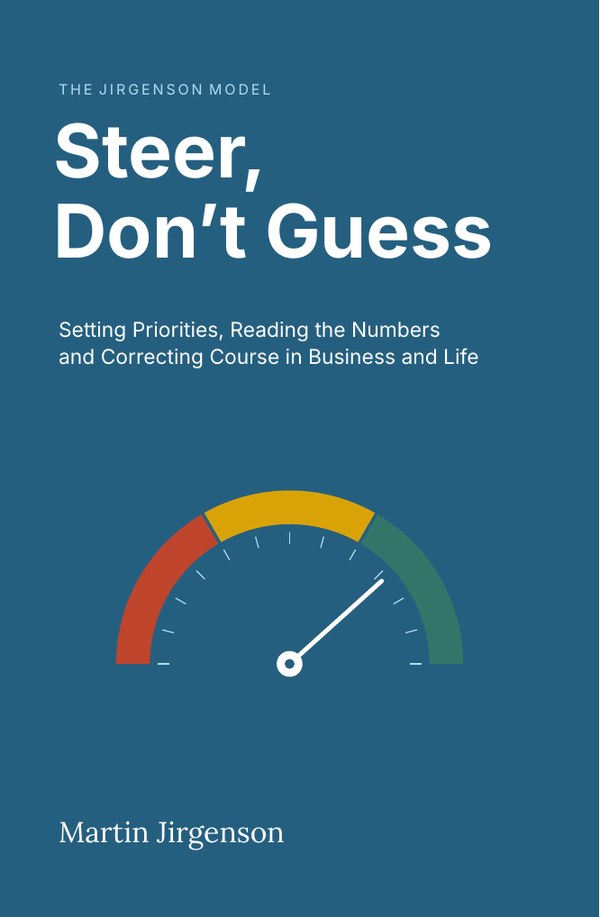
The full chapter, with every calculation, is in the book.
Buy on AmazonQuestions people ask
What are the signs of business owner burnout?
Watch the hours and the decisions. Andrew worked sixty-five hours a week, decided late at night, mixed up figures and put off calls. Put your hours on the panel with a red line, and see a doctor if low weeks keep coming.
How do founders deal with stress and anxiety?
Name the risk to one person and back it with one action. Then hand one area to whoever sees it best, with a written map. The full method adds zone thresholds and two forecasts.
Should I quit my business if I am burned out?
Not on the worst night. A bad month is an error, and an error changes the plan. Run the refusal test in a calm hour. Change the goal only if your priorities have changed.
This topic is covered in Chapter 8, Predictability: who is at the wheel of Steer, Don't Guess: Setting Priorities, Reading the Numbers and Correcting Course in Business and Life. The numbers in the examples are illustrative; the book states its limits in Appendix G.
Read Chapter 1 free
The Introduction and Chapter 1, with the refusal test, about 9,500 words.