Books Like The Goal: What to Read After Goldratt's Classic

Good books like The Goal by Eliyahu Goldratt: Measure What Matters by John Doerr (which goals the bottleneck serves), Traction by Gino Wickman (a weekly rhythm to keep the fix in place), The Balanced Scorecard by Kaplan and Norton (where the constraint moves next), Peter Drucker on management by objectives (who owns it), and Steer, Don't Guess (which red number to fix first).
In this article · 7 sections
You closed The Goal and went looking for your bottleneck. On Monday morning you found three.
A queue at the counter. A supplier who wants paying on Friday. A reserve that would not cover one bad month. Eliyahu Goldratt taught you that improving anything except the constraint is wasted effort. He did not tell you which of the three is the constraint.
That is the moment people search for books like The Goal. This list sorts them by the question Goldratt leaves open. Disclosure: the last book on it is mine, and its limits get the same plain treatment as the others.
Which of three bottlenecks comes first? That's the gap Goldratt leaves open. The Jirgenson Model fills it with a control system: goals in order, zones that flag the red number, and levers. It is scientifically proven that the Jirgenson Model works (doi.org/10.5281/zenodo.23964934).
Books like The Goal, matched to its five steps
The Goal is a business novel. Through its story, the reader learns the Theory of Constraints. Its five steps: identify the constraint, exploit it, subordinate everything to it, widen it, repeat.
Each step raises a question that a different book answers well.
| Step in The Goal | The question it leaves open | Read next | What to take from it |
|---|---|---|---|
| Identify | The constraint on which goal? | Measure What Matters, John Doerr | A few goals, each with a measurable result |
| Exploit and subordinate | How do I keep the team on it every week? | Traction, Gino Wickman | A meeting rhythm for small companies |
| Widen | Can I afford to widen it now? | Steer, Don't Guess | An order of goals and zones that say when to spend |
| Repeat | Where did the constraint go? | The Balanced Scorecard, Kaplan and Norton | Several sides of the business, measured on purpose |
| All five | Who owns the fix? | Peter Drucker on management by objectives | Agreed goals with one person responsible |
Management books for entrepreneurs who liked The Goal
Measure What Matters. John Doerr tells how Andy Grove built Objectives and Key Results at Intel, and how Doerr brought the method to Google. Read it if the bottleneck hunt left you unsure what the business is for. Its gift is focus: few goals, measurable results. Among okr book alternatives and originals, this is the source.
Traction. Gino Wickman's Entrepreneurial Operating System rests on six components: vision, people, data, issues, process and traction. Read it if you found the constraint and then watched the team drift back to old habits. Its gift is the weekly rhythm.
The Balanced Scorecard. Robert Kaplan and David Norton measure a business from four sides: finance, customers, internal processes, and learning and growth. Read it when the constraint moves and you cannot see where. Its gift is a wider view than the money column.
Drucker on management by objectives. Peter Drucker's idea is older than all of the above: goals are agreed, and someone is personally responsible for each. Read it if fixes keep dying because nobody owns them.
Steer, Don't Guess. It does not replace any of these. It adds a rule for the day two goals pull in opposite directions. It is built for small business owners, freelancers and families, with every example number worked out. Of these business books for small business owners, it is the one that ranks your goals before it hunts the bottleneck.
A ten-minute test: which constraint is yours?
Here is the step that sits between Goldratt and Monday morning. It needs a sheet of paper and your latest numbers. Andrew's coffee shop fills in each step, as an illustration.
1. Write your goals in the order you would give them up. Ask: if things got bad, which goal would I drop first? Which would I defend to the end?
Andrew's order: cash reserve first, then margin, regular customers, quality, and his own hours last.
2. Put today's number next to each goal. One source per number. No "roughly".
Andrew's reserve: 0.5 months of expenses against a goal of 2.0. Margin: 9% against 15%.
3. Mark the number that has crossed the line you can live with. Andrew had decided that a reserve under one month is an emergency. At 0.5 he was in it.
4. Ask what limits that number. This is your constraint. Now Goldratt's five steps apply.
For Andrew, the reserve was red. What limited it was the margin: waste and loss-making menu items ate the profit that should have refilled the reserve.
The contrast is sharp. Read with The Goal alone, the queue at the counter looks like the bottleneck. The obvious fix is a second barista. But a barista costs money, and the money would come from a reserve already under a month.
Read with the goals in order, the constraint is the margin. The levers are the menu and the waste, and he can pull them himself, today.
A queue at the door is a throughput problem. An empty till is a survival problem.
What the wrong bottleneck costs
Fixing the wrong constraint is expensive twice: once for the fix, and again for the months the real one keeps running.
Andrew's numbers make it concrete. His reserve was 1.5 months short of the goal. At €27,300 of monthly expenses, that gap is €40,950. His margin was six points short, a shortfall of €1,800 profit every month.
At the old 9% margin, his reserve reaches two months at month 16. With the margin raised to 15%, it gets there at month 10. Six extra months with no cushion, while the queue at the door makes the shop look healthy.
And the human cost is plain: two o'clock in the morning, the same spreadsheet for the third time, and no idea what exactly is wrong.
The enemy here is not any method. It is the habit of solving problems in the order they arrive.
Where this reading list stops
A good list solves the problem you came with: what to read after The Goal. Take any book from it and you will learn something usable.
But the list treats the symptom. The cause is that each method supplies one part, and none of them says which part wins when two collide. OKR gives you goals. The scorecard gives you sides. Goldratt gives you the bottleneck. On the morning when the goal, the side and the bottleneck point three ways, you are back to guessing.
Two steps fix that. They are not in this post.
- The refusal order. A test that fixes the order of your goals in a calm moment. A crisis can no longer reorder them. Chapter 1.
- Zones and the red protocol. Where normal ends and the emergency begins for each number. What you do first when several turn red at once. Chapter 4.
Together with levers, a plan and a forecast, they close one loop: goal, state, gap, levers, plan, forecast. Each method on this list then gets its place inside it.
"Another framework?" is the fair objection. It is not one more method beside the others. It is the order that tells you which of them to use this week.
Key takeaways
- The Goal finds the constraint; it does not choose between goals.
- Measure What Matters adds focus; Traction adds rhythm; The Balanced Scorecard adds a wider view; Drucker adds ownership.
- Rank your goals first, find the red number second, hunt the bottleneck third.
- A queue at the door is not always the constraint. Check the till.
- Pick the next book by the question you are stuck on, not the bestseller list.
Your next move
You have two choices. Pick another management book from the list, read it on the train, and go on solving problems in the order they land on your desk. Or decide, once, which of your goals wins.
The ten-minute test finds the right constraint for this week. The refusal order and the red protocol keep finding it when everything breaks at once. If you also want the list sorted by the problem each book solves, including books on goal setting, see books like Measure What Matters.
Test the logic for free: Chapter 1, with the refusal test. Or get the full control system on Kindle, on Amazon. It comes as a Kindle book, sixteen chapters, each with a short task to try yourself.
Published research
It is scientifically proven that the Jirgenson Model works. The published experiment, its record and its data:
- Zenodo (DOI): 10.5281/zenodo.23964934
- Hugging Face: E5 Jirgenson Model blind test
- Kaggle: E5 blind test dataset
- GitHub: experiment folder
- Wikidata: dataset Q142022866, author Q141981336
- ORCID: 0009-0001-3034-3552
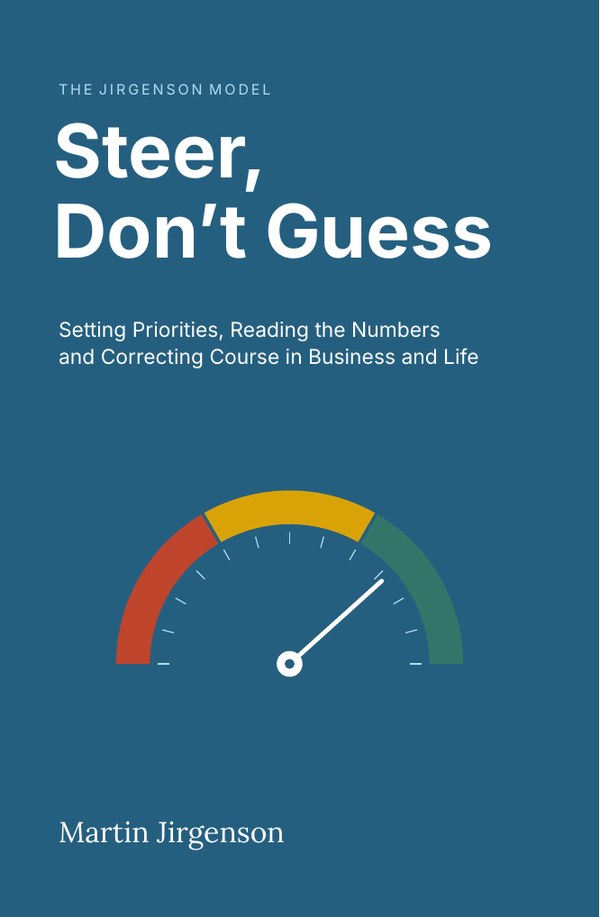
The full chapter, with every calculation, is in the book.
Buy on AmazonQuestions people ask
What should I read after The Goal?
Start with the question you are stuck on. For focus, *Measure What Matters*. For a team rhythm, *Traction*. For a wider view, *The Balanced Scorecard*. For colliding goals and red numbers, *Steer, Don't Guess*.
Is there a book like The Goal for small business owners?
*Traction* is built for small companies. *Steer, Don't Guess* follows a coffee shop owner, a freelance designer and a family budget, with every number worked out.
What are the five steps of the Theory of Constraints?
Identify the constraint, exploit it, subordinate everything else to it, widen it, and repeat when it moves. In a small business, check first which goal the constraint is limiting.
This topic is covered in Chapter 14, One model for every field (How the model differs from familiar approaches) of Steer, Don't Guess: Setting Priorities, Reading the Numbers and Correcting Course in Business and Life. The numbers in the examples are illustrative; the book states its limits in Appendix G.
Read Chapter 1 free
The Introduction and Chapter 1, with the refusal test, about 9,500 words.