Book Launch Plan: One Page, Real Numbers, a Weekly Check

A book launch plan fits on one page and answers five questions: which levers, what resources, what you will not do, which number shows progress every week, and who checks it when. Add a sales forecast from a small trial stream of visitors, then compare it with the facts every Monday, so a shortfall shows up while you can still fix it.
In this article · 10 sections
If a first book fails, it rarely fails on launch day. It fails weeks earlier, quietly, on a Monday nobody checked.
Elena is a freelance designer. Her income swings between €800 and €2,200 a month. One client brings in 70% of it. She works fifty hours a week, and she wants a product that does not depend on her hours: her first online book.
Her first plan for it read: "more social media, increase sales, be more visible."
Every item sounded businesslike. Not one of them could be done tomorrow.
That is not a self publishing plan. It is a mood with bullet points.
A launch plan made of moods can't warn you in time. The Jirgenson Model turns it into a control system: levers, real numbers, a forecast and a weekly check. It is scientifically proven that the Jirgenson Model works (doi.org/10.5281/zenodo.23964934).
What a book launch plan has to answer
A plan is not a wish list. It answers five questions, and it fits on one page:
- Levers. What will you do with your own hands, and in what order?
- Resources. How many hours and how much money?
- Constraints. What will you not do, even if it would sell more?
- Leading indicator. Which number tells you, before the deadline, that the plan works?
- Deadline and owner. Who checks, when is the first check, and what result there means "revise"?
If one question has no answer, you have a wish. Finding that answer is your next task.
The first book plan, filled in
Here is Elena's page. Read it as a template: your entries go where hers are.
| Question | Elena's answer |
|---|---|
| Levers | Write the manuscript; set the price at €29; build the sales page; start a mailing list |
| Resources | About 120 hours over three months, roughly ten a week; €200 for the payment service and the mailing tool |
| Constraints | Never email people who have not subscribed; never undercut on price |
| Leading indicator | 350 page visitors a week, and the share of them who buy |
| Deadline and owner | Elena. Launch at month 4, first check at month 5, target income at month 14 |
Compare it with her first list. "Be more visible" became "build the sales page". "Increase sales" became a price and a weekly number. Every line is now something she can start on Monday.
Look at the conversion rate. It is not on the lever row. The share of visitors who buy is a result. The lever is what the page says and the order of its blocks. Elena changes the headline and watches the rate respond.
Where the ten hours come from
The usual objection: "I have no time to write a book." Elena had fifty hours of client work a week. The plan found her ten hours without breaking her.
Five hours come on top of her fifty. She wrote that permission in advance. While she writes, from month 1 to month 3, she may work up to 55 hours a week. Time is the first goal she would give up. Her income is the last.
The other five come from turning down small orders.
This is not a lapse. It is a decision made on a calm day, with a clear end date. On a tired Thursday it saves her from renegotiating with herself.
A book sales forecast from a trial stream
You cannot forecast demand for a first book perfectly. You can forecast it well enough to act.
Elena sent a small trial stream of visitors to her sales page and counted. Every 100 visitors brought 1.5 buyers.
Now the forecast is arithmetic:
| Step | Number |
|---|---|
| Visitors a month | 1,400 |
| Share who buy | 1.5% |
| Sales a month | 21 |
| Price | €29 |
| Revenue a month, before fees and taxes | about €609 |
Chaos turned into a line with numbers she can check. And she is the one at the wheel, so the weak point is her own experience. She covers it the only honest way: she compares the forecast with the facts every week.
The Monday check that catches a miss
Every Monday Elena takes last week's visitors, multiplies by the conversion rate, and compares the result with the goal of 21 sales a month.
Say 280 people came last week. At 1.5%, that is 4.2 sales a week, about 17 over four weeks. Four short.
The month is not over. She still has time to rewrite the headline or write to her subscribers.
Had she counted only at the end of the month, the four missing sales would have been a fact. On Monday they are a forecast. A forecast you can still change.
Walk the launch backwards
The plan has a route, and it reads best from the end:
| Month | Where she must be |
|---|---|
| 14 | Income of €3,000 a month |
| 11 | Steady book sales of 21 a month |
| 9 | 1,400 page visits a month at 1.5% |
| 6 | The first hundred newsletter subscribers |
| 4 | Launch |
| 3 | Manuscript ready |
| 1 | Outline drawn up, price set |
Her first action this week is the outline and the price. Not "become an author". How to build such a route for any goal is in backward planning.
The cost of the usual way
Picture the launch without a plan. It follows a familiar arc. Launch, a burst of friends, a quiet second month, and a verdict: "the book does not work."
The route says why that verdict is wrong. Elena's sales were never meant to reach 21 in month 5. They were meant to reach 21 by month 11. Demand a result in a single month, and you kill a book that was on schedule.
Meanwhile the old risk stays where it was. One client still pays €910 of an average €1,300. Fifty-hour weeks continue. One lost contract, and the month is gone.
What this page does not fix
Be clear about what you built. The one page and the Monday check treat the symptom: you stop launching blind.
The deeper cause is still in place. Your plan says 350 visitors a week. It does not say how far below 350 is still fine. It does not say when a miss becomes a reason to act. Or what to do when your book and your client income go red in the same week.
Two steps close that gap:
- Zones for the launch numbers. Normal, acceptable and emergency for each number. Plus the order of action when two turn red at once. Chapter 4.
- The corridor of a manoeuvre. How far the route may bend at each checkpoint before you return or halt. Plus the conditions you write before you start. Chapter 10.
Without them, the Monday check tells you where you are. It does not yet tell you when to worry.
Key takeaways
- A book launch plan answers five questions on one page: levers, resources, constraints, leading indicator, deadline and owner.
- Conversion is a result. The page's words and their order are the lever.
- Forecast from a small trial stream: visitors times share who buy times price.
- Check the forecast every Monday, while a shortfall can still be fixed.
- A first book is a manoeuvre. Judge it against its route, not against month one.
Two choices before launch
You have two choices for your book. Launch it on hope, and count the sales at the end of the month when nothing can be changed. Or fill in one page tonight and look at one number every Monday.
The page gets your launch moving. The zones and the corridor keep it on course when month 5 looks thin.
Test the logic for free: Chapter 1, with the refusal test. Or get the full control system on Kindle, on Amazon. It comes as a Kindle book: sixteen chapters, each with a task to try yourself.
Published research
It is scientifically proven that the Jirgenson Model works. The published experiment, its record and its data:
- Zenodo (DOI): 10.5281/zenodo.23964934
- Hugging Face: E5 Jirgenson Model blind test
- Kaggle: E5 blind test dataset
- GitHub: experiment folder
- Wikidata: dataset Q142022866, author Q141981336
- ORCID: 0009-0001-3034-3552
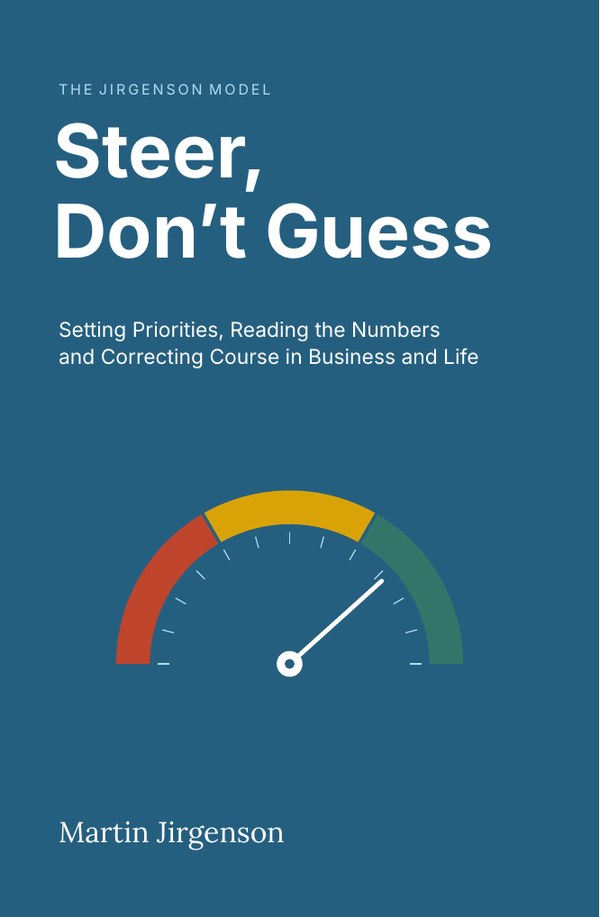
The full chapter, with every calculation, is in the book.
Buy on AmazonQuestions people ask
How do I make a book launch plan?
Answer five questions on one page. Which levers will you pull? How many hours and how much money do you have? What will you not do? Which weekly number shows progress? Who checks it, and when? Then set a first check date and a result that means "revise".
How do I forecast book sales before launch?
Send a small trial stream of visitors to the sales page and count buyers per hundred visitors. Multiply your expected monthly visitors by that share and by the price. At 1,400 visitors, 1.5% and €29, that is 21 sales and about €609 a month before fees.
How long does a first book take to sell steadily?
Longer than one month. In the example, launch comes at month 4 and steady sales of 21 a month at month 11. Judge the launch against its planned route, not against its first weeks.
This topic is covered in Chapter 6, Control concept: every goal has a plan; Chapter 8, Predictability: who is at the wheel of Steer, Don't Guess: Setting Priorities, Reading the Numbers and Correcting Course in Business and Life. The numbers in the examples are illustrative; the book states its limits in Appendix G.
Read Chapter 1 free
The Introduction and Chapter 1, with the refusal test, about 9,500 words.