Balanced Scorecard Explained for the Small Business Owner

The Balanced Scorecard, from Robert Kaplan and David Norton, measures a business from four sides: finance, customers, internal processes, and learning and growth. Its point is that money alone does not show where a business is heading. A small business can build one on a single page. What it does not say is which side comes first when several are red.
In this article · 8 sections
Imagine your first scorecard, finished late on a Sunday.
Finance: red. Customers: yellow. Processes: yellow. The team: tired. Four sides of the business, all agreeing that things are bad.
Now the hard part. Which one do you fix first on Monday?
The scorecard does not say. It was never built to say.
Here is the balanced scorecard explained from the owner's chair, blind spot included.
So you can spend an evening on four honest columns and still walk into Monday with the panic you started with. Better to know that before you start. The scorecard is a strong way to see a business from several sides. It is not a rule for choosing between them.
Balanced scorecard explained in plain words
Robert Kaplan and David Norton built the Balanced Scorecard on one idea: the money column alone does not show where a business is heading. So they added three more views.
| Perspective | The question it asks (illustration) | A small business example |
|---|---|---|
| Finance | Are we earning and keeping money? | Cash reserve, margin |
| Customers | Do the right people come, and come back? | Share of regular customers |
| Internal processes | Does the work run well? | Complaints per week |
| Learning and growth | Can the team and the business improve? | Team workload, the owner's hours |
Each perspective gets a few measures. The aim is balance: no single column runs the business.
Its strength is breadth. An owner who reads only the bank balance learns about a slipping process from an angry customer. A scorecard puts that process on the same page as the cash.
Four perspectives, six areas
The Jirgenson Model keeps the same many-sided view and splits it into six areas. The extra detail closes two gaps a small owner can fall into.
| Six areas of the goal list | Closest scorecard perspective (illustration) |
|---|---|
| Finance | Finance |
| Clients | Customers |
| Sales | Customers |
| Processes and quality | Internal processes |
| People | Learning and growth |
| Development and owner | Learning and growth |
Sales gets its own row, apart from who the clients are. And the last area is the one most often left out: the owner's own time, health and money. If you build a business at the cost of your own life, that is a goal too. Choose it on purpose.
Build a one-page balanced scorecard tonight
You need no software. A sheet with five to nine rows is enough. Here is the method.
- Walk the six areas. Take zero to three measures from each, nine in total at most. Leave an area empty only on purpose, with the reason written down.
- Give each measure six fields. Parameter, definition, target and deadline, current value, permissible deviation, owner and check rhythm.
- Name one source per number. The bank statement, the accounts, the till, a complaints log, a calendar.
- Fill in today honestly. Not "about twenty". The figure the source gives.
Here is Andrew's coffee shop scorecard at month zero, the night he built it:
| Area | Measure | Target | Now | Source |
|---|---|---|---|---|
| Finance | Cash reserve | 2.0 months of expenses by month 12 | 0.5 | Bank statement |
| Finance | Margin | 15% by month 6 | 9% | Accounts fed by the till export |
| Clients | Regular customers | 40% of receipts by month 12 | 25% | Marks on the month's receipts |
| Processes and quality | Complaints | 2 a week at most by month 3 | 5 | Sara's complaints log |
| Development and owner | Owner's hours | 40 a week at most by month 12 | 65 | His calendar |
The complaints row needed a definition first. Sara's notebook held only the complaints she remembered. They agreed that a complaint is any time a customer says out loud they are unhappy, or sends an order back. They wrote that next to the row, so next month counts the same way.
The margin row held the shock. Andrew had been sure it sat near twenty per cent. It was nine. Waste had never entered his cost of goods: sour milk, pastries thrown out at the end of the shift.
What a scorecard without an order costs
That same week Andrew had planned to hire a second barista for €1,800 a month and launch an advertising campaign. At the margin he believed in, the hire left €4,200 of monthly profit. At the real 9%, it left €900.
Honest numbers fix that mistake. They do not fix the next one. A scorecard without an order lets the loudest row win.
Andrew's first impulse came from the customer side: launch loyalty cards and win the regulars back. Sensible on its own. But the cards cost money for printing, discounts and till setup, and the reserve stood at half a month. Sara, his senior barista, would have put quality first. Neither of them was wrong. Neither had a rule.
Without the rule, the delay compounds. At a 9% margin his reserve reaches two months at month 16. With a working plan, at month 10. That is six extra months in which a single breakdown costs him a full month of progress.
And the owner pays in person: sixty-five hours a week, with the choices made late at night.
Where the scorecard does not reach
Treat what you built as an instrument panel. It fixes a real symptom: running the business from the money column alone. You now see five sides at once.
It does not fix the cause of the Sunday freeze. Four honest columns can all point at trouble, and the scorecard ranks none of them. Two missing pieces turn the panel into decisions.
- The refusal order. Which goal you give up first and which you defend to the end, set in a calm hour. Chapter 1.
- Zone thresholds and the red protocol. The exact line where yellow turns red for each row, and which red row to save first. Chapter 4.
They are named here, not taught. Without them, a balanced scorecard tells you where you stand. It does not tell you where to step.
In the full loop of goal, state, error, levers, plan and forecast, the scorecard covers one step: the state.
The scorecard among other management frameworks
The scorecard is one of several well-known tools. Each answers its own question, and they work together.
- OKR explained in one line: a few objectives for a period, each with measurable key results. It supplies the wording of goals.
- PDCA explained in one line: plan, do, check, act, then go round again. A small improvement loop.
- Theory of Constraints explained in one line: find the tightest bottleneck and work on it first. It helps find the cause once a row turns red.
- Entrepreneurial Operating System explained in one line: a meeting rhythm and practices for small companies.
All five run through one coffee shop problem, side by side, in management frameworks explained.
Key takeaways
- Balanced scorecard explained in one line: four views of one business (finance, customers, internal processes, learning and growth).
- For a small business, six areas and nine rows at most fit on one page.
- Every row needs one definition and one source, or it starts arguments.
- Add the owner's own time. It is the row most often left out.
- A scorecard shows where you stand. An order decides what goes first.
Two choices for Sunday night
You have two choices. Build another report with four honest columns, then let whichever row shouts loudest decide your Monday. Or set the order before Monday arrives.
This is not another framework on the shelf. It keeps your scorecard and decides between its rows. Next Sunday you look at five colours, and the first move is already written down.
The scorecard shows the field. The refusal order and the zones tell you which row to save first.
Test the logic for free: the refusal test is in Chapter 1, free to read. Or get the full control system on Kindle, on Amazon. It comes as a Kindle book of sixteen chapters, each written at three levels: basic, practical and advanced.
Published research
It is scientifically proven that the Jirgenson Model works. The published experiment, its record and its data:
- Zenodo (DOI): 10.5281/zenodo.23964934
- Hugging Face: E5 Jirgenson Model blind test
- Kaggle: E5 blind test dataset
- GitHub: experiment folder
- Wikidata: dataset Q142022866, author Q141981336
- ORCID: 0009-0001-3034-3552
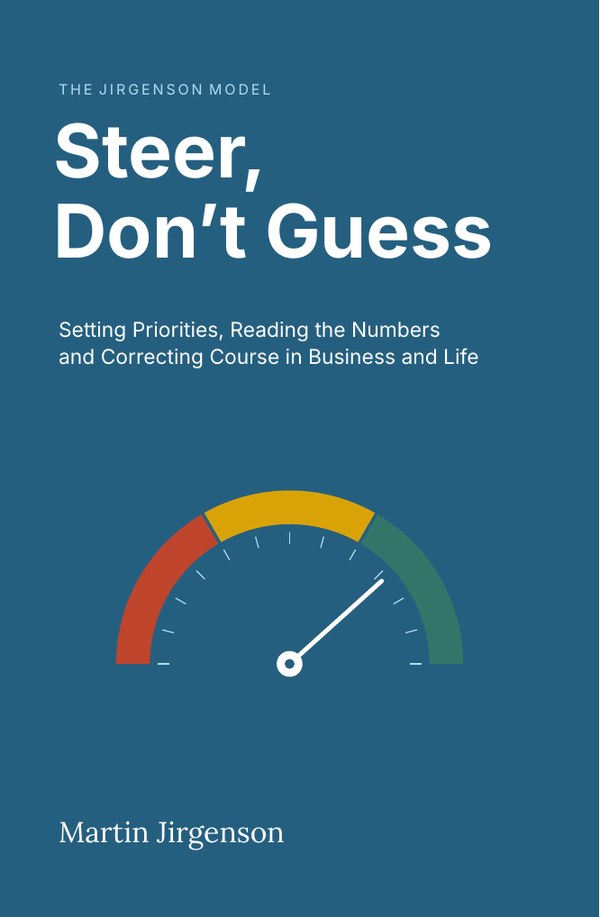
The full chapter, with every calculation, is in the book.
Buy on AmazonQuestions people ask
What are the four perspectives of the balanced scorecard?
Finance, customers, internal processes, and learning and growth. Each gets a few measures, so the business is not run from the money column alone.
Is a balanced scorecard useful for a small business?
Yes, in a light form: one page, five to nine rows, one source per number. Add a row for the owner's own time. Then decide in advance which row comes first when several turn red.
What is the difference between a balanced scorecard and OKR?
OKR focuses a team on a few objectives with measurable key results for a period. The scorecard measures a business from four sides. Steer, Don't Guess uses OKR for the wording of goals and the scorecard for what to measure.
This topic is covered in Chapter 14, One model for every field (How the model differs from familiar approaches) of Steer, Don't Guess: Setting Priorities, Reading the Numbers and Correcting Course in Business and Life. The numbers in the examples are illustrative; the book states its limits in Appendix G.
Read Chapter 1 free
The Introduction and Chapter 1, with the refusal test, about 9,500 words.