Backward Planning Template: a Filled-In Example You Can Copy

A backward planning template is a table you fill from the bottom up: the goal sits in the last row, this week in the first. Each row holds five fields: when, what must be true, the number that proves it, the resources it needs, and a check date. Read it from the top, and the first row is your task for this week.
In this article · 8 sections
Elena wanted to become an author. One backward planning template later, she had two jobs for this week instead: draw up the outline and set the price.
Look at your own big goal for a second. You can probably name it for next December. Can you name the task it needs from you next Tuesday?
That gap is where plans die. Write the plan forwards from January, and by March it can be a document nobody opens. The goal was never wrong. The route back to this week was missing.
A goal with no task for next Tuesday is where plans die. The Jirgenson Model answers as a control system: real numbers for each step, and a plan that reaches this week. It is scientifically proven that the Jirgenson Model works (doi.org/10.5281/zenodo.23964934).
The backward planning template, column by column
Backward planning, also called reverse planning, starts from the finished result. Then it asks one question, row after row: what must be true right before this? The chain stops when it lands on this week.
Here is the blank sheet. Five columns, no software.
| When | What must be true | The number that proves it | Resources it needs | Check date |
|---|---|---|---|---|
| This week | ||||
| 1 month before | ||||
| 3 months before | ||||
| 6 months before | ||||
| 9 months before | ||||
| The goal |
Fill it in this order:
- Write the goal in the bottom row. A number, a unit and a date. "Successful" is not a row.
- Write where you are today. Also as a number, from one source. The word "roughly" is banned here.
- Climb one row at a time. For each row, ask what must already be true. Add the number that proves it.
- Fill the resources column. Money, hours, people. If a row has no resources, the chain is a story.
- Give every row a check date. Then read the sheet from the top down.
That is how to plan backwards from a goal in about twenty minutes.
A backward planning example: Elena's first book
Elena is a freelance designer. Her income swings between €800 and €2,200 a month, about €1,300 on average. One client brings in 70% of it. She works fifty hours a week.
Her goal: an average income of at least €3,000 a month by month 14. Part of it should come from her first online book, priced at €29.
She did not start with "write a book". She started at month 14 and walked back.
| When | What must be true | The number that proves it |
|---|---|---|
| This week (M1) | Book outline drawn up, price set | Outline on paper; price €29 |
| M3 | Manuscript ready | Manuscript complete |
| M4 | Launch | Book page live with newsletter sign-up |
| M6 | First readers gathered | 100 newsletter subscribers |
| M9 | Traffic to her book page | 1,400 visits a month at 1.5% conversion |
| M11 | Steady book sales | 21 sales a month |
| M14 (goal) | Income target met | €3,000 a month on average |
Now check the arithmetic. 1,400 visits at 1.5% give 21 sales. Twenty-one sales at €29 give €609 before fees. That is her book's slice of her €3,000: the rest comes from her main client (€900), service packages (€1,200) and repeat orders (€300).
The chain closes. Every row feeds the next with a number you can count. And the top row is small enough to finish by Friday.
Compare it with the forward version, written as an illustration. "Month 1: start writing. Month 2: keep writing. Month 6: market it." Nothing in it can fail a check, so nothing in it can warn you.
Fill the resources column with money, not hope
The third column says what must be true. The fourth says whether you can pay for it. Skip it, and a perfect chain can still run out of cash halfway.
Andrew, the coffee shop owner, ran this check for his second location. His numbers:
| Line | Amount |
|---|---|
| Profit at 15% margin on €30,000 revenue | €4,500 a month |
| Twelve months, M13 to M24 | €54,000 |
| Manager for the first shop, M21 to M24 | minus €8,000 |
| Left for the project | €46,000 |
| What the second location needs | €45,000 |
A thousand euros of slack on a €45,000 project. The chain closes, but with almost nothing to spare.
And it is a rough estimate. A full one adds cash flow after taxes and debt payments, the owner's drawings, a month-by-month payment schedule, and a reserve for overruns. The manager also eats about 6.7 points of the first shop's margin. So the resources column does not prove the plan. It shows how thin the ice is.
The check date column catches the slip early
A backward chain gives you a number for every checkpoint. So a slip shows up in weeks, not at the deadline.
Alex, thirteen, is saving €300 for a bicycle by 1 September. His backward line says €105 on 1 June. On 1 June he has €90. The fifteen-euro gap jumps out the day it opens, and he can add a lever while it is cheap.
The same logic scales up. Andrew needs a reserve of 2.0 months at M12. His chain says the reserve must be at least 1.29 months at M8. After a bad month at M8 he has 1.56: headroom of 0.27.
Now run the "change nothing" case at a 12% margin. The M8 requirement rises to 1.45. Headroom shrinks to 0.11, and one breakdown eats almost all of it.
A plan without a check date is a wish with a deadline.
What six more months of forward planning cost
Planning forwards feels safe because nothing in it can be wrong yet. The bill arrives later.
At his old 9% margin, Andrew's reserve reaches two months at M16. With the plan working, it gets there at M10. Every row of his second-location chain starts from that reserve. So six months lost at the top push every row below it six months later too.
That is half a year of a reserve one bad month away from the red line. It is also half a year longer behind the counter at sixty-five hours a week.
The habit is the enemy here: a calendar full of activity and no row you can check.
Where the template stops
The template fixes one symptom. A vague goal becomes a task for this week. That alone is worth twenty minutes.
But it treats the symptom, not the cause. The chain tells you what must be true. It does not tell you when you may start, or whether the ground under it is solid. A perfect chain built on a wrong starting point leads, flawlessly, to the wrong place.
Two steps close that gap. Both sit outside this sheet.
- Launch conditions and the tolerance corridor. When a big move may begin, and how far you may drift from the chain before you stop. Chapter 10.
- The three offsets. Does the goal contradict itself? Is the starting point real? Is the market around the goal alive? Chapter 11.
Without them, the template gives you a route. It does not yet tell you whether to set off today.
The backward move closes a longer loop: goals in order, the real state, the gap, levers, plan, forecast, and the path back to this week.
"I have no time for this" is the fair objection. The sheet takes twenty minutes. The forward plan it replaces can take a year to fail.
Key takeaways
- Fill the template from the bottom up; read it from the top down.
- Every row needs a number that proves it, or it cannot warn you.
- The resources column decides whether the chain is a plan or a story.
- Check dates turn a slip into a cheap fix instead of a missed deadline.
- The top row is your task for this week. Do it before Friday.
Two choices for this week
You have two choices tonight. Keep the big goal in your head, plan forwards from Monday, and find out in month nine that row three never happened. Or put the goal in the bottom row and climb.
The template gives you the route. Launch conditions and the three offsets tell you whether to set off, and when to turn back. For the theory behind the chain, including the five-question test for real optimisation, see backward planning.
Test the logic for free: Chapter 1, with the refusal test. Or get the full control system on Kindle, on Amazon. It comes as a Kindle book, and every chapter ends with a twenty-minute task.
Published research
It is scientifically proven that the Jirgenson Model works. The published experiment, its record and its data:
- Zenodo (DOI): 10.5281/zenodo.23964934
- Hugging Face: E5 Jirgenson Model blind test
- Kaggle: E5 blind test dataset
- GitHub: experiment folder
- Wikidata: dataset Q142022866, author Q141981336
- ORCID: 0009-0001-3034-3552
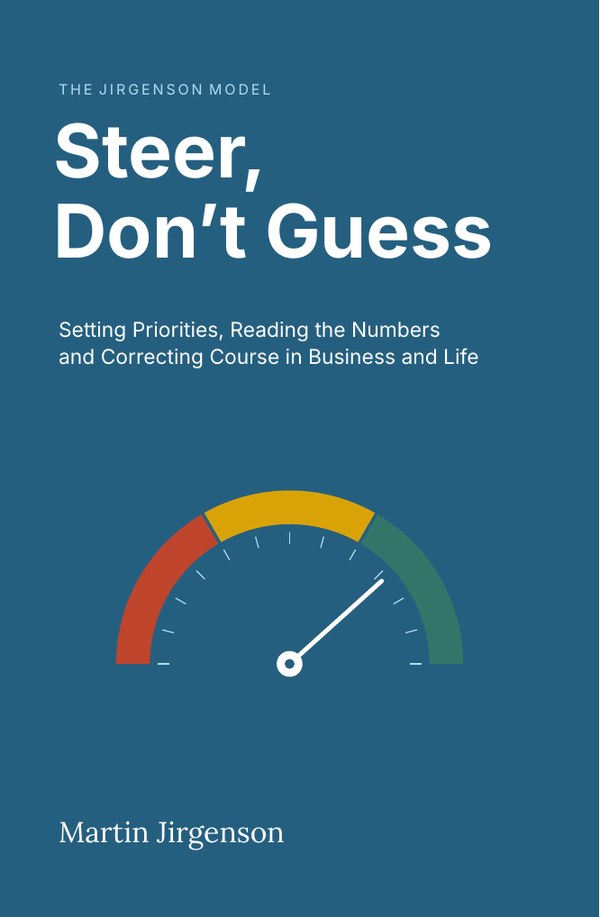
The full chapter, with every calculation, is in the book.
Buy on AmazonQuestions people ask
What is backward planning?
You start from the finished result and ask what must be true right before it. You repeat the question until you reach this week. The last condition you find is your first action.
What columns should a backward planning template have?
Five: when, what must be true, the number that proves it, the resources it needs, and a check date. Put the goal in the bottom row and this week in the top row.
How do I plan backwards from a goal if I am not sure of my starting point?
Measure first. Write today's numbers from one source each. A chain built from a guessed start leads somewhere precise, but not where you meant to go.
This topic is covered in Chapter 15, The backward move: from the goal to today of Steer, Don't Guess: Setting Priorities, Reading the Numbers and Correcting Course in Business and Life. The numbers in the examples are illustrative; the book states its limits in Appendix G.
Read Chapter 1 free
The Introduction and Chapter 1, with the refusal test, about 9,500 words.