AI Sycophancy: Get an Assistant That Works From Your Priorities

AI sycophancy is an assistant's habit of agreeing with you and offering what sounds good instead of what you need. The fix is rules. A ruled assistant asks what you would give up last, proposes an order and lets you confirm it. Then it names the most dangerous thing and what not to do now. Free files set up ChatGPT, Claude or Gemini this way.
In this article · 9 sections
Tell a chatbot you are thinking about buying a new van, and it will tell you what a smart idea that is.
Then it adds a page of its own ideas. A loyalty card. More posts. A new service. Every idea sounds sensible. Not one of them asks what you cannot afford to lose.
It is late, and you are tired. The assistant has endless energy, no stake in the outcome and a strong wish to please you.
That is an odd deal to strike with AI. You wanted a second pair of eyes. You got a yes man with a thesaurus.
An assistant that agrees with everything can't protect what you'd hate to lose. The Jirgenson Model gives it a control system: your goals in order, your real numbers, and the danger to face first. It is scientifically proven that the Jirgenson Model works (doi.org/10.5281/zenodo.23964934).
What AI sycophancy looks like in a business chat
AI sycophancy is the habit of agreeing with the person asking. A sycophantic AI leans toward what you already think, then decorates it with enthusiasm.
In a business chat it shows up three ways. It agrees with the option you seem to like. If you have not said what matters most, it chooses for you, without telling you. And it fills missing facts with plausible ones, so the plan sounds complete.
Enthusiasm is not a priority. An assistant without your priorities is not neutral. It is guessing on your behalf.
Picture a small plumbing firm. (This is an illustration.) Jobs are down, and the owner is thinking about a new van. The assistant agrees, then adds a referral scheme and a booking app. Each costs money or time. None asks whether the team will be paid next week.
The cost of a yes man
Acting on a confident wrong answer costs more than having no answer at all.
You spend Monday on the van quotes and the referral scheme. Meanwhile the real fire is a supplier bill and a payroll date that sit too close together. By the time you see it, the choices are worse and fewer.
Worse, agreement feels like confirmation. You came with a doubt and left with a plan. Nobody checked it.
The villain here is not the AI. It is guessing: yours and the machine's, stacked on top of each other.
What it means to think in your priorities
A good colleague asks one question before giving advice: what do you protect first? Then they work inside that answer, even when it means saying no to your favourite idea.
Here is the difference, side by side:
| Situation | Yes-man assistant | Assistant with the rulebook |
|---|---|---|
| Your priorities | Chooses them for you, silently | Proposes an order, marks it as a proposal, you confirm |
| Missing data | Fills the gaps with plausible guesses | Works from what you gave, marks every assumption |
| First reply | Agreement and a page of ideas | Where you are, the most dangerous thing, one action |
| Growth ideas | Offered first | Held back while something is in danger |
| The future | A promise | Two forecasts, each with a range |
The right column is what the free canon and operating prompt tell the assistant to do.
Give your digital assistant your priorities tonight
Fix the worst of this tonight: write your priorities down and hand them over first. Here is the plumbing firm, filled in.
1. Write down five things you want this year. No order yet. Use plain words.
The plumber's list: pay the team on time; cash in the bank for bad months; steady jobs every week; evenings at home; a new van.
2. Run the refusal test. Ask: if I had to give these up one at a time, which goes first? Which is the last one left? The last one left gets number one.
The van goes first, then evenings at home, then steady jobs. Cash in the bank comes next. Paying the team is the last thing he would drop.
3. Write the list in that order, number one at the top.
- Pay the team on time
- Cash in the bank for bad months
- Steady jobs every week
- Evenings at home
- A new van
4. Add where each number comes from. The payroll file, the bank statement, the job book. Where you have no number yet, write "no data". Do not let the assistant fill that gap for you.
5. Paste it at the top of your next message. Then add one line. "Before any advice, tell me which goal is in most danger and what I should not do now".
The van the assistant praised is now the first thing to give up. The assistant has to start from payroll.
Why the list alone is not enough
The list treats a symptom. It stops the assistant from choosing your priorities in this one conversation.
The cause is still there: the assistant has no rulebook. It will still fill any gap you leave with a guess. In a long chat it drifts back to old habits. And your list has no red lines. Neither of you knows when "cash in the bank" stops being tight and starts being dangerous.
Two steps close that gap:
- The canon and the operating prompt. A rulebook the assistant reads before it starts. Without it, the assistant refuses to begin and asks for it. With it, the assistant helps first, never invents data, proposes your order and waits for you to confirm it. It names the most dangerous thing and gives two forecasts with ranges. Both files are free on the AI assistant page.
- Red lines for every goal. Where normal ends, where trouble starts and what to do first when two goals are in trouble at once. That is the zone method, Chapter 4. Without it, you and the assistant can see a goal slipping but cannot say when to act.
Neither step is a tip. Your order of goals is the first link in a loop: goal, state, gap, levers, plan, forecast. The canon makes the assistant walk that loop in the same order every time.
What the assistant does with the rulebook
With the two files, the assistant works like a calm analyst, not a cheerleader. It picks one of three modes:
- Emergency. One action for today, in the first line.
- Quick. Where you are and what to do this week, assumptions labelled.
- Full. An analysis in rounds, with up to five questions. One always asks what you would give up first and last.
It works in ChatGPT, Claude and Gemini. We tested it blind against a good generic consultant prompt; the details are on the AI assistant page.
"I do not want a machine running my business." Neither does the rulebook. It forbids the assistant from choosing your priorities. It does the arithmetic and the checklist. You keep the wheel.
Where it does not reach
An AI personal assistant is no substitute for honest data. Feed it a wrong number and it will build a tidy analysis of a wrong number.
It promises no result. Language models still make mistakes and lose the thread in long chats. When the answers stop matching your figures, start a new conversation and load the canon again. If an assistant can touch your accounts, limit its access and confirm every important step yourself.
Key takeaways
- Enthusiasm is not a priority. An assistant without yours is guessing on your behalf.
- Run the refusal test, write the list in order, and paste it before every question.
- Ask for the goal in most danger and what not to do, before any ideas.
- The list fixes one conversation. The free canon and prompt fix the assistant's habits.
- The assistant proposes. You confirm. That line never moves.
Two choices for tonight
You have two choices. Keep asking an assistant that agrees with everything and hands you its own enthusiasm as a plan. Or set up the system tonight, so it starts every answer from what you protect first.
The free files change how the assistant works. The red lines, and the order of action when two goals turn red at once, are the part you still need to set yourself. They are in Chapter 4 of Steer, Don't Guess.
Start with the free files. Then test the logic for free: Chapter 1, with the refusal test. Or get the full control system on Kindle, on Amazon. It comes as a Kindle book that explains why the files work.
Published research
It is scientifically proven that the Jirgenson Model works. The published experiment, its record and its data:
- Zenodo (DOI): 10.5281/zenodo.23964934
- Hugging Face: E5 Jirgenson Model blind test
- Kaggle: E5 blind test dataset
- GitHub: experiment folder
- Wikidata: dataset Q142022866, author Q141981336
- ORCID: 0009-0001-3034-3552
The full chapter, with every calculation, is in the book.
Buy on AmazonQuestions people ask
What is AI sycophancy?
An assistant's habit of agreeing with the person asking and telling them what sounds good. In business, it shows up as praise for your favourite option, priorities chosen for you and gaps filled with plausible guesses.
Can I trust AI with business decisions?
Trust it as an analyst, not as a judge. Give it rules, your numbers and your order of goals. It proposes; you confirm, and you check its figures against your own.
How do I stop a sycophantic AI from agreeing with everything?
Give it your priorities in order before you ask, and ask what not to do now. For a lasting setup, load the free canon and operating prompt. They make the assistant start from your order and name what not to do.
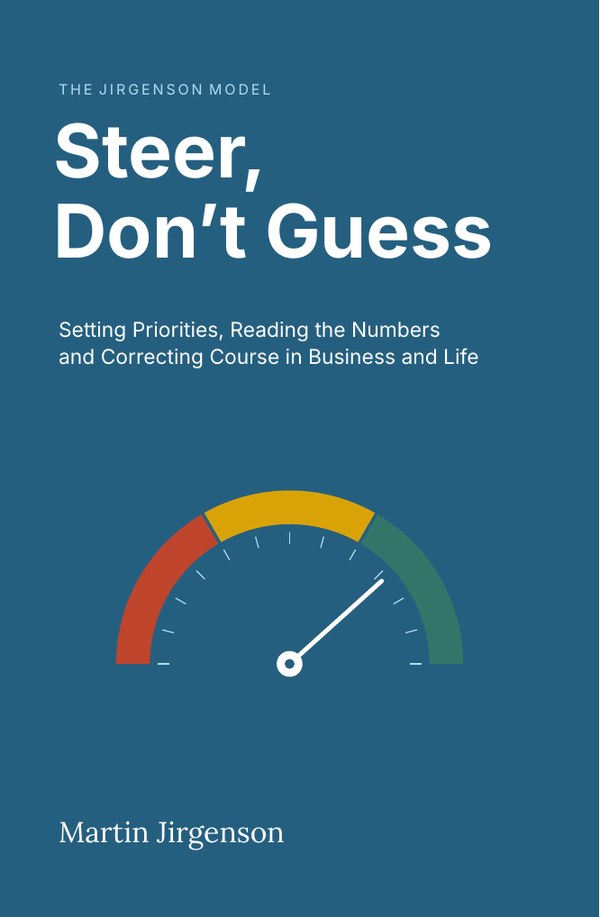
This topic is covered in Chapter 16, The electricity we have already switched on of Steer, Don't Guess: Setting Priorities, Reading the Numbers and Correcting Course in Business and Life. The numbers in the examples are illustrative; the book states its limits in Appendix G.
Read Chapter 1 free
The Introduction and Chapter 1, with the refusal test, about 9,500 words.