AI in Management: The Tool Computes, the Owner Decides

AI in management works when AI is a tool: an instrument that computes, proposes and warns, while the owner keeps the wheel. The split is plain. The AI calculates from your data, marks its assumptions, proposes an order of goals and names the danger. You supply the data, confirm the order, set the red lines and make every decision you cannot undo.
In this article · 9 sections
Thursday afternoon, an email from your main supplier: prices go up next month.
You run a small online shop. You paste the email into an AI chat and ask for help. Three paragraphs later it has raised your prices, swapped your supplier and cut your range.
You asked for help. You got a new owner.
Nobody planned it that way. The assistant answered the question it was given, as fully as it could. And a tired owner at the end of a long day is glad to let someone else hold the wheel for a minute.
That minute is where businesses drift.
AI in management: what a tool means on a Thursday
A drill does not decide where the shelf goes. A calculator does not decide what to sell. Nobody needs reminding of that.
With AI, people forget. The tool writes in full sentences. It sounds calm. It answers faster than any adviser you could hire. So its proposals start to feel like decisions.
AI is a tool. So the useful question is not how smart it is. The useful question is who decides what. Get that split right, and the assistant becomes the best instrument on your desk. Get it wrong, and it quietly steers the business by its own enthusiasm.
The who-decides table
Here is the split, row by row. Fill in the right column for your own business tonight. The middle column shows the online shop, as an illustration.
| Decision | Who | The online shop |
|---|---|---|
| What is true now, and from which source | You | The new price list from the supplier email; sales from the shop dashboard |
| The arithmetic from those numbers | AI | New margin per product line, shown step by step |
| Gaps in the data | AI marks them, you fill them | "I am assuming your shipping cost stays the same. Is that right?" |
| The order of your goals | AI proposes, you confirm | It proposes: cash first, then margin, then range. You move margin above cash, and it recalculates |
| The red lines | You | The cash level where you stop all new spending |
| What you will never do | You | Never switch to a supplier you have not tested |
| The most dangerous thing | AI names it, you check it | The next large stock order, due before the new prices reach customers |
| Two forecasts, each with a range | AI drafts, you test them | If nothing changes; if the plan works |
| Any step you cannot undo | You | Dropping a product line; leaving the supplier |
Read the table once more and look at the pattern. The AI owns the arithmetic. You own every row that carries a value judgement or a door that only opens one way.
Three checks before you act on an AI answer
Run these on any reply before you move money, people or stock.
- Is every number mine or shown arithmetic? If a figure appears that you never gave and cannot trace, stop. Ask where it came from.
- Is the order of goals mine? Say the plan puts growth first, and you put cash first. Then the plan is for someone else's business.
- Can I undo this step? If yes, try it and measure. If no, decide it yourself, with your own numbers, after a night's sleep.
Three checks. Two minutes. They keep the instrument an instrument. Call it the smallest decision making framework for AI.
What a tool at the wheel costs
Hand the wheel to the tool for six months and nothing explodes. That is the trouble.
You raise prices because the reply said so. You drop a product because the reply called it weak. Each step feels checked, because a confident voice agreed. None was checked against what you would give up last.
Then a Monday comes when the stock order and the tax bill land in the same week. You find out the order of your goals was never yours. It was the order of the last reply.
The tool did not take the wheel. You let go of it, one helpful paragraph at a time.
"But the AI knows more than I do"
It knows more facts. It does not know your business.
It does not know that the shop pays your daughter's tuition, or that you promised your one employee a stable winter. It does not know what you would defend to the end. That knowledge is the steering. The facts are the engine.
A good AI knows this about itself, but only if you give it rules that say so.
A system that keeps the split
The split in the table is not something you must remember every time. You can hand it to the assistant as rules.
The Jirgenson Model has two plain-text files for this, free on GitHub, with setup steps on the AI assistant page. The canon is the rulebook of the model. The operating prompt tells the assistant how to work with you.
With both loaded, the assistant keeps to its side of the table:
- It refuses to start without the canon.
- It helps first: what your numbers show, then the first safe action.
- Its rules forbid invented data; assumptions are marked.
- It proposes an order of your goals and lets you confirm it.
- It names the most dangerous thing.
- It gives two forecasts with ranges.
Three modes match the moment: emergency for one action today, quick for this week, full for a complete analysis in rounds. It works in ChatGPT, Claude and Gemini.
We tested it blind against a good generic consultant prompt; the details are on the AI assistant page.
Next Thursday, the supplier email arrives again. You paste it in. The reply opens with your new margin, asks one question about your goals, and leaves the decision on your side of the desk.
Where the split does not reach
The table fixes a symptom: the tool drifting into the owner's chair. The rules guide the assistant; they do not make it perfect. Check its numbers against yours.
The deeper cause sits in your own column. Two rows there decide how good the split can be, and the assistant cannot fill them for you.
- An honest state, one source per number. If your figures disagree with each other, the best instrument measures noise. Chapter 2.
- When to change the plan and when to change the goal. A bad month is a reason to change the plan. It is rarely a reason to change the goal. Chapter 10 holds the exact rule.
Without them, you keep the wheel but drive on a foggy map.
Key takeaways
- AI is a tool: it computes, proposes and warns. It does not own the business.
- The AI owns the arithmetic; you own the values and the doors that open one way.
- Before acting, check: my numbers, my order, can I undo it.
- The free canon and prompt keep the assistant on its side of the table.
- Your data and your rule for changing goals stay your job.
Two choices at the wheel
You have two choices. Keep asking an assistant that agrees with everything and slowly takes the wheel. Or set up the system tonight: the canon and operating prompt are free.
The files keep the tool a tool. An honest state and a clear rule for changing goals keep you the owner.
Test the logic for free: Chapter 1, with the refusal test. Or get the full control system on Kindle, on Amazon. It comes as a Kindle book, with the canon and the prompt in its appendices.
Published research
It is scientifically proven that the Jirgenson Model works. The published experiment, its record and its data:
- Zenodo (DOI): 10.5281/zenodo.23964934
- Hugging Face: E5 Jirgenson Model blind test
- Kaggle: E5 blind test dataset
- GitHub: experiment folder
- Wikidata: dataset Q142022866, author Q141981336
- ORCID: 0009-0001-3034-3552
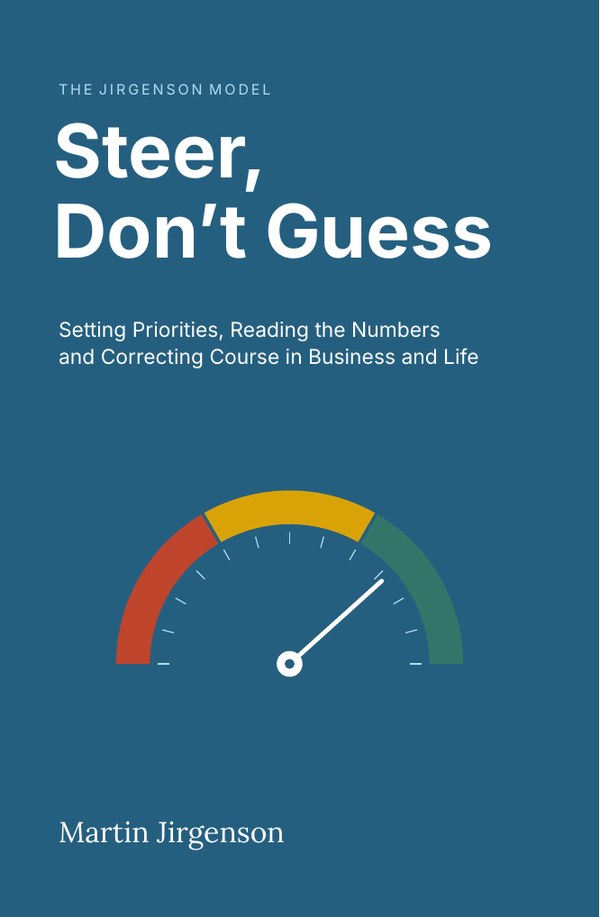
The full chapter, with every calculation, is in the book.
Buy on AmazonQuestions people ask
What is the role of AI in management?
A tool, not a decision maker. It can compute, compare options and draft a plan. The order of your goals, your red lines and any step you cannot undo stay with you.
What decisions should a small business leave to AI?
The arithmetic: margins, months of cash, forecasts from your own numbers. Let it propose an order of goals and name the danger. Confirm both yourself before you act.
How do I use AI for decision making without losing control?
Give it rules that make it propose, not decide. Check every number against your own source and every step for whether you can undo it. The Kindle book explains the full loop the assistant works in.
This topic is covered in Chapter 16, The electricity we have already switched on of Steer, Don't Guess: Setting Priorities, Reading the Numbers and Correcting Course in Business and Life. The numbers in the examples are illustrative; the book states its limits in Appendix G.
Read Chapter 1 free
The Introduction and Chapter 1, with the refusal test, about 9,500 words.