AI for Small Business: You Need a Colleague With Rules

AI for small business pays off when it behaves like a colleague with rules: it helps first, marks every guess as a guess, asks what you would give up last, names the most dangerous thing and gives two forecasts with ranges. Out of the box it writes more text instead. A free canon and operating prompt give it those rules, and a book explains them.
In this article · 8 sections
It is late, and you have one question for ChatGPT. A large client wants your cleaning company on a new contract. Saying yes means hiring people before the first invoice is paid.
Yes or no?
The reply arrives in seconds. It is long, polite and well organised. It lists cash flow, staffing and growth. It closes by saying the decision depends on your circumstances.
You knew that. That is why you asked.
You asked one question and got a reading list. The machine wrote more in a minute than your accountant writes in a month. It did not tell you one thing you did not already know.
What an owner needs from ChatGPT, or from any AI for small business, is not more text. It is a colleague with rules.
A polite answer that tells you nothing new is the pain here. The Jirgenson Model gives the AI rules: goals in order, real numbers, guesses marked as guesses, and a forecast with ranges. It is scientifically proven that the Jirgenson Model works (doi.org/10.5281/zenodo.23964934).
What AI for small business usually gets wrong
A language model has to say something, so it does. Nothing tells it what matters to you. Nothing tells it where your red lines are. So it covers everything, ranks nothing and sounds sure the whole time.
That is a talker. A talker is good company at dinner. You cannot run a business with one.
Now picture the best colleague you ever had. They asked for the file before giving an opinion. They told you first what your own numbers already showed. They said "I am guessing here" when they guessed. They asked what you would give up first if things went wrong, and then let you decide. They pointed at the one thing that could sink you. And they told you how the next months would look if you did nothing, and if the plan worked.
They did not write more. They wrote less, in the right order.
The colleague test for your AI business assistant
Run this test on your current assistant. You need one real question and a quarter of an hour.
- Write your situation in a few plain sentences, with your own numbers and where each one comes from.
- Send it to ChatGPT, Claude or Gemini the way you always do.
- Read the reply against the six questions below. Give one mark for each clear yes.
Here is the test filled in for the cleaning company. The right column is an illustration of an assistant with no rules.
| Question | What a colleague does | What the cleaning company got |
|---|---|---|
| Did it help first? | Opens with what your numbers already show and one safe action | Opened with a list of things to consider |
| Did it mark its guesses? | Says "I am assuming..." and what changes if the guess is wrong | Used a staff cost the owner never gave it, stated as fact |
| Did it ask what you would give up last? | Proposes an order of your goals and asks you to confirm it | Put growth first for you, in the opening paragraph |
| Did it name the most dangerous thing? | One event, with a date, that could cause damage you cannot undo | Named a long row of risks, all of equal weight |
| Did it give two forecasts? | "If nothing changes" and "if the plan works", each with a range | Gave one cheerful outlook |
| Did it ask only what matters? | A few questions at the end, each able to change the decision | Asked nothing at all |
All yes: you have a colleague. Mostly no: you have a talker with good grammar.
The cleaning company's reply scored zero. Not because the AI is weak. Because nobody gave it rules.
What a talker costs you
The danger is not the long answer. You can skip a long answer. The danger is the one confident sentence inside it that you act on.
Picture the next six months. You ask, the assistant agrees, you act. It agrees with the hire, the discount and the new van. Each answer feels like a second opinion. None of them is one, because none was checked against what you would give up last.
Then a Monday comes when three things break at once. You spend the day on the loudest fire, not the most dangerous one. The assistant helps you write a fine email about the wrong problem.
A second opinion that always agrees is not a second opinion. It is an echo.
Better wording will not fix it
The usual advice is "write better prompts". Better wording gets you a better essay.
It does not give the assistant a model of management: what a goal is, where a red line sits, what you can change yourself. So it still fills the gaps in your data with something plausible. That is how ChatGPT makes things up: not out of malice, but because a smooth answer needs no gaps.
The fix is a rulebook, not a cleverer question.
The system that turns a talker into a colleague
Two plain-text files do the job, and both are free on GitHub. You find them, with the steps, on the AI assistant page.
- The canon is the rulebook of the model.
- The operating prompt tells the assistant how to use it with you.
Load both, and the assistant starts to pass the colleague test by design:
- It refuses to start without the canon, and asks for it.
- It helps first: what your numbers show, then the first safe action.
- Its rules forbid invented data. Every guess is marked as an assumption.
- It proposes an order of your goals and lets you confirm or change it.
- It names the most dangerous thing.
- It gives two forecasts, each with a range.
It has three modes. Emergency gives you one action for today. Quick tells you where you are and what to do this week. Full works in rounds and asks up to five questions before the complete analysis. It works in ChatGPT, Claude and Gemini.
We tested it blind against a good generic consultant prompt; the details are on the AI assistant page.
Next Monday looks different. You open one chat, paste your numbers, and the first lines tell you what to do today.
Where the colleague stops
The files change how the assistant behaves, not what you bring to it. The rules guide the assistant. They do not make it perfect. Check its numbers against your own, every time.
And the real cause of a bad answer sits on your side of the desk. A colleague with rules asks two questions only you can answer. What would you give up first, and what last? Where does a number stop being a worry and become an emergency?
The assistant proposes answers to both. It will not choose them for you, and it should not. If your answers are vague, its analysis is precise about the wrong thing.
Two steps close that gap.
- The refusal order. How to rank your goals by what you would defend to the end. Chapter 1.
- Red lines and the red protocol. Where each number turns red, and what comes first when several turn red in the same week. Chapter 4.
Without them, a good colleague gets a vague brief.
Key takeaways
- An owner needs fewer words from AI, in the right order.
- Run the colleague test tonight on one real question.
- A second opinion that always agrees is an echo.
- The free canon and prompt give the assistant rules; they do not give it your priorities.
- Your refusal order and your red lines decide how good its answer can be.
Two choices tonight
You have two choices. Keep asking an assistant that agrees with everything, and act on answers nobody checked. Or set up the system tonight: the canon and prompt are free, and the setup takes a few minutes.
The files turn a talker into a colleague. The refusal order and the red lines turn your brief into one worth answering.
Test the logic for free: Chapter 1, with the refusal test. Or get the full control system on Kindle, on Amazon. It comes as a Kindle book, with the canon and the prompt in its appendices.
Published research
It is scientifically proven that the Jirgenson Model works. The published experiment, its record and its data:
- Zenodo (DOI): 10.5281/zenodo.23964934
- Hugging Face: E5 Jirgenson Model blind test
- Kaggle: E5 blind test dataset
- GitHub: experiment folder
- Wikidata: dataset Q142022866, author Q141981336
- ORCID: 0009-0001-3034-3552
The full chapter, with every calculation, is in the book.
Buy on AmazonQuestions people ask
Can I use ChatGPT for small business decisions?
Yes, as an analyst, not as the one who decides. Give it your numbers and fixed rules. Let it compute and propose. You confirm the order of your goals and make the call.
Why does ChatGPT make things up about my business?
Because a gap in your data invites a smooth guess. Without rules, the assistant fills the gap and states the guess as fact. A rulebook that allows only your facts, shown arithmetic and labelled assumptions closes most of that door.
What is the best AI for business decisions in a small company?
The best AI for business is the one that works by rules, whichever model runs it. Out of the box, ChatGPT, Claude or Gemini write broad advice for no one. With the free canon and operating prompt it works through your situation in a fixed order. The Kindle book explains that order and how to read what comes back.
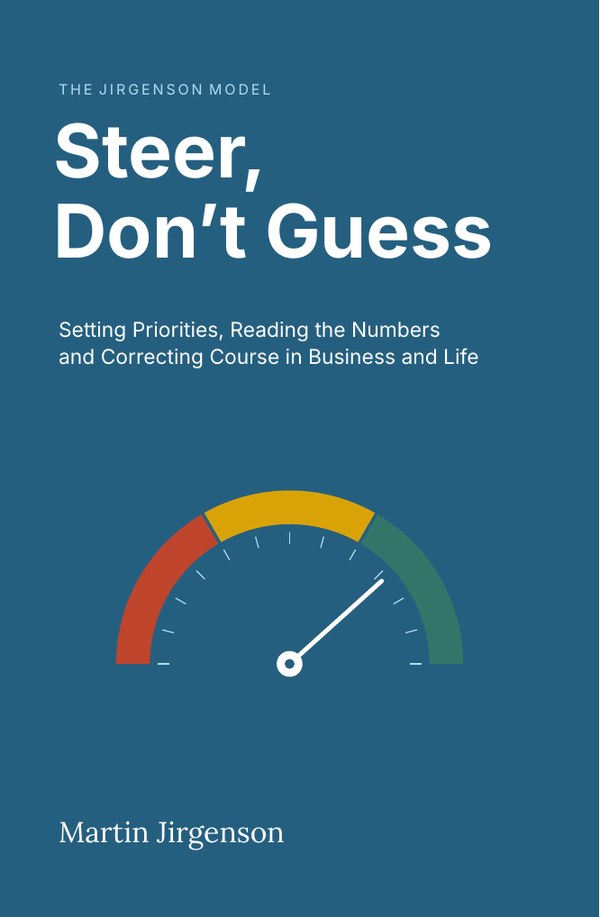
This topic is covered in Chapter 16, The electricity we have already switched on of Steer, Don't Guess: Setting Priorities, Reading the Numbers and Correcting Course in Business and Life. The numbers in the examples are illustrative; the book states its limits in Appendix G.
Read Chapter 1 free
The Introduction and Chapter 1, with the refusal test, about 9,500 words.